Tormented girls writhing in agony, stern judges meting out harsh verdicts, nineteen bodies swinging on Gallows Hill.
The stark immediacy of what happened in 1692 has obscured the complex web of human passion, individual and organized, which had been growing for more than a generation before the witch trials. Salem Possessed explores the lives of the men and women who helped spin that web and who in the end found themselves entangled in it.
From rich and varied sources—many previously neglected or unknown—Paul Boyer and Stephen Nissenbaum give us a picture of the events of 1692 more intricate and more fascinating than any other in the already massive literature on Salem. "Salem Possessed," wrote Robin Briggs in The Times Literary Supplement, "reinterprets a world-famous episode so completely and convincingly that virtually all the previous treatments can be consigned to the historical lumber-room."
Not simply a dramatic and isolated event, the Salem outbreak has wider implications for our understanding of developments central to the American experience: the breakup of Puritanism, the pressures of land and population in New England towns, the problems besetting farmer and householder, the shifting role of the church, and the powerful impact of commercial capitalism.
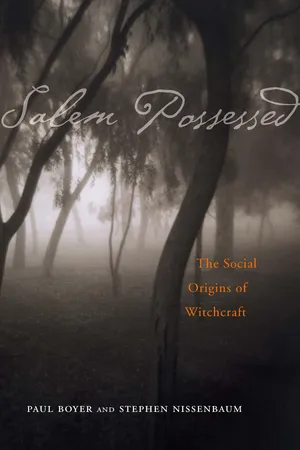
- English
- ePUB (mobile friendly)
- Available on iOS & Android
eBook - ePub
About this book
Trusted by 375,005 students
Access to over 1.5 million titles for a fair monthly price.
Study more efficiently using our study tools.
Information
Publisher
Harvard University PressYear
1976Print ISBN
9780674785267
9780674785250
eBook ISBN
9780674282667
1 1692: Some New Perspectives
Salem witchcraft. For most Americans the episode ranks in familiarity somewhere between Plymouth Rock and Custer’s Last Stand. This very familiarity, though, has made it something of a problem for historians. As a dramatic package, the events of 1692 are just too neat, highlighted but also insulated from serious research by the very floodlights which illuminate them. “Rebecca Nurse,” “Ann Putnam,” “Samuel Parris”—they all endlessly glide onto the stage, play their appointed scenes, and disappear again into the void. It is no coincidence that the Salem witch trials are best known today through the work of a playwright, not a historian. It was, after all, a series of historians from George Bancroft to Marion Starkey who first treated the event as a dramatic set piece, unconnected with the major issues of American colonial history. When Arthur Miller published The Crucible in the early 1950’s, he simply outdid the historians at their own game.
After nearly three centuries of retelling in history books, poems, stories, and plays, the whole affair has taken on a foreordained quality. It is hard to conceive that the events of 1692 could have gone in any other direction or led to any other outcome. It is like imagining the Mayflower sinking in midpassage, or General Custer at the Little Big Horn surrendering to Sitting Bull without a fight.
And yet speculation as to where events might have led in 1692 is one way of recapturing the import of where they did lead. And if one reconstructs those events bit by bit, as they happened, without too quickly categorizing them, it is striking how long they resist settling into the neat and familiar pattern one expects. A full month, maybe more, elapsed between the time the girls began to exhibit strange behavior and the point at which the first accusations of witchcraft were made; and in the haze of those first uncertain weeks, it is possible to discern the shadows of what might have been.
Bewitchment and Conversion
Imagine, for instance, how easily the finger of witchcraft could have been pointed back at the afflicted girls themselves. It was they, after all, who first began to toy with the supernatural. At least one neighboring minister, the Reverend John Hale of Beverly, eventually became convinced that a large measure of blame rested with these girls who, in their “vain curiosity to know their future condition,” had “tampered with the devil’s tools.”1 And Hale’s judgment in the matter was shared by his far more influential colleague Cotton Mather, who pinpointed as the cause of the outbreak the “conjurations” of thoughtless youths, including, of course, the suffering girls themselves.2
Why then, during 1692, were the girls so consistently treated as innocent victims? Why were they not, at the very least, chastised for behavior which itself verged on witchcraft? Clearly, the decisive factor was the interpretation which adults—adults who had the power to make their interpretation stick—chose to place on events whose intrinsic meaning was, to begin with, dangerously ambiguous.
The adults, indeed, determined not only the direction the witchcraft accusations would take; it was they, it seems, who first concluded that witchcraft was even in the picture at all. “[W]hen these calamities first began,” reported Samuel Parris in March 1692, “. . . the affliction was several weeks before such hellish operations as witchcraft was suspected.”3 Only in response to urgent questioning—“Who is it that afflicts you?”—did the girls at last begin to point their fingers at others in the Village.
It is not at all clear that the girls’ affliction was initially unpleasant or, indeed, that they experienced it as an “affliction” at all. Unquestionably it could be harrowing enough once witchcraft became the accepted diagnosis, but the little evidence available from late February, before the agreed-upon explanation had been arrived at, makes the girls’ behavior seem more exhilarated than tormented, more liberating than oppressive. One of the early published accounts of the outbreak, that of Robert Calef in 1700, described the girls’ initial manifestations as “getting into holes, and creeping under chairs and stools . . ., [with] sundry odd postures and antic gestures, [and] uttering foolish, ridiculous speeches which neither they themselves nor any others could make sense of.”4
Had Samuel Parris and his parishioners chosen to place a different interpretation on it, the “witchcraft episode” might have taken an entirely different form. This, in fact, is what almost happened, miles away from Salem Village, in another witchcraft case of 1692: that of Mercy Short. Mercy was a seventeen-year-old Boston servant girl who in June 1692 was sent by her mistress on an errand to the Boston town jail, where many accused Salem witches happened to be held pending their trials. When one of them, Sarah Good, asked Mercy for tobacco, the girl, belying her name, threw a handful of wood shavings in the prisoner’s face and cried: “That’s tobacco good enough for you!” Soon after, Mercy Short began to exhibit the strange physical behavior that people had by now come to think of as proof of bewitchment.5 Cotton Mather, as her minister, was interested in Mercy’s case from the beginning, and through the winter of 1692–93 he spent much time with her, offering spiritual counsel and maintaining a detailed record of her behavior. Mather’s notes make clear that what Mercy experienced was far from unmitigated torment. At times, in fact, “[h]er tortures were turned into frolics, and she became as extravagant as a wildcat,” her speech “excessively witty” and far beyond her “ordinary capacity.”6 On other occasions, she delivered long religious homilies and moral exhortations.
Although it was generally agreed that Mercy was bewitched, what is interesting is that Mather directed the episode into quite another channel. He treated it not as an occasion for securing witchcraft accusations but as an opportunity for the religious edification of the community. As word of Mercy’s condition spread, her room became a gathering place, first for pious members of Mather’s congregation and then for local young people. These boys and girls, who had already organized weekly prayer services apart from the adults, “now adjourned their meetings . . . unto the Haunted Chamber.” With Mather’s encouragement, as many as fifty of them would crowd into the room, praying and singing psalms (sometimes until dawn) and occasionally themselves displaying unusual physical manifestations. At one point during the winter of 1692–93 they assembled every night for nearly a month.7
The entire Mercy Short episode, in fact, suggests nothing so much as the early stages of what would become, a generation later, a looming feature of the American social landscape: a religious revival. Mather himself made the point: “[T]he souls of many, especially of the rising generation,” he wrote, “have been thereby awakened unto some acquaintance with religion.”8 Nor was this “awakening” simply a Matherian conceit; in his diary the minister recorded that “some scores of young people” (including Mercy herself) had joined his church after being “awakened by the picture of Hell exhibited in her sufferings.”9 Such a mass movement toward church membership, coming on a tide of shared religious experiences, had been almost unknown up to that time in New England and indicates how close the town of Boston may have been, that winter of 1692–93, to a full-scale revival.
When viewed not simply as freakish final splutters in the centuries-old cycle of witchcraft alarms, but as overtures to the revival movement, both the Boston and the Salem Village episodes emerge in a fresh light and take on a new interest. With a slight shift in the mix of social ingredients, both communities could have fostered scenes of mass religious questing in 1692. In Salem Village, the afflicted girls occasionally displayed an inclination to ascribe their supernatural visitations to a divine rather than a demonic source. On April 1, according to Deodat Lawson’s first-hand account, Mercy Lewis “saw in her fit a white man, and [she] was with him in a glorious place, which had no candles nor sun, yet was full of light and brightness, where was a great multitude in white glittering robes.”10 Similar heavenly visions, Lawson noted, appeared to the other girls as well. And as for the “foolish, ridiculous speeches which neither they themselves nor any others could understand,” do they not suggest, in inchoate form, the Pentecostal gift of tongues which would figure so prominently in later revival outbreaks?
Even the more obviously painful symptoms which the girls manifested in their “fits”—the convulsive paroxysms, the hysterical muscular spasms—foreshadow the characteristic behavior of “sinners” in the agonizing throes of conversion.11 How would the girls have responded if their ministers, their neighbors, or their families had interpreted their behavior as the initial stages of a hopeful religious awakening?
The parallel is underscored if we turn a full 180 degrees and examine, from the perspective of 1692, the first mass outbreak of religious anxiety which actually was interpreted as a revival: the so-called “Little Awakening” which began in the western Massachusetts town of Northampton in 1734. Here, as in Salem Village, a group of people in the town began, unexpectedly and simultaneously, to experience conditions of extreme anxiety. They underwent “great terrors” and “distresses” which threw them into “a kind of struggle and tumult” and finally brought them to “the borders of despair.” Nineteen-year-old Abigail Hutchinson felt such “exceeding terror” that “her very flesh trembled”; for others the terror took such vivid forms as that of a “dreadful furnace” yawning before their eyes. Even a four-year-old girl, Phebe Bartlet, took to secreting herself in a closet for long periods each day, weeping and moaning.12
As in Salem Village, some people of Northampton began to whisper ominously that “certain distempers” were in the air. The town soon became the talk and concern of the entire province, and there were even those who spoke of witchcraft. And, again as in Salem Village, the episode eventually culminated in violent death: not executions, this time, but suicide. On Sunday, June 1, 1735, after two months of terror and sleepless nights, Joseph Hawley slit his throat and died. In the wake of this event many other persons were tempted to the same course, impelled by voices which urged: “Cut your own throat, now is a good opportunity. Now! Now!”13
In Northampton in 1735 as in Salem Village a generation earlier, the young played a central role. In both episodes, the catalyst was a group of young people who had taken to spending long hours together, away from their homes. In Salem Village, these gatherings began as fortune-telling sessions and soon took a scary turn; in Northampton, they started as “frolics” but were soon transformed, under the influence of the town’s young minister, Jonathan Edwards (later to become the greatest theologian of his era), into occasions for prayer and worship.14 In both places, too, the preoccupations of these youthful meetings soon spread to the community as a whole, and became the overriding topic of conversation. In Salem Village, the afflicted girls dominated the packed gatherings where the accused were examined. In Northampton, church services and household routines alike were disrupted by crying and weeping, again with the younger generation taking the lead.
In a reversal of status as breathtaking in 1735 as it had been in 1692, the young people of both Northampton and Salem Village at least momentarily broke out of their “normal” subservient and deferential social role to become the de facto leaders of the town and (for many, at least) the unchallenged source of moral authority.15
Nor were the young the only group whose social position was temporarily altered by the traumatic episodes they had helped engender. The ministers, too, were profoundly affected. In Salem Village, it was to Samuel Parris—who had been experiencing difficulty in filling the Village meetinghouse for weekly worship and even in persuading the congregation to pay his salary—that most Villagers turned during 1692 for an understanding of what was happening. In Northampton, where Jonathan Edwards (the author of the account from which we have been quoting) had been going through comparable difficulties, attendance and involvement in the public worship also picked up noticeably, with “every hearer eager to drink in the words of the minister as they came from his mouth.” Even on weekdays, Edwards received unaccustomed attention: “the place of resort was now altered, it was no longer the tavern, but the minister’s house.”16
By encouraging and even exploiting the unusual behavior of the young people in their communities, both ministers had managed to turn a potentially damaging situation to their own benefit. Both drew upon the energies, ostensibly disruptive and anti-authoritarian, of a hitherto subdued and amorphous segment of the population to shore up their own precarious leadership. In each case, the effort was dramatically successful—but only for a time; as it turned out, Parris and Edwards were both dismissed from their jobs only a few years after the events they had done so much to encourage.
But the differences are as significant as the similarities, for when all is said and done, the fact remains that Northampton experienced not a witchcraft outbreak, but a religious revival. With the backing of his congregation, Edwards chose to interpret the entire episode not as demonic, but as a “remarkable pouring out of the spirit of God.” Under his guidance, most of the sufferers passed throu...
Table of contents
- Cover
- Title
- Copyright
- Contents
- Preface
- Salem Village in the Seventeenth Century: A Chronology
- Abbreviations Used in the Notes
- Prologue: What Happened in 1692
- 1 1692: Some New Perspectives
- 2 In Quest of Community, 1639–1687
- 3 Afflicted Village, 1688–1697
- 4 Salem Town and Salem Village: The Dynamics of Factional Conflict
- 5 Two Families: The Porters and the Putnams
- 6 Joseph and His Brothers: A Story of the Putnam Family
- 7 Samuel Parris: A Pilgrim in Bethlehem
- 8 Witchcraft and Social Identity
- Epilogue: To the Eighteenth Century
- Index
Frequently asked questions
Yes, you can cancel anytime from the Subscription tab in your account settings on the Perlego website. Your subscription will stay active until the end of your current billing period. Learn how to cancel your subscription
No, books cannot be downloaded as external files, such as PDFs, for use outside of Perlego. However, you can download books within the Perlego app for offline reading on mobile or tablet. Learn how to download books offline
Perlego offers two plans: Essential and Complete
- Essential is ideal for learners and professionals who enjoy exploring a wide range of subjects. Access the Essential Library with 800,000+ trusted titles and best-sellers across business, personal growth, and the humanities. Includes unlimited reading time and Standard Read Aloud voice.
- Complete: Perfect for advanced learners and researchers needing full, unrestricted access. Unlock 1.5M+ books across hundreds of subjects, including academic and specialized titles. The Complete Plan also includes advanced features like Premium Read Aloud and Research Assistant.
We are an online textbook subscription service, where you can get access to an entire online library for less than the price of a single book per month. With over 1.5 million books across 990+ topics, we’ve got you covered! Learn about our mission
Look out for the read-aloud symbol on your next book to see if you can listen to it. The read-aloud tool reads text aloud for you, highlighting the text as it is being read. You can pause it, speed it up and slow it down. Learn more about Read Aloud
Yes! You can use the Perlego app on both iOS and Android devices to read anytime, anywhere — even offline. Perfect for commutes or when you’re on the go.
Please note we cannot support devices running on iOS 13 and Android 7 or earlier. Learn more about using the app
Please note we cannot support devices running on iOS 13 and Android 7 or earlier. Learn more about using the app
Yes, you can access Salem Possessed by Paul Boyer,Stephen Nissenbaum in PDF and/or ePUB format, as well as other popular books in History & North American History. We have over 1.5 million books available in our catalogue for you to explore.