About this book
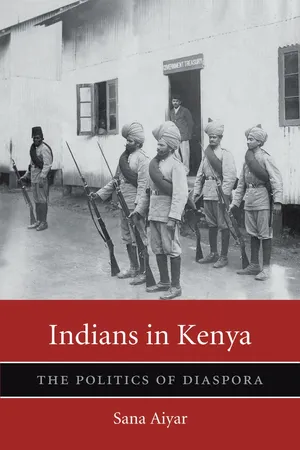
Working as merchants, skilled tradesmen, clerks, lawyers, and journalists, Indians formed the economic and administrative middle class in colonial Kenya. In general, they were wealthier than Africans, but were denied the political and economic privileges that Europeans enjoyed. Moreover, despite their relative prosperity, Indians were precariously positioned in Kenya. Africans usually viewed them as outsiders, and Europeans largely considered them subservient. Indians demanded recognition on their own terms. Indians in Kenya chronicles the competing, often contradictory, strategies by which the South Asian diaspora sought a political voice in Kenya from the beginning of colonial rule in the late 1890s to independence in the 1960s.
Indians' intellectual, economic, and political connections with South Asia shaped their understanding of their lives in Kenya. Sana Aiyar investigates how the many strands of Indians' diasporic identity influenced Kenya's political leadership, from claiming partnership with Europeans in their mission to colonize and "civilize" East Africa to successful collaborations with Africans to battle for racial equality, including during the Mau Mau Rebellion. She also explores how the hierarchical structures of colonial governance, the material inequalities between Indians and Africans, and the racialized political discourses that flourished in both colonial and postcolonial Kenya limited the success of alliances across racial and class lines. Aiyar demonstrates that only by examining the ties that bound Indians to worlds on both sides of the Indian Ocean can we understand how Kenya came to terms with its South Asian minority.
Tools to learn more effectively

Saving Books

Keyword Search

Annotating Text

Listen to it instead
Information
Table of contents
- Contents
- Introduction
- 1. From the America of the Hindu to White Man’s Country
- 2. “Civilization” in Kenya
- 3. Political Homelands across the Indian Ocean
- 4. Between Rebellion and Suppression
- 5. Negotiating Nationhood
- 6. Uhuru and Exodus
- Epilogue
- Notes
- Archives Consulted
- Acknowledgments
- Index
Frequently asked questions
- Essential is ideal for learners and professionals who enjoy exploring a wide range of subjects. Access the Essential Library with 800,000+ trusted titles and best-sellers across business, personal growth, and the humanities. Includes unlimited reading time and Standard Read Aloud voice.
- Complete: Perfect for advanced learners and researchers needing full, unrestricted access. Unlock 1.4M+ books across hundreds of subjects, including academic and specialized titles. The Complete Plan also includes advanced features like Premium Read Aloud and Research Assistant.
Please note we cannot support devices running on iOS 13 and Android 7 or earlier. Learn more about using the app