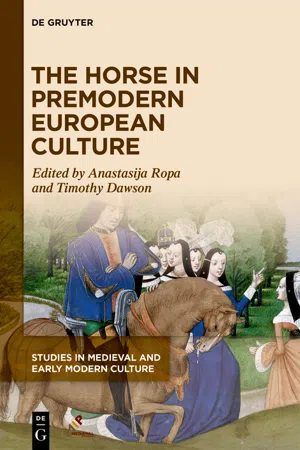
This volume provides a unique introduction to the most topical issues, advances, and challenges in medieval horse history. Medievalists who have a long-standing interest in horse history, as well as those seeking to widen their understanding of horses in medieval society will find here informed and comprehensive treatment of chapters from disciplines as diverse as archaeology, legal, economic and military history, urban and rural history, art and literature. The themes range from case studies of saddles and bridles, to hippiatric treatises, to the medieval origins of dressage literary studies. It shows the ubiquitous – and often ambiguous – role of the horse in medieval culture, where it was simultaneously a treasured animal and a means of transport, a military machine and a loyal companion. The contributors, many of whom have practical knowledge of horses, are drawn from established and budding scholars working in their areas of expertise.
Trusted by 375,005 students
Access to over 1 million titles for a fair monthly price.
1 Equestrian Cities: The Use of Riding Horses and Characteristics of Horse Husbandry in Late Medieval Urban Agglomerations
FabienneMeiers
Of Hooves, Heels, and Wheels
After the fall of the Western Roman Empire at the end of the fifth century, there remained no centralized power to maintain the extensive road network, which comprised more than 400,000 kilometers of fortified roadways.1 Gradually, the ways, roads, and long-distance highways decayed. Also, many infrastructures along the roads, such as horse changing stations (mutationes) and relay stations (mansiones), became less important – like the roads, they slowly fell apart as time went by.2
In comparison to the centrally controlled Roman road network with its sophisticated system of road stations, conditions in the Middle Ages were more delicate: small, fragmented territorial states led by many rivaling territorial lords made administration, regulation, and maintenance of roads on mainland Europe more difficult.
Thus, despite some exceptions, most of the Roman roads were in poor condition in the Middle Ages. Circulation of persons, goods, and services overland became less efficient and more time-consuming. In particular, wheeled vehicles, such as carts and carriages, were affected by this development: the wooden spokes could easily break at faster traveling speeds on roads that were not maintained on a regular basis, especially when the vehicles were of heavy construction. Moreover, traveling in wagons was not very comfortable: the iron suspension chains – not every vehicle for passenger transportation even had those – only had a limited effect.3 Traveling on foot, on the other hand, was not bound to any traffic construction – but it was arduous, slow, and not befitting the social status of many of the travelers. What other choices remained to travel as efficiently as possible on land? Riding was the best option.
Interurban Mobility during the Eleventh and Twelfth Centuries
Despite the circumstances in the Middle Ages, which were more difficult than in Roman times, mobility was not only a necessity, but also compulsive for certain social groups, such as the ruling classes and traders. As Gerd Althoff postulated in his trailblazing article “Vom Zwang zur Mobilität und ihren Problemen” (On the compulsion to mobility and its problems), mobility allowed for the promotion and maintenance of political alliances, diplomatic relations, and economic activities through a permanent communication exchange.4 An individual’s physical presence at a meeting place was especially important when complex political or economic decisions needed to be taken. This was also the case for urban authorities and their functionaries.
During the eleventh century, many cities emerged on the European mainland, while older ones developed and grew. This led to an increasing demand for faster and more reliable services to help exchange information and perform administrative tasks in the municipal area and beyond.5 The new communication modalities comprised above all messenger services, which were carried out on foot or on horseback, official trips to the surrounding area, and long-distance diplomatic travels. To ensure that the messengers and envoys could travel efficiently and in a manner that was suited to their representative status, they mostly traveled on horseback.
Sources and Methodology
The various aspects of the increasing importance of equestrian traffic in medieval cities are mostly reflected in written sources, such as municipal chronicles, legal texts, real estate records, and especially account books. Iconographic representations have also survived, and sources of material culture were brought to light by archaeological excavations. John Clark has already shown some of the most interesting finds from urban excavations in London.6 Unfortunately, urban archaeology is still in its infancy in Luxembourg, and only a few finds can be associated with equine activities, equestrianism, and horse husbandry.7
The focus of this study is on urban account books from the city of Luxembourg. These provide detailed insight into the different urban revenues and expenditures issued between 1388 and 1795. Most of the account books have been critically edited by Claudine Moulin and Michel Pauly since 2007.8 At present, ten volumes have already been published; eleven to twelve are expected. An online version is also planned. The books are written in a western dialectical form of Early New High German, which is quite easy to understand even for modern German speakers. The following excerpts from 1415 and 1389 exemplify the kind of information that can be drawn from account books:
Messenger service: Item des donnerſtdages 10ten dages Octobris geuen dem ſeluen arnolt zu bolchin zu Rydin 25 gr.9
(Also given on Thursday 10th of October to the same Arnold for riding to Bollich 25 groats.) 10
Diplomatic travel: Item geuen dem Rijchter zu paffenfaſſenacht do er zu dijdenhouen geryddin was nae den gevangen dije zu gors gevangen wurdin 11 gul 4 gr.11
(Also given to the judge on Estomihi [= February 28, 1389], when he rode to Diedenhofen/Thionville to see after the prisoners who were taken at Gorze 11 gulden 4 groats.) 12
These two excerpts show that account books are a very multilayered source type, although they are testimonies of pragmatic textuality. In most instances, they are composed of beneficiary of the expense (messenger, envoy, or urban functionary), date of the service, means of transportation, purpose of travel, and amount of the expenditure.
To collect useful data concerning equestrian traffic, a qualitative methodology (based on content) and a quantitative methodology (based on numbers) were used. After that, some of the noteworthy results were compared with those brought together from account books from other European cities, including Aachen, Duisburg, Trier, Cologne, Metz, and Mons. Equine-related data comprised:
Functions or services that necessitate traveling on horseback, including mounted messenger services, administrative tasks, diplomatic missions, military expeditions, and escorts;
horse-related professions, such as horse traders, blacksmiths, veterinarians, saddlers and strap makers, spur and bit makers, horse slaughterers, and castrators;
expenditures for horses, such as costs for horse rentals, fodder, housing, and horse gear; and
data in conjunction with traveling on horseback, encompassing names, numbers, position, and social status of travelers as well as the quantity and quality of their horses,13 the motives for traveling, the point of departure, travel destination, travel duration, length of stay, traveling month, and the use of other means of transportation during the trips.
Using this approach, more than 3,150 accounting entries from sixty-six volumes containing approximately 10,300 entries in total were collected, each volume standing for an accounting year. More than 5 percent (163 entries) were directly linked to the horse. 750 entries were dedicated to messenger services (47.1 percent), 306 to administrative travels by urban functionaries (19.2 percent), and 264 to diplomatic travels (16.6 percent). For distribution of types of official travels, see Fig. 1.1. Out of the remaining 271 other types of travels mentioned in the account books, military expeditions prevailed in almost half of the cases. Additionally, trips to pay the annual taxes in neighboring cities and to purchase goods as well as escort services are mentioned in nearly equal measure.
Fig. 1.1: Types of official travels in shares as encountered in the account books of the City of Luxembourg. Chart: ...
Table of contents
Title Page
Copyright
Contents
Introduction
Part I: Working Horses and Their Equipment
2 Working Horses in the Northern European Countryside between the Thirteenth and Sixteenth Centuries: What Advantage for a Farm?
3 Baggage Animals – The Neglected Equines. An Introductory Survey of Their Varieties, Uses, and Equipping
4 Medieval Horse Harness – The Evidence of the Images
Part II: Warhorses
6 The Use of the Crossbow in Medieval Cavalry
Part III: Performing Horses
8 How to Ride before a Prince: The Rise of Riding as a Performance Art
Part IV: Caring for Horses
10 Bread for My Horses
Part V: Material Cultures of Riding
12 An Autopsy of Renaissance Equestrianism: The Materials, Making, and Use of a ca. 1535 War Saddle from the Musée des Beaux-Arts of Rennes
Part VI: The Represented Horse: Law, Administration, and Literature
14 The Price and Value of the Warhorse in Late Medieval England
15 The (Galloway) Horse and His Boy: Le Roman Des Aventures De Fregus and “The Best Breed in the North”?
Index of Personal Name
Index of Place
General Index
Frequently asked questions
Yes, you can cancel anytime from the Subscription tab in your account settings on the Perlego website. Your subscription will stay active until the end of your current billing period. Learn how to cancel your subscription
No, books cannot be downloaded as external files, such as PDFs, for use outside of Perlego. However, you can download books within the Perlego app for offline reading on mobile or tablet. Learn how to download books offline
Perlego offers two plans: Essential and Complete
Essential is ideal for learners and professionals who enjoy exploring a wide range of subjects. Access the Essential Library with 800,000+ trusted titles and best-sellers across business, personal growth, and the humanities. Includes unlimited reading time and Standard Read Aloud voice.
Complete: Perfect for advanced learners and researchers needing full, unrestricted access. Unlock 1.4M+ books across hundreds of subjects, including academic and specialized titles. The Complete Plan also includes advanced features like Premium Read Aloud and Research Assistant.
Both plans are available with monthly, semester, or annual billing cycles.
We are an online textbook subscription service, where you can get access to an entire online library for less than the price of a single book per month. With over 1 million books across 990+ topics, we’ve got you covered! Learn about our mission
Look out for the read-aloud symbol on your next book to see if you can listen to it. The read-aloud tool reads text aloud for you, highlighting the text as it is being read. You can pause it, speed it up and slow it down. Learn more about Read Aloud
Yes! You can use the Perlego app on both iOS and Android devices to read anytime, anywhere — even offline. Perfect for commutes or when you’re on the go. Please note we cannot support devices running on iOS 13 and Android 7 or earlier. Learn more about using the app
Yes, you can access The Horse in Premodern European Culture by Anastasija Ropa, Timothy Dawson, Anastasija Ropa,Timothy Dawson in PDF and/or ePUB format, as well as other popular books in History & Social History. We have over one million books available in our catalogue for you to explore.