
eBook - ePub
Regional Integration in Europe and Latin America
Monetary and Financial Aspects
- 536 pages
- English
- ePUB (mobile friendly)
- Available on iOS & Android
eBook - ePub
Regional Integration in Europe and Latin America
Monetary and Financial Aspects
About this book
Originally published in 2004. This comprehensive collection provides an innovative analysis and a comparison between economic and financial integration in Europe and Latin America, addressed from a global, regional and country-specific perspective. It constitutes a valuable overview focusing on three topics: regional integration and monetary cooperation in Europe and Latin America, exchange rate strategies and financial sector structure. The collection is the outcome of a Workshop and high-level Seminar organized by the Banco de España and the European Central Bank that brought together senior European and Latin American central bankers, as well as senior representatives from international institutions. The 31 contributors presented high quality papers, allowing the reader to take advantage of a rigorous economic analysis that uses first-hand information and draws useful lessons for the future.
Tools to learn more effectively

Saving Books

Keyword Search

Annotating Text

Listen to it instead
Information
PART I
REGIONAL INTEGRATION AND MONETARY COOPERATION
Chapter 1
The Quest for Nominal and Real Convergence through Integration in Europe and Latin America
Introduction
Over the last decade economic integration has advanced in both Latin America and Europe. Integration, encompassing trade and capital openness, has been seen in Latin America and in the European periphery2 as a recipe for growth and real convergence with the more developed countries (more precisely with the United States for Latin America and the core European countries for the EU periphery). In the light of the European, and also the Latin American experience, this view is probably too simplistic (Figure 1.1). Integration could indeed be considered as an important catalyst for real convergence, but on the other hand, the opening up of the trade and capital account may entail an increase in exposure and therefore in the potential vulnerability of the economies in question. In any case, economic integration will only lead to real convergence when complemented with other elements that can be grouped under two headings: macroeconomic stability and an adequate structural setting. Macroeconomic stability requires a framework to maintain policy discipline, so as to counterbalance the potential increase in vulnerability and to allow for growth to be steady and sustainable. An adequate structural setting, defined by the observance and endurance of market principles, a consistent regulatory framework and the flexibility of the economy, shapes a stable environment to attract a continuous flow of capitals and to consolidate the functioning of the economy, thus contributing to create the conditions for sustainable growth.

Source: Own elaboration.
Figure 1.1 Basis for real convergence and growth
The European integration process, in particular the experience of those peripheral countries in Europe, has attracted the interest of Latin America countries.3 And in return, the potential and modalities of Latin American integration are of increasing interest to Europe.
At first sight, both experiences are quite different in nature. For instance, the process in Latin America has advanced very rapidly on all the fronts considered (trade integration, macro stability and structural setting) since the late 1980s, but it is devoid of sound institutional underpinnings. On the contrary, the European process has been lengthy and uneven, and it has tended to focus first on trade integration, then on macro stability – including exchange rate stability – and, more recently, on structural reforms. In the meantime a dense, imbricate and very robust institutional structure has been set in place which has sustained and reinforced the whole process.
Now that Europe has reached an important milestone in the integration process with the introduction of euro notes and coins, and that in Latin America there seem to be mixed feelings over the results of a decade of integration and reforms, a comparison of the respective processes would be particularly timely. Thus, this paper aims to study these experiences which, while very diverse in nature, depth and scope, may however offer through their differences and analogies interesting insights, especially for Latin America, as the degree of integration in Europe is much more advanced.
In order to frame our discussion, a summary comparison of the economic outcomes of both processes is displayed in the following figures, focusing on the last two decades:
Integration (Figure 1.2): The outcome was quite similar in general for the new entrants in the EU in the 1980s and for Latin America. Openness in the economy and capital flows increased substantially, and at much higher rates than the reference countries (EU as a whole, and the US/OECD, respectively) in both regions. Moreover, trade within the region has tended in general to increase as a share of total trade.

Source: WEFA, IMF and own calculations.
Figure 1.2 Europe and Latin America: external trade
Macro-economic stability (Figure 1.3): The results are more diverse here. The process of nominal convergence did accelerate in the latter years in Europe, against the background of the EMU-required convergence criteria (inflation, deficit, debt, exchange rate stability, long-term interest rates).

Source: AMECO, EUROSTAT, IMF and own calculations.
Figure 1.3 Europe and Latin America: Macroeconomic stability

Source: IMD.
Figure 1.4 Europe and Latin America: competitiveness scoreboard

Source: IMF and Banco de España.
Figure 1.5 Europe and Latin America: real convergence (OECD level = 100)
The reduction in macro imbalances, especially on the price stability and fiscal fronts, enjoyed a conclusive boost in the second half of the 1990s. In Latin America the headway has been remarkable in price stability. In terms of fiscal discipline, after drastic stabilisation in the late 1980s there has been some slippage, which has been corrected in the last couple of years. However, spreads on debt, which diminished dramatically in the European periphery, have followed an uneven trend in Latin America due to the sequence of financial crises in emerging markets. Also, the contrast in exchange rate stability reflects the process of locking of exchange rates prior to EMU, starting around 1995, and the exchange rate crises and drift towards floating regimes in Latin America.
Structural setting (Figure 1.4): The European periphery made decisive progress over recent years in the structural framework of the economy as reflected in the competitiveness scoreboard displayed in the figure.4 The picture in Latin America is more diverse. The region as such has stalled but there have been advances in recent years in some countries.
Real convergence (Figure 1.5): The European periphery experience shows that the process of real convergence is not necessarily sustained. It accelerated around the entry dates due to the beneficial effects of the opening up of the economy, but it suffered setbacks (as a case in point, after the EMS crises). In the final years the process acquired fresh momentum in most countries. A similar lesson can be drawn from Latin America, which converged in the first half of the 1990s but saw this process reversed in the second half, in the wake of financial crises.
The paper is organised as follows. The first section – the European experience, focusing on the European periphery (and in particular the Spanish experience), is reviewed, stressing the main lessons and insights of the process. In the following section a similar evaluation of the Latin American experience to date is made. The final section draws and develops the main conclusions of the analysis.
The European Experience (with Special Reference to Peripheral Countries)
Comprehensive Integration Process
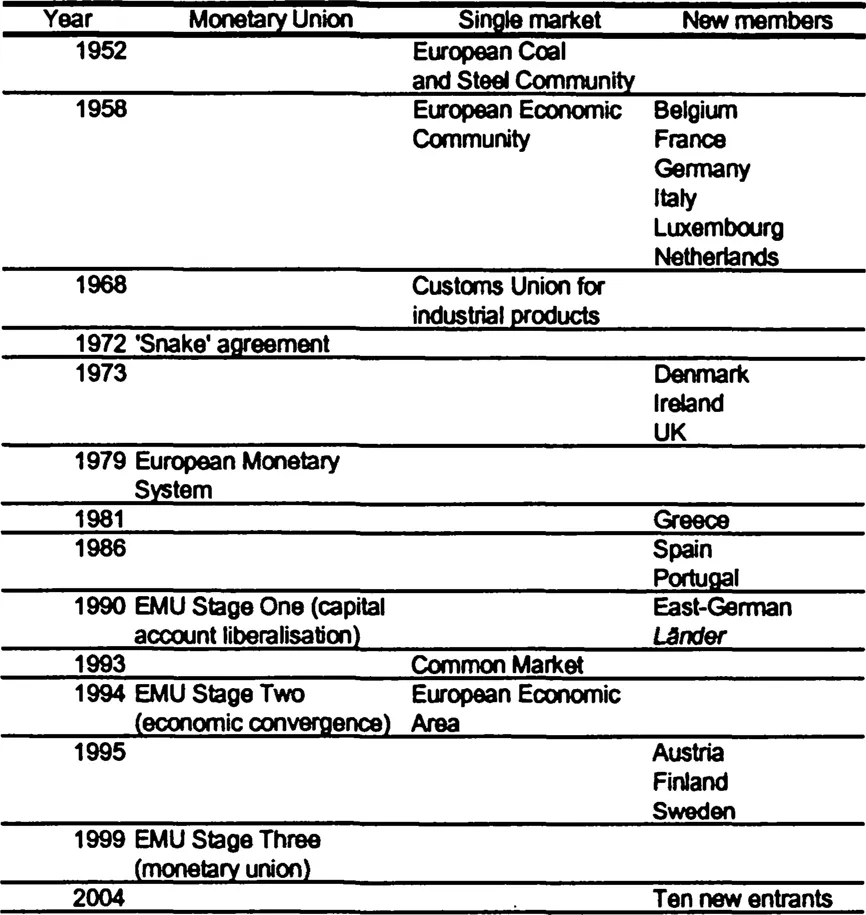
The introduction of euro banknotes and coins on 1 January 2002 marked a milestone in the process of European monetary integration, in which the decisive step was taken three years earlier, in January 1999, with the creation of the euro and the establishment of a single monetary policy. The pace of integration has been uneven and the process very long. Periods of rapid advancement have been followed by periods of stagnation. Table 1.1 shows the main steps to monetary union, which are described in Annex 1. In the early 1950s, the will to create a common market was undoubtedly related to the legacy of two terrible world wars. It has taken more than 40 years since the establishment of the European Economic Community to arrive at the present juncture and progress, characterised by a gradual deepening of economic and monetary co-operation, has not been free from crises. Having identified the main steps to monetary union, there appear to have been two key moments at which the process of integration was given special impetus. First, in the mid-1980s, when France decided to give priority to a stable exchange rate between the French franc and the Deutsche mark and hence to price stability, which was Germany’s main policy objective. This followed a proposal for greater political co-operation and a deepening of integration, which led to the Delors Plan and the Single Market as the way forward for the European project. And second, in the mid-1990s, when the peripheral countries, after the severe EMS crises, made real headway in attaining the macroeconomic stability imposed as a condition for joining the euro area.
Table 1.1 Gradual deepening of economic and monetary cooperation
Source: Own elaboration.
Economic interdependence among EU Member States, as measured by the scale of intra-European trade, has grown considerably. The share of intra-EU trade as a percentage of total foreign trade rose from 40 per cent in the...
Table of contents
- Cover
- Half Title
- Title Page
- Copyright Page
- Table of Contents
- List of Figures
- List of Tables
- List of Boxes
- List of Contributors
- Acknowledgements
- Introduction and Overview
- Part I: Regional Integration and Monetary Cooperation
- Part II: Exchange Rate Strategies in Latin America
- Part III: Financial Sector Structure
- Participants in the Seminar of the Eurosystem and Latin American Central Banks
- Index
Frequently asked questions
Yes, you can cancel anytime from the Subscription tab in your account settings on the Perlego website. Your subscription will stay active until the end of your current billing period. Learn how to cancel your subscription
No, books cannot be downloaded as external files, such as PDFs, for use outside of Perlego. However, you can download books within the Perlego app for offline reading on mobile or tablet. Learn how to download books offline
Perlego offers two plans: Essential and Complete
- Essential is ideal for learners and professionals who enjoy exploring a wide range of subjects. Access the Essential Library with 800,000+ trusted titles and best-sellers across business, personal growth, and the humanities. Includes unlimited reading time and Standard Read Aloud voice.
- Complete: Perfect for advanced learners and researchers needing full, unrestricted access. Unlock 1.4M+ books across hundreds of subjects, including academic and specialized titles. The Complete Plan also includes advanced features like Premium Read Aloud and Research Assistant.
We are an online textbook subscription service, where you can get access to an entire online library for less than the price of a single book per month. With over 1 million books across 990+ topics, we’ve got you covered! Learn about our mission
Look out for the read-aloud symbol on your next book to see if you can listen to it. The read-aloud tool reads text aloud for you, highlighting the text as it is being read. You can pause it, speed it up and slow it down. Learn more about Read Aloud
Yes! You can use the Perlego app on both iOS and Android devices to read anytime, anywhere — even offline. Perfect for commutes or when you’re on the go.
Please note we cannot support devices running on iOS 13 and Android 7 or earlier. Learn more about using the app
Please note we cannot support devices running on iOS 13 and Android 7 or earlier. Learn more about using the app
Yes, you can access Regional Integration in Europe and Latin America by Pierre van der Haegen in PDF and/or ePUB format, as well as other popular books in Business & Business General. We have over one million books available in our catalogue for you to explore.