![]()
Diabetes basics
Diabetes, more properly diabetes mellitus, is a complex chronic metabolic/endocrine disorder characterized by loss of normal blood glucose regulation (p. 1) and hyperglycaemia (p.33).
Glucose derived from the diet (p.9) is the body’s main source of energy. Blood glucose levels are regulated by the pancreas.
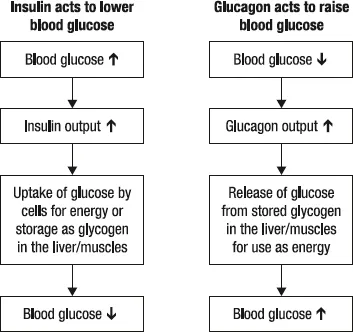
Beta cells within the pancreas produce the hormone insulin (p.19). By activating insulin receptors in cell walls, insulin enables the body’s tissues to take up circulating glucose for use as energy or for storage as glycogen in the liver/muscles. The beta cells secrete a steady supply of background (basal) insulin, ensuring availability of glucose to tissues at all times, with an extra burst (bolus) of insulin output in response to a glucose load.
Low blood glucose levels, e.g. during fasting periods or exercise (p.16), trigger secretion of another hormone, glucagon, from the alpha cells in the pancreas. Glucagon stimulates the release of glucose from stored glycogen in the liver/muscles back into the bloodstream for use as energy.
Blood glucose levels vary throughout the day and from person to person, with the normal fasting range 3.5–5.9 mmol/L. Blood glucose regulation is governed by negative feedback.
Figure 1 Blood glucose regulation
In diabetes, factors compromising normal blood glucose regulation (p.1) are:
• insulin deficiency – a problem with insulin production
• insulin resistance – reduced sensitivity to the action of insulin.
The two main types of diabetes are type 1 diabetes (p.3) and type 2 diabetes (p.3). The old terms ‘insulin-dependent’ and ‘non-insulin-dependent’ diabetes no longer apply and should not be used. There are no ‘mild’ forms of diabetes.
Type 1 diabetes
Type 1 diabetes is an autoimmune/idiopathic disorder where the pancreatic beta cells are destroyed and the ability to produce insulin is lost, causing absolute insulin deficiency. This is a life-threatening condition, often with acute presentation (diabetic ketoacidosis [DKA] (p.35)), that requires lifelong insulin (p.19) therapy for survival, alongside a healthy lifestyle (p.8). Type 1 diabetes typically occurs in children and young people (p.47) but can occur in older people.
Around 10–15% of people with diabetes have type 1 diabetes. It is thought to result from a combination of genetic (a first-degree relative with type 1 diabetes increases the risk) and environmental (e.g. viral, chemical) factors. Other autoimmune conditions are more common in people with type 1 diabetes, including coeliac and thyroid disease.
Type 2 diabetes
Type 2 diabetes is a progressive condition characterized by insulin resistance and relative insulin deficiency. Onset is usually more gradual than type 1 diabetes (p.3) and may go undetected for several years, leading to the development of long-term complications (p.44) prior to diagnosis (p.6). Lifestyle (p.8) interventions form the foundation of care, with the addition of medication (p.19), including insulin, as required for glycaemic control (p.30).
The commonest cause of insulin resistance is obesity – 80–90% of people with type 2 diabetes are overweight (p.17) at diagnosis. Insulin production continues but typically declines over time. The majority of people with diabetes have type 2 (85–90%). It is more common in people of South Asian, African and Afro-Caribbean origin, and in people with a family history of the disease. Previously regarded as mature-onset, with escalating obesity levels type 2 diabetes is now presenting in younger people, including growing numbers of children. It is often preceded by a state of impaired glucose regulation (p.6).
Other types of diabetes
Diabetes can be secondary to pancreatic impairment due to surgery (pancreatectomy) and conditions such as cystic fibrosis, pancreatitis and haemochromatosis.
Gestational diabetes is a first diagnosis of diabetes in pregnancy (p.50). It usually resolves post-delivery but women who experience gestational diabetes are at risk of developing type 2 diabetes (p.3) in later life.
Monogenic diabetes is caused by a mutation in a single gene. Affecting just 1–2% of diabetes cases, the main forms of monogenic diabetes are:
• Maturity-Onset Diabetes of the Young (MODY) – inherited diabetes usually diagnosed between the ages of 5 and 30
• Neonatal diabetes – transient or permanent diabetes diagnosed before the age of 6 months (new mutation).
The symptoms of diabetes are the symptoms of hyperglycaemia (p.33). They are reversible and will resolve once normal blood glucose levels are restored. Experience of hyperglycaemic symptoms can be very individual.
Symptom | Reason |
Polyuria, especially ... |