Groups
A Guide to Small Group Work in Healthcare, Management, Education and Research
- 192 pages
- English
- ePUB (mobile friendly)
- Available on iOS & Android
Groups
A Guide to Small Group Work in Healthcare, Management, Education and Research
About this book
In this introductory text, the author presents the law relating to child care and the reforms introduced by the Children Act 1989, assessing its impact on child care practice and procedures. Focusing on a practical interpretation of the law by the use of hypothetical examples, practice notes and recommendations, the book illustrates its relevance to those working in the caring and health professions, and incorporates details of various sets of Guidance and Regualtions issued by the Department of Health. In addition it provides an outline of adoption law, the principles of consent to treatment and the effect of surrogacy and "assisted reproduction" on the legal definition of parenthood.
Tools to learn more effectively

Saving Books

Keyword Search

Annotating Text

Listen to it instead
Information
Part 1
Introduction
1
What is a group? And what does it do?
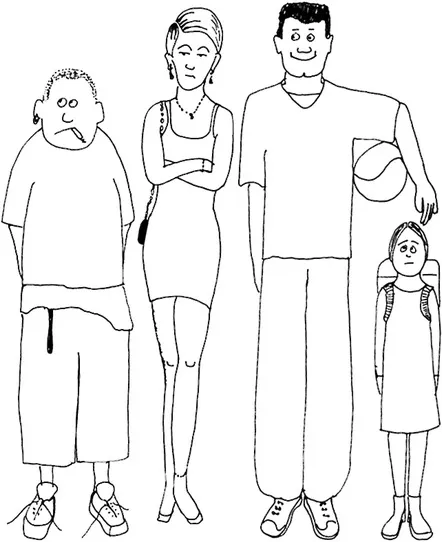
What is a group?
- a shared identity
- a shared frame of reference and
- shared objectives.
- Formal groups are created as mechanisms within a wider organisation and supported by the structures and power relationships within that structure. Their functions tend to be clearly specified, their membership restricted and their control over resources limited. Formal groups include project teams and (sometimes but not always) committees, boards of directors and boards of examiners.
- Informal groups are looser and more erratic in their behaviour and less constrained by rules and expectations. They are usually based on friendship and/or prior shared beliefs about how things should be done. It is often in informal groups that new ideas are tested and creative solutions explored. Moreover, it is often within these informal groups and networks that real power resides within organisations, and the importance of this fact is widely recognised in the literature on social network theory.5
What does a group do?
- 1 Active participation – i.e. everyone in the group takes part in some way. Note, however, that some participants naturally have a more interactive style than others. A member may contribute actively to the group process by body language, facial expression and the sensitive use of silence, as well as by verbal expression.Table 1.1: Examples of different types of group (adapted from a number of sources)7,8,9,10,11 and 12

- 2 A specific task – i.e. a defined and focused set of objectives. All group members must understand and agree on the objectives at the outset of the task, otherwise the group quickly becomes dysfunctional and frustrated.
- 3 Reflection – i.e. the group members incorporate experience into their shared task through an explicit process of discussion, questioning, evaluation and self-reflection.7 Reflection is a crucial feature of deep learning (see p. 176).
Why is group work suddenly so popular?
- process (how something is done) affects the outcome (the results or the product)
- in general terms (but for important exceptions see p. 166) teams are more successful than individuals
- group member participation leads t...
Table of contents
- Cover
- Title Page
- Copyright Page
- Contents
- Preface
- About the authors
- Contributorship
- Acknowledgements
- Part 1 Introduction
- Part 2 The Small Group Process
- Part 3 Small Group Work in Educational Settings
- Part 4 Small Group Work in Organisational Settings
- Part 5 Small Groups in Research
- Index
Frequently asked questions
- Essential is ideal for learners and professionals who enjoy exploring a wide range of subjects. Access the Essential Library with 800,000+ trusted titles and best-sellers across business, personal growth, and the humanities. Includes unlimited reading time and Standard Read Aloud voice.
- Complete: Perfect for advanced learners and researchers needing full, unrestricted access. Unlock 1.4M+ books across hundreds of subjects, including academic and specialized titles. The Complete Plan also includes advanced features like Premium Read Aloud and Research Assistant.
Please note we cannot support devices running on iOS 13 and Android 7 or earlier. Learn more about using the app