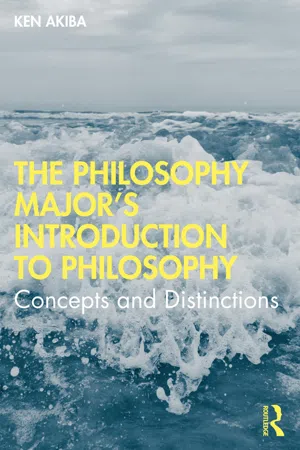
Many philosophy majors are shocked by the gap between the relative ease of lower-level philosophy courses and the difficulty of upper-division courses. This book serves as a necessary bridge to upper-level study in philosophy by offering rigorous but concise and accessible accounts of basic concepts and distinctions that are used throughout the discipline. It serves as a valuable advanced introduction to any undergraduate who is moving into upper-level courses in philosophy.
While lower-level introductions to philosophy usually deal with popular topics accessible to the general student (such as contemporary moral issues, free will, and personal identity) in a piecemeal fashion, The Philosophy Major's Introduction to Philosophy offers coverage of important general philosophical concepts, tools, and devices that may be used for a long time to come in various philosophical areas. The volume is helpfully divided between a focus on the relation between language and the world in the first three chapters and coverage of mental content in the final two chapters, but builds a coherent narrative from start to finish. It also provides ample study questions and helpful signposts throughout, making it a must-have for any student attempting to engage fully with the problems and arguments in philosophy.
Key Features
Integrates topics from various areas of philosophy, such as philosophy of language, metaphysics, epistemology, ethics, and philosophical logic
Provides descriptions of logico-mathematical tools necessary for philosophical studies, such as propositional logic, predicate logic, modal logic, set theory, mereology, and mathematical functions
Makes connections with modern philosophy, including discussions of Descartes's skepticism and dualism, Locke's theory of personal identity, Hume's theory of causation, and Kant's synthetic a priori
Includes well-known entertaining puzzles and thought experiments such as the Ship of Theseus, the Statue and the Clay, a Brain in a Vat, and Twin Earth
Lists helpful Exercise Questions and Discussion Questions at the end of each chapter and answers selected questions at the back of the book
Trusted by 375,005 students
Access to over 1.5 million titles for a fair monthly price.
To begin, let’s take a look at the whiteboard (Figure 1.1).
Figure 1.1Words on the whiteboard.
How many words are there on the board? Two or three?
Some of you may say that there are two words on the board, ‘dog’ and ‘cat’. Others may say that there are three words, ‘dog’, ‘cat’, and another ‘dog’ at the bottom. But whether you say ‘two’ or ‘three’, you’d agree that there is a sense in which the other answer is also correct. So how do you precisely describe the number of words on the board?
This is how. We introduce two terms, a word token and a word type. A word token is a particular inscription or utterance of a word, whereas a word type is a type of word which can be expressed possibly by multiple word tokens. So, in the present example, there are three word tokens ‘dog’, ‘cat’, and another ‘dog’, written on the board, expressing two word types, ‘dog’ and ‘cat’.
This type/token distinction can be used not only for words but more generally. For instance, philosophers talk about event tokens and event types. If I kiss my wife twice, each kissing can count as an event token; so there are two event tokens here, two kissings. But there is one event type, kissing. (Actually, those two event tokens can be tokens of a different event type, including kissing, kissing a woman, kissing somebody’s wife, and kissing Ken’s wife.)
The term ‘token’ should be understood as a technical term. You may have heard the word in a totally different context before. For instance, a special kind of coin you purchase and insert into the slot of a turnstile at a subway station may be called ‘token’ (though nowadays they have mostly been replaced with Metrocards). If someone says ‘as a token of my appreciation’, that ‘token’ basically means ‘symbol’. Anyway, take the word ‘token’ introduced here as a special technical term.
Then, how would you describe the situation in my backyard (Figure 1.2)? How many animals are there?
Figure 1.2Animals in my backyard.
If you say, in analogy with the last example, that there are three animal tokens, two dogs and one cat, expressing two animal types, dog and cat, that’s absolutely correct. There is nothing wrong with that. Philosophers, however, also traditionally use another pair of technical terms: particulars instead of ‘tokens’ and universals instead of ‘types’. Then there are three particulars, two dogs and one cat, Max, Fido, and Tibbles, in the backyard; they instantiate (or exemplify) two universals, dogness and catness. They also instantiate the universal animalness. I define a universal as a thing (in the broadest sense, or an entity, as many philosophers put it) that can be instantiated by particulars; more specifically, it can be instantiated by multiple particulars at different locations at once. Particulars are also called individuals in this book.
Thus, the particulars Max and Fido instantiate the universal dogness, the particular Tibbles instantiates the universal catness, and they all instantiate animalness. Considered the other way around, we abstract dogness, catness, and animalness from those particulars. So universals are a species of abstract objects.1 Generally, an abstract object is an object that has no spatiotemporal location; it exists outside of spacetime. Objects that are not abstract are concrete objects; so a concrete object exists somewhere in spacetime.
Can you give examples of particulars and universals? Particulars are easy to find: all individual people, such as Barack Obama, Donald Trump, Queen Elizabeth II, each of you, me, etc.; individual physical objects such as this table, that chair, that building, etc.; tiny objects such as cells, molecules, atoms, and fundamental particles and large objects such as New York City, the USA, Earth, and the Milky Way galaxy. Note that each individual may have parts, which themselves are individuals. So, for instance, the Milky Way galaxy contains 200 billion solar systems including ours; our solar system contains the Sun and eight planets including Earth; and Earth contains a few hundred countries, each of which contains many cities and towns, etc. We will talk more about parts later, but all those parts can be considered particulars of their own right.
Universals are, or at least include, properties and relations shared by particulars. They include properties such as beauty, honesty, courage, tallness, shortness, roundness, squareness, blackness, whiteness, redness, greenness, humanness (or humanity), dogness, catness, etc. (As you can see, if you have an adjective or a common noun such as ‘tall’ or ‘dog’ and add ‘-ness’ at the end, most likely the result will be a name of a property.) There are also such properties as being an old professor, being a bright student, being a black chair, and being a round table. (Then tallness = the property being tall; dogness = the property being a dog, etc.) Some properties are instantiated by particulars for a long period of time; others are instantiated only briefly. So two young people jogging instantiate the property jogging (or joggingness?) only so long as they are jogging, but they instantiate the property youth for several years and personhood so long as they live as persons.
While properties are instantiated by single individuals, relations are instantiated by groups of individuals. Examples are love, hate, kissing, kicking, speaking to, the relations being taller than, being heavier than, sitting next to, etc. These are 2-place rel...
Table of contents
Cover
Half Title
Title Page
Copyright Page
Dedication
Contents
List of figures
Preface
Chapter 1 Particulars and Universals; Logic and Language
Chapter 2 Extension and Intension
Chapter 3 Analyticity, Apriority, and Necessity
Chapter 4 Content, Linguistic and Mental
Chapter 5 Internalism and Externalism
Answers to Selected Exercise Questions
Bibliography
Index
Frequently asked questions
Yes, you can cancel anytime from the Subscription tab in your account settings on the Perlego website. Your subscription will stay active until the end of your current billing period. Learn how to cancel your subscription
No, books cannot be downloaded as external files, such as PDFs, for use outside of Perlego. However, you can download books within the Perlego app for offline reading on mobile or tablet. Learn how to download books offline
Perlego offers two plans: Essential and Complete
Essential is ideal for learners and professionals who enjoy exploring a wide range of subjects. Access the Essential Library with 800,000+ trusted titles and best-sellers across business, personal growth, and the humanities. Includes unlimited reading time and Standard Read Aloud voice.
Complete: Perfect for advanced learners and researchers needing full, unrestricted access. Unlock 1.5M+ books across hundreds of subjects, including academic and specialized titles. The Complete Plan also includes advanced features like Premium Read Aloud and Research Assistant.
Both plans are available with monthly, semester, or annual billing cycles.
We are an online textbook subscription service, where you can get access to an entire online library for less than the price of a single book per month. With over 1.5 million books across 990+ topics, we’ve got you covered! Learn about our mission
Look out for the read-aloud symbol on your next book to see if you can listen to it. The read-aloud tool reads text aloud for you, highlighting the text as it is being read. You can pause it, speed it up and slow it down. Learn more about Read Aloud
Yes! You can use the Perlego app on both iOS and Android devices to read anytime, anywhere — even offline. Perfect for commutes or when you’re on the go. Please note we cannot support devices running on iOS 13 and Android 7 or earlier. Learn more about using the app
Yes, you can access The Philosophy Major’s Introduction to Philosophy by Ken Akiba in PDF and/or ePUB format, as well as other popular books in Philosophy & Epistemology in Philosophy. We have over 1.5 million books available in our catalogue for you to explore.