eBook - ePub
Comparative Kinesiology of the Human Body
Normal and Pathological Conditions
- 576 pages
- English
- ePUB (mobile friendly)
- Available on iOS & Android
eBook - ePub
Comparative Kinesiology of the Human Body
Normal and Pathological Conditions
About this book
Comparative Kinesiology of the Human Body: Normal and Pathological Conditions covers changes in musculoskeletal, neurological and cardiopulmonary systems that, when combined, are the three pillars of human movement. It examines the causes, processes, consequences and contexts of physical activity from different perspectives and life stages, from early childhood to the elderly. The book explains how purposeful movement of the human body is affected by pathological conditions related to any of these major systems. Coverage also includes external and internal factors that affect human growth patterns and development throughout the lifespan (embryo, child, adult and geriatrics).
This book is the perfect reference for researchers in kinesiology, but it is also ideal for clinicians and students involved in rehabilitation practice.
- Includes in-depth coverage of the mechanical behavior of the embryo as one of the major determinants of human movement throughout the lifecycle
- Provides a comparison of human movement between normal and pathological conditions
- Addresses each body region in functional and dysfunctional kinesiological terms
Trusted by 375,005 students
Access to over 1.5 million titles for a fair monthly price.
Study more efficiently using our study tools.
Information
Topic
MedicineSubtopic
PhysiologyPart 1
History and basics of kinesiology
Outline
Chapter 1
Past, present and future of kinesiology
Fatma Uygur, Faculty of Physical Therapy and Rehabilitation, Hacettepe University, Ankara, Turkey
Abstract
The term kinesiology originates from the Greek words kinesis, to move and logy, to study. Ever since Aristotle, the manner in which humans walk and move have been studied by various scientists. Borelli, the Weber brothers, Marey, Muybridge, Braune, Fisher, Amar, Elftman and Winter have all contributed to the understanding of kinematics and kinetics of gait. Following the Second World War the Berkeley group; led by Inman and Eberhardt and further developed by Perry and Sutherland have moved the science of gait analysis dramatically forward by adding kinesiological electromygraphy, 3D force and energy measurements. This interpretation of movement led to the clinical application of gait analysis; to assist in the precise diagnosis and effective treatment of patients with locomotor disorders. Through movement science we came to understand the importance of core stabilization, motor learning, feed forward and feedback control, feed forward insufficiencies, anticipitory planning deficits and the means of optimizing these effects on skill acquisition. Human motion analysis has enabled us to design and produce endoprosthesis, limb prostheses, orthoses, various rehabilitation devices and humanoid robots. As the science of motion advances, new and more powerfull observation and modeling techniques and stimulation studies will develop enabling us to interpretate movement patterns for smart survelliance in security sensitive areas and to study human biomechanical responses to partial gravity.
Keywords
Kinesiology; History of kinesiology; Motion analysis
Historical perspective of the kinesiology studies
Human movement has undoubtedly been observed ever since the time of the first human being, however the earliest written comments regarding the manner in which humans walk can be attributed to Aristotle in the fourth century before Christ.
During the Renaissance, Leonardo da Vinci and Galileo Galilei concentrated on the rudiments of biomechanics and Galileo was the first person to marry deductive reasoning with experimental observation.
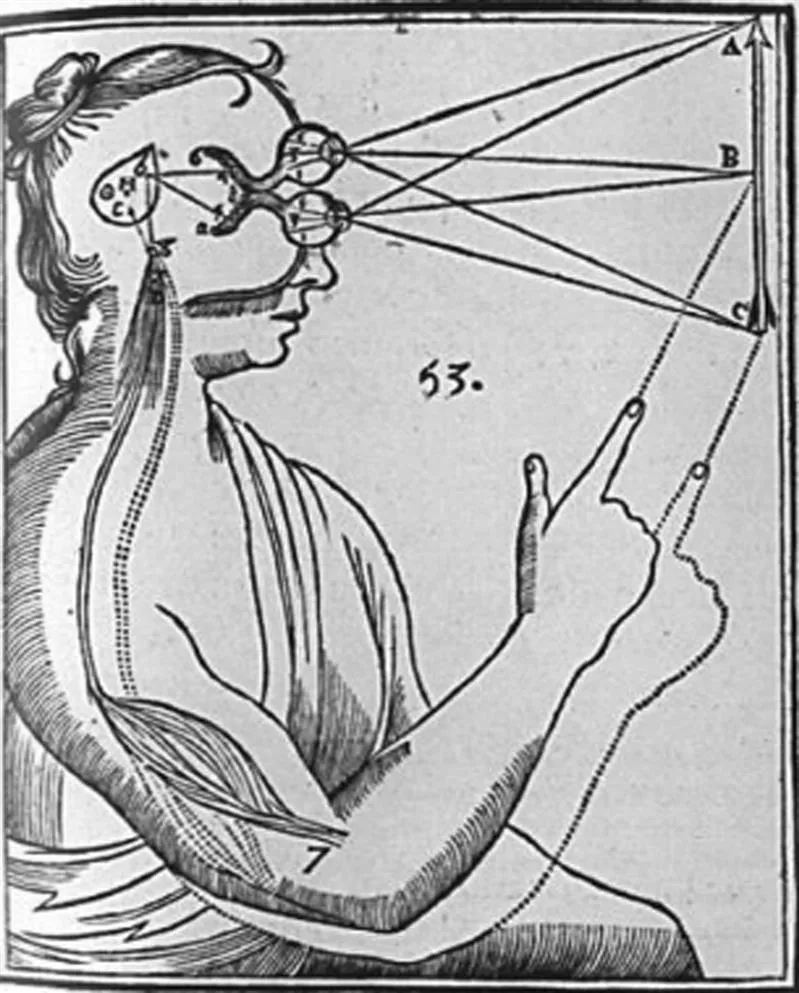
Rene Descartes first conceived of an orthogonal co-ordinate system for describing the position of objects in space. In an illustration within his book De Homine published in 1662 after his death, Rene Descartes demonstrated a closed loop motor control with the movement of the arm being controlled by muscular activity under the influence of nerves connected to the brain and with feedback provided by the eyes (Baker, 2007), (Fig. 1.1).
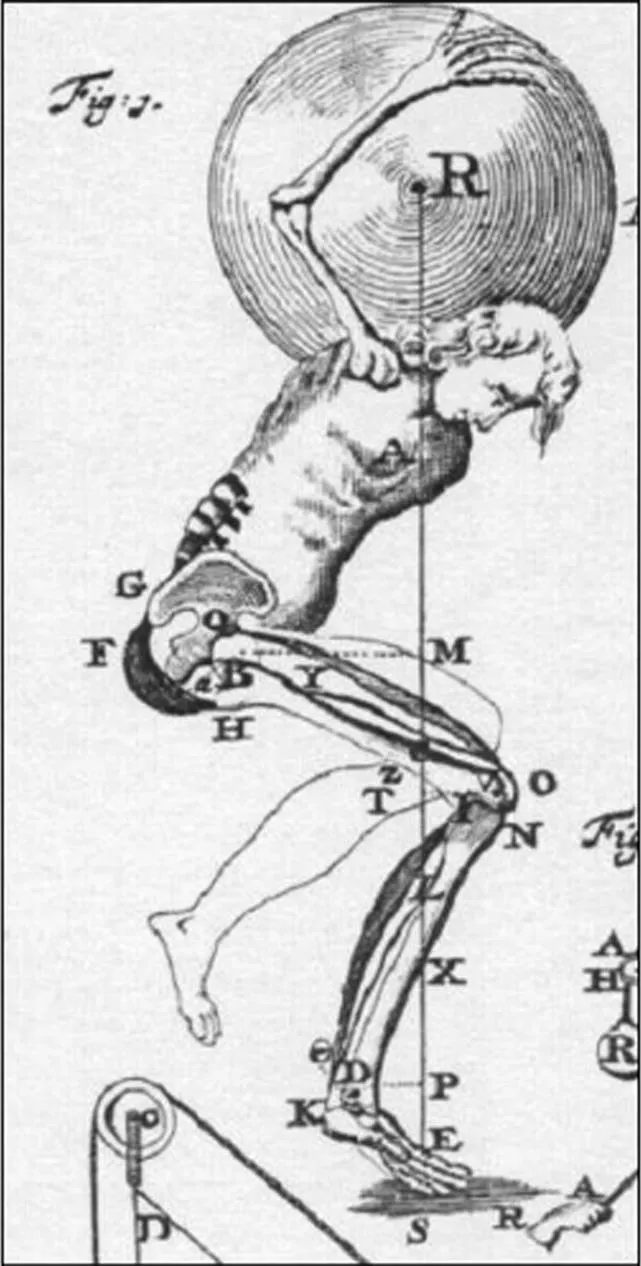
Giovanni Alfonso Borelli, a student of Galileo was among the first scientists to analyze motion and performed the first experiment in gait analysis, and through this experiment he deduced that there was a medio-lateral movement of the head during walking; also developed his theory of muscle action based on mechanical principles. He published “De Motu Animalum” in 1682 and used a scientific approach in his description of walking (Fig. 1.2). For more scientific progress the physical laws governing forces were to be formulated by Isaac Newton in “Mathematical Principles in Natural Philosophy” in 1688 (Whittle, 1996; Banta, 1999; Baker, 2007).
In “Physiologie des Mouvements” published in 1867 Duchenne; the founder of electrophysiology; described the function of individual muscles of the human body. It is accepted to be the first scientific systematic evaluation of muscle function (Banta, 1999).
Development of kinesiology in modern age
During the early nineteenth century, the first formal biomechanical investigations were made by the Weber brothers in Germany (Whittle, 1996; Banta, 1999; Andriacchi and Alexander, 2000). In 1836 the Weber brothers, Edward and Wilhelm published their book “Mechanics of the Human Walking Apparatus” in which they gave the first clear description of the gait cycle. They conducted experiments utilizing a stop watch, measuring tape and a telescope and made accurate measurements of the timing of gait and of the pendulum-like swinging of the leg of a cadaver. They were the first to develop illustrations showing the attitude of the limb segments at different instances of the walking cycle (Baker, 2007), (Fig. 1.3).

The earliest kinematic studies on human walking were performed in the 1870s by Marey in France and Muybridge in the States. These early investigations were made using still cameras; Marey utilized chronophotograph whereby a single plate camera had the shutter opened and closed at fixed time intervals, thus recording on the plate successive positions of the human body during function; he made multiple photographic exposures, on a single plate, of a subject who dressed in black, except for brightly illuminated stripes on the limbs. He also investigated the path of the center of gravity of the body and the pressure beneath the foot (Fig. 1.4). Maybridge used a series of cameras to take multiple pictures in rapid succession of both animals and humans in movement (Whittle, 1996; Paul, 1998; Andriacchi and Alexander, 2000).
Also, during that time period Wilhelm Braune and Otto Fisher reported measurements of body segment movements to calculate joint forces and energy expenditures using Newtonian mechanics. They photographed the subject with four cameras. One camera was positioned in front of the subject, one behind and one on each side, making the measurements three dimensional. The process of collecting data alone required 8–10 hours per subject and months to calculate kinematic measurements (Paul, 1998; Banta, 1999; Andriacchi and Alexander, 2000; Sutherland, 2002; Baker, 2007). Wilhelm Braune and Otto Fisher published their work in 1895 “Der Gang des Menchen” which is considered to be the first 3-D gait analysis (Baker, 2007).
Marey’s students Carey, Ampar and Demeny searched for scientific methods of recording the magnitude of foot-heel contact. Demeny developed a pneumatic mechanism which measured the vertical component of the ground reaction (Sutherland, 2005; Baker, 2007).
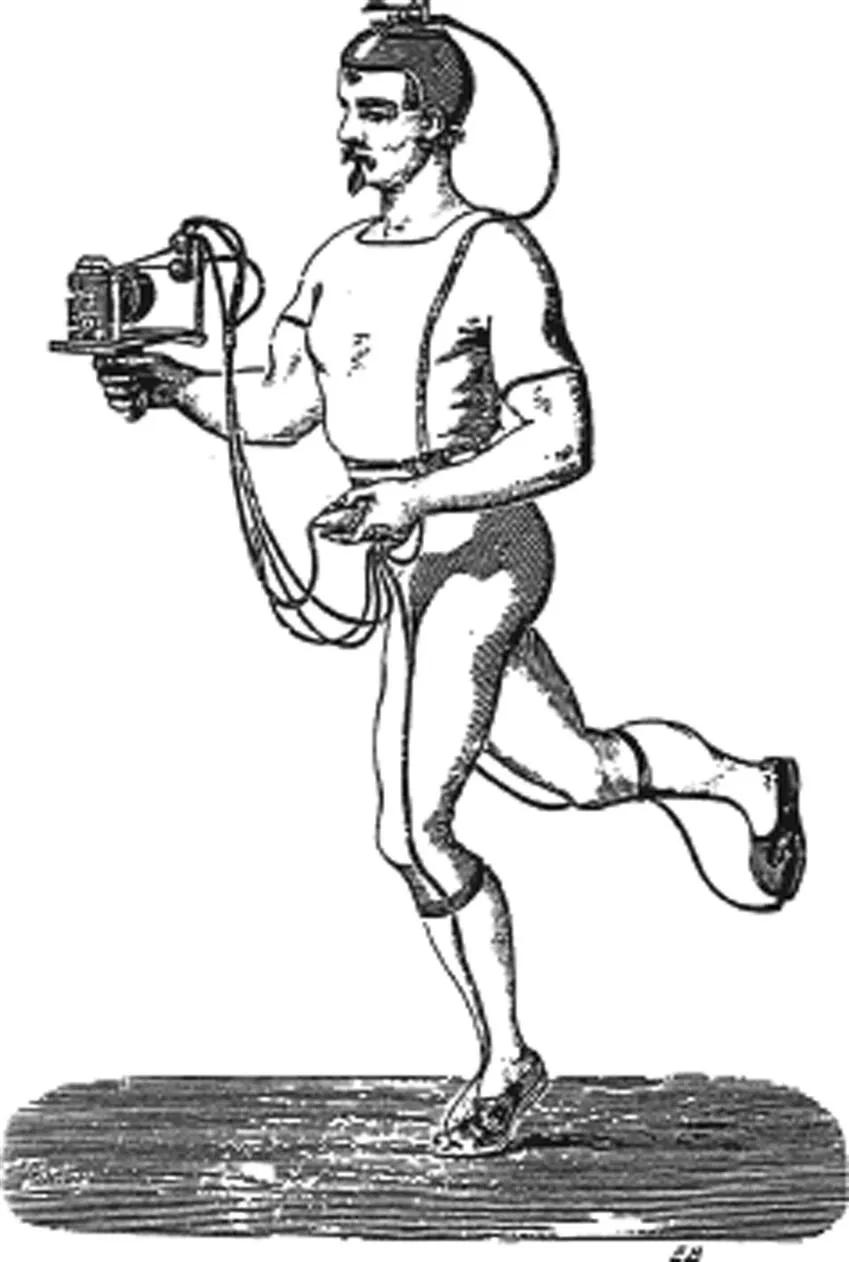
Jules Amar was the first to develop a three-component pneumatic force plate. Amar was a rehabilitation doctor working with amputees after the First World War (Fig. 1.5). Elftman later developed a full-three component mechanical force plate in 1938 and commercial strain gauge platforms became available in the 1970s (Sutherland, 2005; Baker, 2007).

A full understanding of normal gait requires the knowledge of which muscles are active during different parts of the gait cycle. The Berkeley Group headed by Inman and Eberhart at the University of California was assembled as a result of the causalities of the Second World War to advance prosthetic devices for war veterans. This group made the biggest advances in gait analyses. Vern Inman and colleagues moved the science of gait analysis dramatically forward by adding kinesiological electromyography, 3-D force and energy measurements in the study of walking in normal subjects and amputees (Sutherland, 2001).
In his landmark ar...
Table of contents
- Cover image
- Title page
- Table of Contents
- Copyright
- Dedication
- List of contributors
- Foreword
- Preface
- Acknowledgments
- Part 1: History and basics of kinesiology
- Part 2: Tissues
- Part 3: Upper extremity
- Part 4: Trunk and pelvis
- Part 5: Cardiorespiratory system
- Part 6: Lower extremity
- Part 7: Sensory-motor integration and performance
- Part 8: Locomotion
- Index
Frequently asked questions
Yes, you can cancel anytime from the Subscription tab in your account settings on the Perlego website. Your subscription will stay active until the end of your current billing period. Learn how to cancel your subscription
No, books cannot be downloaded as external files, such as PDFs, for use outside of Perlego. However, you can download books within the Perlego app for offline reading on mobile or tablet. Learn how to download books offline
Perlego offers two plans: Essential and Complete
- Essential is ideal for learners and professionals who enjoy exploring a wide range of subjects. Access the Essential Library with 800,000+ trusted titles and best-sellers across business, personal growth, and the humanities. Includes unlimited reading time and Standard Read Aloud voice.
- Complete: Perfect for advanced learners and researchers needing full, unrestricted access. Unlock 1.5M+ books across hundreds of subjects, including academic and specialized titles. The Complete Plan also includes advanced features like Premium Read Aloud and Research Assistant.
We are an online textbook subscription service, where you can get access to an entire online library for less than the price of a single book per month. With over 1.5 million books across 990+ topics, we’ve got you covered! Learn about our mission
Look out for the read-aloud symbol on your next book to see if you can listen to it. The read-aloud tool reads text aloud for you, highlighting the text as it is being read. You can pause it, speed it up and slow it down. Learn more about Read Aloud
Yes! You can use the Perlego app on both iOS and Android devices to read anytime, anywhere — even offline. Perfect for commutes or when you’re on the go.
Please note we cannot support devices running on iOS 13 and Android 7 or earlier. Learn more about using the app
Please note we cannot support devices running on iOS 13 and Android 7 or earlier. Learn more about using the app
Yes, you can access Comparative Kinesiology of the Human Body by Salih Angin,Ibrahim Simsek in PDF and/or ePUB format, as well as other popular books in Medicine & Physiology. We have over 1.5 million books available in our catalogue for you to explore.