eBook - ePub
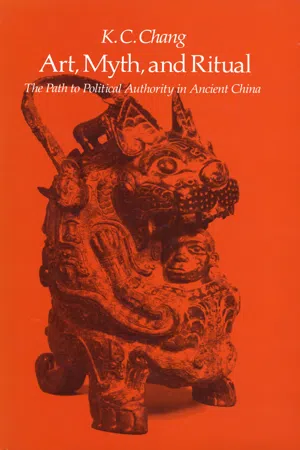
Art, Myth, and Ritual
The Path to Political Authority in Ancient China
- English
- ePUB (mobile friendly)
- Available on iOS & Android
eBook - ePub
About this book
A leading scholar in the United States on Chinese archaeology challenges long-standing conceptions of the rise of political authority in ancient China. Questioning Marx's concept of an "Asiatic" mode of production, Wittfogel's "hydraulic hypothesis," and cultural-materialist theories on the importance of technology, K. C. Chang builds an impressive counterargument, one which ranges widely from recent archaeological discoveries to studies of mythology, ancient Chinese poetry, and the iconography of Shang food vessels.
Information
1
CLANS, TOWNS, AND THE POLITICAL LANDSCAPE
Each of the Three Dynasties was founded by members of a different clan. Actually, in early China there were probably many hundreds of such clans, each characterized by a set of common features. Members of a clan traced their descent from the same mythological ancestor through the paternal line, although the actual fact of descent in the far remote past usually could not be genealogically demonstrated.1 The myth of the ancestral birth gave rise in most cases to a name and an emblem (“totem”) used by the entire clan.2 Clan members supposedly all shared some special quality or character, and this was given as one of the reasons why they did not intermarry.3
Although we are certain that each of the many hundreds of these agnatic clans in ancient China had its own myth of ancestral origins, only a few have been preserved in the literature. These were myths of the clans whose members founded the major dynasties and other political houses.
The Hsia dynasty, the first political dynasty in traditional recorded history, was founded by members of the Ssu clan. Perhaps because of the greater antiquity of the dynasty, for which texts are as yet unknown, the mythical origin of the clan’s ancestors is unclear. In one version4 the mother of Yü, founder of the dynasty (Figure 4), gave birth to him as the result of eating some grains of Job’s tears (Coix lacryma-jobi). (Job’s tears were called yi-ssu, hence the name of the clan, and they are one of the oldest domesticated crops in Eastern Asia.) In another story, however, the clan’s ancestor appears to have been born out of a rock. Yü’s father, Kun, charged with the task of stemming a great flood, “stole from the [Supreme God] the ‘swelling mold’ (hsi jang) – a magical kind of soil which had the property of ever swelling in size. With this he tried to build dams which, through their swelling, would hold back the waters. When his efforts failed, the [Supreme God], angered by his theft, had him executed. There his body remained for three years [turning into a stone], until somebody . . . cut it open with a sword; thereupon Yü emerged from his father’s belly.”5 This story is more or less repeated to account, as well, for the birth of Yü’s son: “While digging a passage through a certain mountain, [Yü] was changed . . . into a bear. His wife, [the Lady of T’u Shan], seeing him, ran away and herself became changed to stone. She was pregnant at the time, and so when Yü pursued her and called out, ‘Give me my son!’ the stone split open on its north side and a son, Ch’i [which means ‘to open’] came forth.”6 (See the appendix for lists of the kings of the Three Dynasties.)
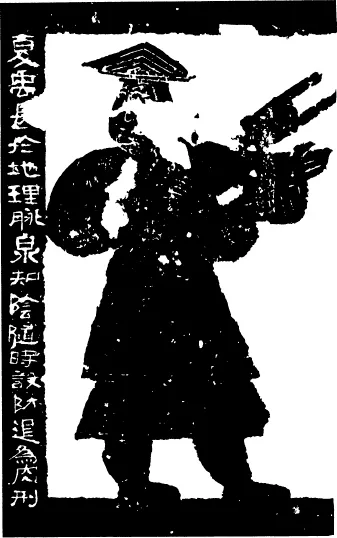
4. The Great Yü as portrayed in the Wu Liang Tz’u mural.
The Shang dynasty was founded by members of the Tzu clan, who were descendants of the clan’s founder, Hsieh. According to Shang myth, an egg dropped by a dark bird was devoured by Hsieh’s mother, who became pregnant as a result and later gave birth to him (Figure 5).7 The myth of ancestral birth from a bird’s egg was widespread in ancient times among the peoples in the eastern coastal areas of China and Northeast Asia,8 a fact which seems to support the belief of many scholars that the Shang people had come from the east.
The last of the Three Dynasties, the Chou, was founded by members of the Chi clan, which derived its name – according to one account – from the name of a small river flowing in the clan’s homeland. The clan’s ancestor, Ch’i (“the Abandoned One”) or Hou Chi (“Lord Millet”), shown in Figure 6, was according to the origin myth “Sheng min” (in Shih) a direct descendant of Supreme God himself, who made an imprint with his foot and caused Lady Yuan of the Chiang clan to become pregnant when she trod on the big toe of the footprint. “Sheng min” relates that after Chiang Yuan gave birth to Hou Chi, he was abandoned in a narrow lane, then in a far-off wood, and then on ice, but each time he was saved, by oxen and sheep, by woodcutters, or by birds. When he grew up, he became a specialist in plant husbandry, was adept in growing millet, beans, and other plants, and began the practice of offering sacrifices.9 In another dynastic legend, “Mien,” also in Shih, the origin of the human race was compared to the spreading of young gourds. The ancestral birth from bottle gourds is a common myth, and this could be another version of the Chi clan origins.10
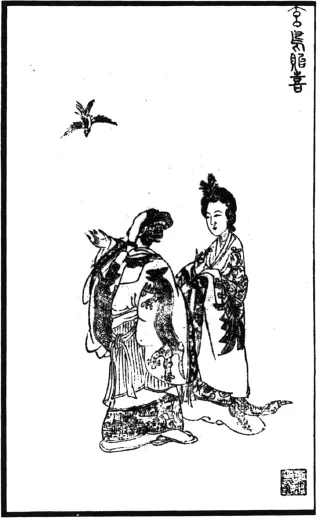
5. The origin myth of the ancestor of the Shang. The bird is shown dropping an egg, and Chien Ti (right), who later devoured it, gave birth to Hsieh.
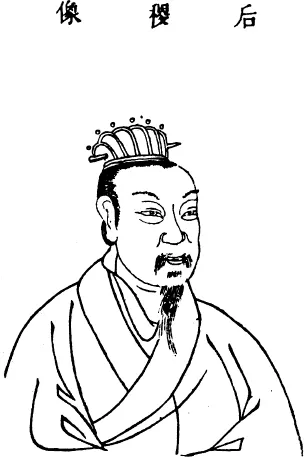
6. Portrait of the mythical figure Hou Chi, ancestor of the Chou dynasty.
Since the Three Dynasties were founded by the three clans – Ssu, Tzu, and Chi – the dynasties’ rise and fall were in fact the rise and fall of the fortunes of the individual clans in the political arena in which many clans coexisted, and this fact – that political authority was wielded by social groups basing their membership on blood relationships – is a prominent feature of the ancient Chinese state. Furthermore, each of the clans was itself highly stratified, again along blood lines. Each clan comprised a number of lineage groups, and the members of each group were related to one another according to a genealogically demonstrable relationship. Individual lineages, and even individual members within each lineage, possessed unequal degrees of political status.
The lineage system of the Three Dynasties is not clearly understood, but the broad principle that political status was genealogically determined is not in question.11 In a number of Chou texts we find clear explications of a system of lineage segmentation, resulting in the fission of the agnatic lineages and the establishment of the branch lineages in their own well-defined spatial domains. As a hypothetical example, consider a major lineage that might have ruled over an urban center with significant political authority. The lineage would have been one of a group of lineages all belonging to a certain clan, but let us assume that this lineage was superior to the others of the same clan and to the other clans within the territory of its rule. It could be termed the “royal” lineage – the ruler of its own dynasty. This lineage would be perpetuated by a line of male heirs, whose status would be determined by specified factors such as being the son of a primary wife or being the first-born among brothers.
At some point in the royal lineage’s life there would arise reasons for sending one of its male members away from the royal domain to establish a new polity. He would be a brother, an uncle, or a cousin of the ruler, and he might be accompanied by a sizable group of people in order to relieve population pressure, to open up new arable land, or to shore up defense. Whatever the reason, he would be sent off with (a) his clan affiliation and emblem, (b) several groups of lineage members of one or more clans to provide both agricultural and industrial labor and military force, (c) title to the land of his newly established domain, (d) a new name for his new polity, and (e) ritual symbols and paraphernalia both to continue his ritual affiliation with his father’s lineage and to manifest his new independence. In the new land he would build a new temple, in which his own tablet would eventually be placed as that of the founder of the new lineage. Thus, a new line of lineage segments would be initiated; they would be secondary lineages with respect to the stem lineage from which they had broken off, and their political as well as ritual status would likewise be secondary. This process of branching off would be repeated to form tertiary, quaternary, and subsequent levels of lineage segments. Such a system of segmentary lineages was thus also a system of decreasing political statuses.12
The focal points of the segmentary lineages were walled towns. The Chinese town, ancient as well as modern (Figure 7), was, in the words of Joseph Needham, “not a spontaneous accumulation of population, nor of capital or facilities of production, nor was it only or essentially a market-centre; it was above all a political nucleus, a node in the administrative network, and the seat of the bureaucrat [or] . . . the ancient feudal lord.”13 The construction of the town was, in fact, in its impetus, a political act that gave the new lineage its new seat of power, typically in a new land. In Shih we read a description of one such political act, involving the founding of a royal capital by a predynastic ancestor of the Chou people:
The ancient prince T’an-fu,
At daybreak he galloped his horses;
He followed the bank of the Western river,
He came to the foot of (mount) Ch’i;
And so together with the lady Chiang
He came and lingered (there) and took up an abode.
At daybreak he galloped his horses;
He followed the bank of the Western river,
He came to the foot of (mount) Ch’i;
And so together with the lady Chiang
He came and lingered (there) and took up an abode.
The plain of Chou was rich and ample;
Even the chin and t’u plants [bitter herbs] were sweet like honey-cakes;
And so he started, he planned,
He notched our tortoises [for divination];
And so he stopped; he halted, he built houses here.
Even the chin and t’u plants [bitter herbs] were sweet like honey-cakes;
And so he started, he planned,
He notched our tortoises [for divination];
And so he stopped; he halted, he built houses here.
And so he remained quiet, he stopped;
He went to the left, he went to the right,
He made boundaries, he made division,
He measured to the cubit, he laid out acres;
From west he went east,
Everywhere he took the task in hand.
He went to the left, he went to the right,
He made boundaries, he made division,
He measured to the cubit, he laid out acres;
From west he went east,
Everywhere he took the task in hand.
And ...
Table of contents
- Cover
- Title
- Copyright
- Contents
- Introduction
- 1 Clans, Towns, and the Political Landscape
- 2 Moral Authority and Coercive Power
- 3 Shamanism and Politics
- 4 Art as the Path to Authority
- 5 Writing as the Path to Authority
- 6 Access to the Path
- 7 The Rise of Political Authority
- Appendix: The Kings of the Three Dynasties
- Sources of Illustrations
- Index
Frequently asked questions
Yes, you can cancel anytime from the Subscription tab in your account settings on the Perlego website. Your subscription will stay active until the end of your current billing period. Learn how to cancel your subscription
No, books cannot be downloaded as external files, such as PDFs, for use outside of Perlego. However, you can download books within the Perlego app for offline reading on mobile or tablet. Learn how to download books offline
Perlego offers two plans: Essential and Complete
- Essential is ideal for learners and professionals who enjoy exploring a wide range of subjects. Access the Essential Library with 800,000+ trusted titles and best-sellers across business, personal growth, and the humanities. Includes unlimited reading time and Standard Read Aloud voice.
- Complete: Perfect for advanced learners and researchers needing full, unrestricted access. Unlock 1.4M+ books across hundreds of subjects, including academic and specialized titles. The Complete Plan also includes advanced features like Premium Read Aloud and Research Assistant.
We are an online textbook subscription service, where you can get access to an entire online library for less than the price of a single book per month. With over 1 million books across 990+ topics, we’ve got you covered! Learn about our mission
Look out for the read-aloud symbol on your next book to see if you can listen to it. The read-aloud tool reads text aloud for you, highlighting the text as it is being read. You can pause it, speed it up and slow it down. Learn more about Read Aloud
Yes! You can use the Perlego app on both iOS and Android devices to read anytime, anywhere — even offline. Perfect for commutes or when you’re on the go.
Please note we cannot support devices running on iOS 13 and Android 7 or earlier. Learn more about using the app
Please note we cannot support devices running on iOS 13 and Android 7 or earlier. Learn more about using the app
Yes, you can access Art, Myth, and Ritual by K. C. Chang,Kwang-chih CHANG in PDF and/or ePUB format, as well as other popular books in Social Sciences & Ethnic Studies. We have over one million books available in our catalogue for you to explore.