This accessible primer on health psychology covers the key theories and models of the discipline. Through the use of real-life case studies and examples, it covers a broad range of topics related to the field of health psychology including: health promotion, risky health behaviour and health in healthcare settings. It explains how health psychology serves to not only promote positive health and reduce maladaptive health behaviours, but also support those who are chronically ill.
Unlike medicine, health psychology takes a more holistic approach through the interaction of psychological, social and biological factors to improve health. This book outlines the inter-relationship between how we think and feel, our biological systems and the social contexts in which we live. It discusses how belief and attitude can shape behavior, the pivotal role of stress and how we can adjust to chronic illness. Drawing from experience, the authors answer important and common questions like how can we stop people from smoking? Does stress really make us ill? Why don't people take their medication as prescribed? And how can we support people to adjust to a chronic health condition? It also provides a unique focus on children and adolescent health which considers how developmental changes impact health behaviours and subsequent health.
It is an essential introductory text suitable for students, professionals and general readers interested in this important and emerging topic area. It also provides useful information for those interested in working in the field by providing an overview of what health psychologists do, where they work and the pathways available to become a registered health psychologist.
Trusted by 375,005 students
Access to over 1.5 million titles for a fair monthly price.
Historical approaches to health: a biomedical model of health and illness
Introduction to the biomedical model
Challenging the biomedical view of health
What is health?
What is health psychology?
Why do we need health psychology?
Health in the twenty-first century: the role of lifestyle on population health
Health policy: the role of government action for lifestyle change
Health psychology today, where are we now?
Research methods in health psychology
Qualitative studies
Quantitative studies
Systematic reviews and meta-analysis
Careers in health psychology
What do health psychologists do and where do they work?
How to become a health psychologist
Stage one
Stage two
What can you expect to earn as a health psychologist?
Interested in health psychology, now what?
Final overview and summary
References
Introduction
This chapter focuses on establishing the context of health psychology by explaining the changing patterns of disease and describing the role of health psychology in understanding these needs.
The chapter begins by setting the context of health psychology. Going through a journey in time, we will explore historical views of health and illness from the adoption of the more traditional biomedical model, where the mind and body are viewed as separate entities, to the more modern perspective of the biopsychosocial perspective, which considers a more holistic approach to understanding health and illness.
We will be exploring public health trends and consider how health psychology has evolved to meet the changing needs of health and how this links to current health policy and to the health of the nation. This chapter will explain current health issues and how through policy and practice health psychology can have a positive impact on population health.
Alongside uncovering the aims of health psychology this chapter will end by answering common questions relating to becoming a health psychologist ‘What do they do?’, ‘Where do they work?’ and ‘how can I become a health psychologist?’.
Historical approaches to health: a biomedical model of health and illness
Introduction to the biomedical model
The history of medicine has shown us how society shapes both our approach and understanding of health, illness and disease. To do this we have to take a step back in history to understand how our thinking of health and illness has changed over the years.
During the Greek classical period an ancient Greek physician, called Hippocrates (460–377 bc) discovered humoral medicine. This idea was then later disseminated by Roman Galen (129–216 ad), labelled as Galen’s Theory of Humours, which continued to dominate western medicine up until the nineteenth century [1].
Based upon ancient medical works, the view was that we all have four ‘humours’ (also referred to as principal fluids): black bile, yellow bile, phlegm and blood, which were produced by various organs in the body. It was proposed that humours existed in cycles according to the seasons; i.e. an illness that occurred in summer was associated with yellow bile, spring with blood, autumn with black bile and winter with phlegm. Treatments were therefore used to counteract the coldness or warmth, for example warm illnesses i.e. those that occurred during the summer were said to affect the yellow bile so cold treatments were used. There was also said to be a strong association with the natural elements: water, earth, fire and air and these with the seasons provided us a useful understanding of how to preserve balance within the body [2].
The idea, and a fundamental premise of this theory was that our characteristics and our disposition defined our health. This idea suggested that our wellbeing was defined by our personality, which in turn was associated with the four elements and their relationship with the four ‘humours’. So, being able to diagnose individuals was largely based on observing individuals on their personalities in a bid to gain clues on what might be wrong with them. An individual, for example who was bad tempered and angry was believed to have an imbalanced yellow bile, the humour associated with the summer season.
Treatment focused on balance and restoration. Treatments were achieved by healing, either through physical (diet, medicine, herbal remedies) or spiritual therapeutics (e.g. bloodletting using leeches, clean bedding, prayer, music, relics of saint) [3].
Figure 1.1Diagram of The Four ‘Humours’
People were beginning to challenge the idea the mind and body were not separate; however, this was controversially challenged by Galen, who argued that the organs were responsible for health. Without any strong evidence to challenge Galen he was able to instill this viewpoint for many centuries [4]. In the seventeenth century René Descartes (1596–1650) sustained this philosophy, postulating the mind (non-material)–body (material also referred to as a machine) dualism. The mind and body were viewed as separate entities and illness was viewed as a malfunction of our machine not the non-material. It was not until the rise of the twentieth century in response to Freud’s psychodynamic theory that this belief was finally challenged.
Challenging the biomedical view of health
Sigmund Freud (1856–1939), a renowned neurologist was met with numerous patients who were presented with ‘hysteria paralysis’, a condition where an individual suffers paralysis, which after numerous medical tests were told there was nothing physically wrong. Freud proposed that our unconscious psychological conflict could directly impact on physical disturbance or symptoms via the voluntary nervous system. For example, if a patient has a memory of trauma, which they fail to confront this can be converted into physical symptoms. This was later supported by Dunbar (1930s) and Alexander (1940s) who argued that internal conflicts unconsciously produce anxiety and take a physiological toll via the autonomic nervous system. This shift in thinking therefore advocated that there was indeed a link between our body and mind and that they were not separate entities as once believed.
The emergence of the field of behavioural medicine also challenged traditional beliefs that the mind and body are separate entities and work independently. Behavioural medicine represented an interdisciplinary field drawing on elements from psychology, sociology and health education. Defined as ‘the field concerned with the development of behavioural science knowledge and techniques relevant to the understanding of physical health and illness and the application of this knowledge and these techniques to prevention, diagnosis, treatment and rehabilitation’ [5]. The careful addition of ‘behavioural’ was not just about semantics, but arguably demonstrated an important shift in thinking about how we understand health and illness. A movement from thinking about our physical and our mental health as separate, this definition argued for a more integrated holistic perspective, one which considered the biological and behavioural factors of health and illness.
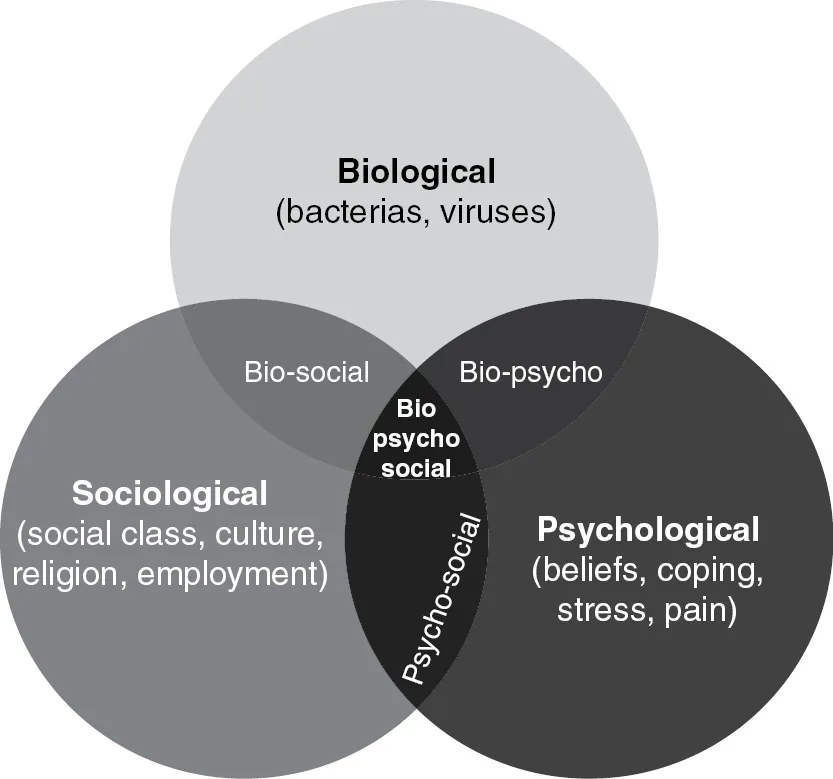
As you can see the views of health were rapidly changing. It was at this time that George Engel [6, 7] challenged traditional biomedical thinking and suggested that in addition to the biological aspects (diseases), psychosocial dimensions should be considered. Engel proposed a biopsychosocial model of health, which considered that the cause, manifestation and outcome of health and illness was formed by the interaction of biological (our genes and biology), psychological (our beliefs, emotions and coping resources) and social-cultural factors (where we live, our social support, our cultural background) (see Figure 1.2).
Figure 1.2The biopsychosocial model showing the interrelationship between the three dimensions adapted from Engel [6, 7]
What is health?
Like our understanding of health and illness, how we have defined health has also changed. Historically, health was viewed as the absence of disease, a negative state, in other words you are either healthy or not healthy.
I would like to think that I am healthy. I mean I go swimming two mornings a week and like to go on long walks at the weekend. Although, I am probably carrying a bit too much weight, certainly my trousers are feeling a bit tighter than they once did. I eat mostly well, but I can’t resist the tempting puddings when we are eating out on a Saturday. I probably stop at the drive thru café a bit too often, for my regular Chai Latte and a chocolate brownie. Note to self, I should stick to eating more fruit. My alcohol consumption is maybe a bit higher than it should be, a few too many Pinot Grigio’s at the weekend, but it is my down time, that is what I like to say anyway.
(John aged 67)
John states that he feels healthy, but if he were to adopt this definition, he would be classified as ‘diseased’, but is this a fair reflection? It is argued that there is more to health than just our physical state. It is claimed that our psychological and social health, in other words the importance of being able to fulfil our potential and obligations, ...
Table of contents
Cover
Half Title
Series Information
Title Page
Copyright Page
Table of Contents
1 The development of health psychology
2 A bio/psycho/social approach to health and wellbeing
3 Attitudes, beliefs and behaviour: Models of health behaviour change
4 Health behaviours of children and adolescents
5 Stress
6 Adjusting to chronic illness
7 Health psychology in healthcare settings
Glossary
Index
Frequently asked questions
Yes, you can cancel anytime from the Subscription tab in your account settings on the Perlego website. Your subscription will stay active until the end of your current billing period. Learn how to cancel your subscription
No, books cannot be downloaded as external files, such as PDFs, for use outside of Perlego. However, you can download books within the Perlego app for offline reading on mobile or tablet. Learn how to download books offline
Perlego offers two plans: Essential and Complete
Essential is ideal for learners and professionals who enjoy exploring a wide range of subjects. Access the Essential Library with 800,000+ trusted titles and best-sellers across business, personal growth, and the humanities. Includes unlimited reading time and Standard Read Aloud voice.
Complete: Perfect for advanced learners and researchers needing full, unrestricted access. Unlock 1.5M+ books across hundreds of subjects, including academic and specialized titles. The Complete Plan also includes advanced features like Premium Read Aloud and Research Assistant.
Both plans are available with monthly, semester, or annual billing cycles.
We are an online textbook subscription service, where you can get access to an entire online library for less than the price of a single book per month. With over 1.5 million books across 990+ topics, we’ve got you covered! Learn about our mission
Look out for the read-aloud symbol on your next book to see if you can listen to it. The read-aloud tool reads text aloud for you, highlighting the text as it is being read. You can pause it, speed it up and slow it down. Learn more about Read Aloud
Yes! You can use the Perlego app on both iOS and Android devices to read anytime, anywhere — even offline. Perfect for commutes or when you’re on the go. Please note we cannot support devices running on iOS 13 and Android 7 or earlier. Learn more about using the app
Yes, you can access Health Psychology by Erica Cook,Lynne Wood in PDF and/or ePUB format, as well as other popular books in Medicine & Applied Psychology. We have over 1.5 million books available in our catalogue for you to explore.