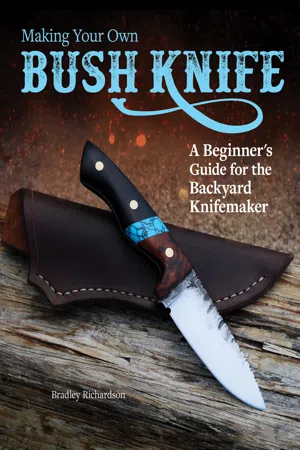
From outdoor excursions to everyday use at home, bush knives are practical tools with many uses. Now, you can make your own! Great for beginning knifemakers, learn the techniques of both stock removal and forging, and how to achieve great results with simple power tools or hand tools. Making Your Own Bush Knife will show you how to select the steel, forge it, quench it, and grind it into a usable knife. No need for all the expensive equipment and tons of space. With a small propane or coal forge in your backyard and just a few other pieces of equipment, discover and enjoy the craft of knifemaking! Author, outdoorsman, blacksmith, knifemaking instructor, and member of the American Bladesmith Society, Bradley Richardson is known for his high-quality custom knives and founded Timberlee Tool & Trade where sells his blades. He appeared in two seasons of the History Channel's show, Alone, where his expertise on knives proved to be vital and has over 19K YouTube subscribers .
eBook - ePub
Making Your Own Bush Knife
A Beginner's Guide for the Backyard Knifemaker
- 250 pages
- English
- ePUB (mobile friendly)
- Available on iOS & Android
eBook - ePub
About this book
Trusted by 375,005 students
Access to over 1 million titles for a fair monthly price.
Study more efficiently using our study tools.
Information
CHAPTER 1: THE STEEL
You can go ahead and make the most beautiful knife ever, but without the proper type of steel, you could be left with a paperweight and many hours of work down the drain. If you want a knife that will stay sharp, straight, and reliable, then it is extremely important to understand what types of steels are good for knifemaking.

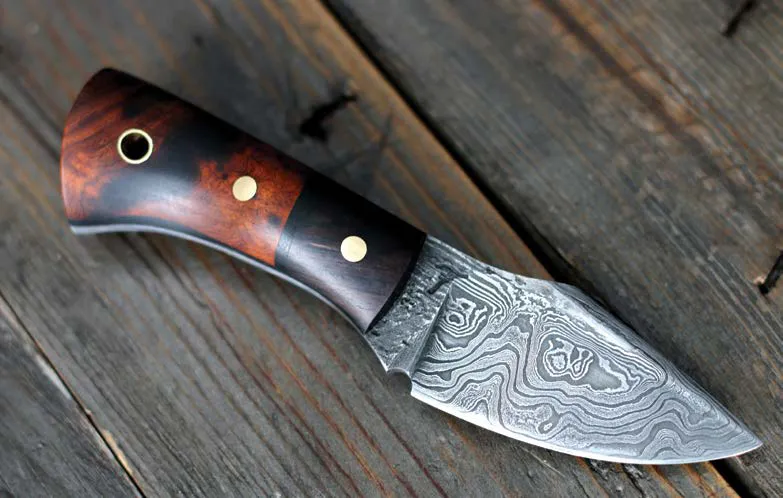
Damascus steel: the combination of high-carbon and nickel-bearing steels results in eye-catching patterns.
When choosing knife steel, you are looking for steel that is hard and tough. There’s a sweet spot between these two characteristics and that’s exactly where you want your steel to fall. A blade that is hard will have good edge retention and stay sharp for an extended period of time; a blade that is tough will withstand the abuse of heavy use.
Making a selection comes down to how you want your knife to perform. The steel you choose and your method of heat treatment (which I cover later on) will determine the hardness, toughness, wear resistance, corrosion resistance, and edge retention of your blade.
Steels with proper amounts of carbon are desirable to the knifemaker because the right carbon content allows the steel to be hardened. Hardening a blade provides the needed strength to survive impact and everyday use (and abuse). Using mild steel, which contains very low amounts of carbon, will result in a poorly performing blade. When using a material such as cast iron, where the carbon content is much higher than needed, you’ll again be left with a poorly performing blade.
Choosing your steel can seem overwhelming, and not just because the wrong choice may lead to complete disaster, but also because there are almost countless types of steels available.
I could write a separate book focused only on steel for the knifemaker. For this go-round, however, I’ll focus on the basics—everything you need to get started with steel. I’ll be categorizing knife steel into five groups: tool steel, high-carbon steel, stainless steel, Damascus steel, and recycled steel.

Take your time selecting steel. A bad steel choice can lead to blade failure and it’s not worth the headache. This blade was made using 80CRV2, which is a high-carbon chrome vanadium that is extremely tough.
Buying Steel
When purchasing steel from a manufacturer it will often be available in a variety of shapes and lengths. Most commonly, you’ll want to seek out flat-bar steel. This can be purchased at the desired width and thickness, saving you steps in the shaping process later on. Steel is also commonly found as round-stock or square-stock; these shapes will need to be flattened out to create a usable surface, so keep this in mind when selecting the size and shape of the steel you’re buying.
*These steels are my personal favorites for knifemaking.

Set of knives made from high-carbon steel.
High-Carbon Steel
Common in survival and outdoor knives, carbon steel has proven to be sturdy and durable. It takes an edge well and sharpens easily. The downfall is that it is more prone to rust and corrosion. In my opinion, this kind of steel is the best place to start as a new knifemaker. It usually comes with a lower price tag and, with a proper heat treatment, will hold up through a lot of use.
Common Types:
1095*
1084*
1080
1075
5160
1095*
1084*
1080
1075
5160
Tool Steel
The label “tool steel” represents a wide variety of carbon and alloy steels that have a distinct hardness and edge retention ideal for making tools. I’ve made many knives from tool steel. It can be a tough and very hard material. Even prior to hardening, I’ve had troubles drilling holes in tool steel without fully annealing or softening the steel. When heat-treated properly, tool steel will hold a great edge and outperform many other steels on the market.
Common Types:
D2
O1*
CPM Steels
A2
D2
O1*
CPM Steels
A2
Stainless Steel
Famous for its resistance to corrosion, stainless steel is made up of carbon steel and chromium. Chromium is what provides this steel with its corrosion resistance. It’s common to consider this a non-rusting steel but, in less than ideal conditions and with improper care, stainless steel will absolutely rust—think of it as “stains-less.” When compared to higher carbon steel, stainless can lack toughness and edge retention. Stainless steel is commonly found in kitchen knives, folding knives, and utility knives.
Common Types:
440
440C
AUS
154CM
440
440C
AUS
154CM
Damascus Steel
Damascus steel is made when multiple layers of metal have been laminated or forge-welded to create one homogenous piece. Oftentimes referred to as pattern welded steel, modern Damascus steel is generally made with the combination of high-carbon steel, such as 1084, and nickel-bearing steel, such as 15N20. The combination of these steels results in eye-catching patterns that are altered though folding, twisting, and other manipulations of the steel. The completed piece is then etched in an acid such as ferric chloride, which reveals the pattern by eating away the high-carbon steel and hardly reacting with the nickel-bearing steel.
Damascus was first produced over 2,000 years ago, with origins in ancient India. There are many different categories of Damascus steel, such as San Mai, mosaic Damascus, or canister Damascus. Making your own Damascus steel can be a very complex and time-consuming process, and it’s not something I’d recommend to a beginner in the craft. It requires very accurate levels of higher forge-welding temperatures, as well as a fluxing agent to help reduce scale buildup when the billet or layers of steel are heated. This is a more advanced process that I won’t go into detail here. Damascus steel can be purchased premade from some steel and knifemaking suppliers, but it usually comes with a higher price tag.
...Table of contents
- Cover
- Title
- Copyright
- Contents
- Gallery
- Introduction
- Chapter 1: The Steel
- Chapter 2: Designing & Profiling
- Chapter 3: The Cutting Edge
- Chapter 4: Preparing the Tang for a Handle
- Chapter 5: Hardening the Blade
- Chapter 6: Finishing the Blade
- Chapter 7: Choosing Handle Material
- Chapter 8: Attaching a Handle
- Chapter 9: Shaping the Handle
- Chapter 10: Proper Knife Care & Maintenance
- Knifemaking Terms
- Appendix: My Setup
- Photo Credits
- About the Author
Frequently asked questions
Yes, you can cancel anytime from the Subscription tab in your account settings on the Perlego website. Your subscription will stay active until the end of your current billing period. Learn how to cancel your subscription
No, books cannot be downloaded as external files, such as PDFs, for use outside of Perlego. However, you can download books within the Perlego app for offline reading on mobile or tablet. Learn how to download books offline
Perlego offers two plans: Essential and Complete
- Essential is ideal for learners and professionals who enjoy exploring a wide range of subjects. Access the Essential Library with 800,000+ trusted titles and best-sellers across business, personal growth, and the humanities. Includes unlimited reading time and Standard Read Aloud voice.
- Complete: Perfect for advanced learners and researchers needing full, unrestricted access. Unlock 1.4M+ books across hundreds of subjects, including academic and specialized titles. The Complete Plan also includes advanced features like Premium Read Aloud and Research Assistant.
We are an online textbook subscription service, where you can get access to an entire online library for less than the price of a single book per month. With over 1 million books across 990+ topics, we’ve got you covered! Learn about our mission
Look out for the read-aloud symbol on your next book to see if you can listen to it. The read-aloud tool reads text aloud for you, highlighting the text as it is being read. You can pause it, speed it up and slow it down. Learn more about Read Aloud
Yes! You can use the Perlego app on both iOS and Android devices to read anytime, anywhere — even offline. Perfect for commutes or when you’re on the go.
Please note we cannot support devices running on iOS 13 and Android 7 or earlier. Learn more about using the app
Please note we cannot support devices running on iOS 13 and Android 7 or earlier. Learn more about using the app
Yes, you can access Making Your Own Bush Knife by Bradley Richardson in PDF and/or ePUB format, as well as other popular books in Technology & Engineering & Technical & Manufacturing Trades. We have over one million books available in our catalogue for you to explore.