Modern mechanobiology converges both engineering and medicine to address personalized medicine. This book is built on the previously well-received edition, Hemodynamics and Mechanobiology of Endothelium. The central theme is "omic" approaches to mechanosignal transduction underlying tissue development, injury, and repair. A cadre of investigators has contributed to the chapters, enriching the interface between mechanobiology and precision medicine for personalized diagnosis and intervention. The book begins with the fundamental basis of vascular disease in response to hemodynamic shear stress and then details cardiovascular development and regeneration, valvular and cardiac morphogenesis, mechanosensitive microRNA and histone unfolding, computational fluid dynamics, and light-sheet imaging. This edition represents a paradigm shift from traditional biomechanics and signal transduction to transgenic models, including novel zebrafish and chick embryos, and targets a wider readership from academia to industry and government agencies in the field of mechanobiology.
eBook - ePub
Modern Mechanobiology
Convergence of Biomechanics, Development, and Genomics
- 250 pages
- English
- ePUB (mobile friendly)
- Available on iOS & Android
eBook - ePub
Modern Mechanobiology
Convergence of Biomechanics, Development, and Genomics
About this book
Trusted by 375,005 students
Access to over 1 million titles for a fair monthly price.
Study more efficiently using our study tools.
Information
Topic
MedicineSubtopic
Biotechnology in Medicine1.1 Introduction
Cardiovascular diseases caused by atherosclerosis represent the main cause of global morbidity and mortality [1, 2]. Atherosclerosis is a chronic inflammatory disease [3] and a focal disease in which atherosclerotic plaques preferentially developed in regions of disturbed/turbulent flow (such as arterial branching points, bifurcations, and inner curvature) but less in regions of laminar flow (such as thoracic aorta) [4–8]. Therefore, the development of atherosclerosis itself is heterogeneous, and this focal nature of atherosclerosis makes the study of different patterns of hemodynamic forces an effective therapeutic strategy to combat atherosclerosis.
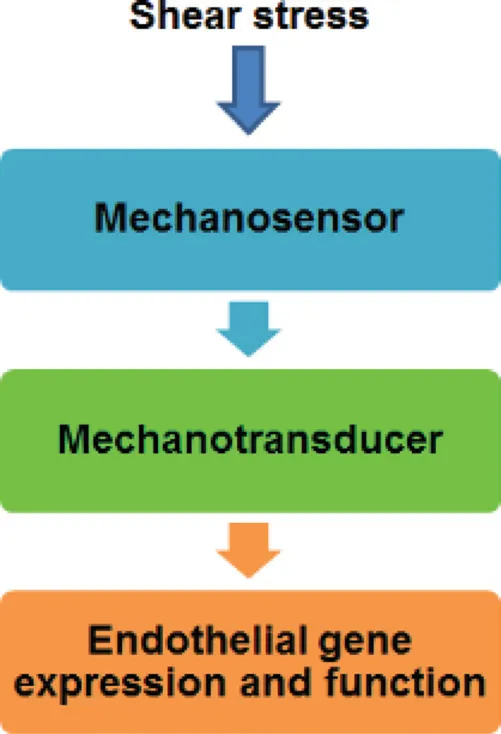
Figure 1.1 Mechanical regulation of endothelial gene expression. After exposure to different types of blood flow, the mechanical signal was sensed by mechanosensors existing on the endothelial cell membrane or specific microdomains. Then, the signal was further transduced to mechanotransducers, which relay the mechanosignal to the inside of endothelial cells. The eventual outcome is the activation or inhibition of gene expression program depending on specific transcriptional factors. By doing so, mechanosensors regulate important endothelial functions and the development of cardiovascular diseases.
Endothelial cells (ECs) are one major type of vascular cells. They line the intima by forming an endothelial monolayer, thereby separating circulating blood from human body [9]. In addition to being a natural barrier between blood components and vessel wall, they are the specific cell type that are in direct contact with blood flow and vessel wall. On the endothelial surface, there are many sensing molecules or microdomains that can serve as effective mechanosensors. They sense and transduce the mechanosignal exerted by shear stress to the inside of ECs. Dysfunctionality of these sensors leads to the alteration of endothelial pathways, gene expression, and endothelial functions, such as vascular tone, vessel stability, and leukocyte adhesion (Fig. 1.1). In this chapter, we provide a systematic overview of the up-to-date functions and mechanisms of different mechanosensors in mediating endothelial function and atherosclerosis. We also highlight future direction in mechanosensor-based studies, without an aim to accelerate cardiovascular drug discovery.
1.2 Shear Stress and Endothelial Phenotype
Generally, there are two major types of shear stress: one is the laminar flow and the other is disturbed flow. The different flow patterns were generated by different hemodynamic forces using different shear stress systems, such as plate viscometer, flow chamber, ibidi system, and other microfluidic systems. Mounting evidence in the past has shown that laminar flow protects against endothelial dysfunction and atherosclerosis, by promoting an endothelial protective and atheroprotective transcriptional program, mediated by transcriptional factors, such as Krüppel-like factor-2 (KLF2) [10–12], KLF4 [13–15], and Nrf21 [16]. In contrast, disturbed flow promotes endothelial dysfunction and atherosclerosis via atherogenic transcriptional factors, such as nuclear factor kappa light chain enhancer of activated B cells (NF-icB) [17], yes-associated protein (YAP) [18–20], and HIF12 [21, 22] (Fig. 1.2). Many drugs, such as statins [23, 24], resveratrol [24–26], tannic acids [27], and histone deacetylase inhibitor SAHA3 [28], mimic laminar flow response by upregulating KLF2 expression and activity. On the other hand, many proatherogenic factors, such as lipopolysaccharide (LPS) [29] and tumor necrosis factor-alpha (TNF-α) [30], mimic the disturbed flow– induced response by activating NF-x:B and downregulating KLF2 expression, suggesting the possibility of target mechanosensitive transcriptional factors modulating atherosclerosis.
_______________
1 Nuclear factor erythroid 2–related factor 2.
2 Hypoxia-inducible factor-1.

Figure 1.2 Focal development of atherosclerotic plaques in disturbed flow area, rather than the laminar flow area of the aorta. Two major hemodynamic forces exist in the vasculature: atheroprotective laminar flow and atheroprone disturbed flow. Two different types of blood flow elicit different gene expression patterns and transcriptional programs. Laminar flow leads to an antioxidant, anti-inflammatory, antiproliferative, and antiapoptotic program. The net effect of laminar flow is EC quiescence. In contrast, disturbed flow confers a proinflammatory, pro-oxidant, proproliferative response, and enhanced endothelial mesenchymal transition (EndoMT) in ECs, with the net effect of EC activation. Mitigating disturbed flow–mediated proatherogenic events or mimicking laminar flow–induced atheroprotective signaling could lead to the identification of novel therapeutic targets and strategies of atherosclerosis. Images were manually drawn using Microsoft PowerPoint.
_______________
3 Suberoyl+anili...
Table of contents
- Cover
- Half Title
- Title Page
- Copyright Page
- Table of Contents
- Preface
- 1. Shear Stress, Mechanosensors, and Atherosclerosis
- 2. Role of Krüppel-Like Factors in Endothelial Cell Function and Shear Stress–Mediated Vasoprotection
- 3. Aortic Valve Endothelium Mechanobiology
- 4. Mechanotransduction of Cardiovascular Development and Regeneration
- 5. Mechanotransduction in Heart Formation
- 6. Mechanotransduction in Cardiovascular Development and Regeneration: A Genetic Zebrafish Model
- 7. Mechanosensitive MicroRNAs in Health and Disease
- 8. Biomechanics in Cardiac Development Using 4D Light-Sheet Imaging
- Index
Frequently asked questions
Yes, you can cancel anytime from the Subscription tab in your account settings on the Perlego website. Your subscription will stay active until the end of your current billing period. Learn how to cancel your subscription
No, books cannot be downloaded as external files, such as PDFs, for use outside of Perlego. However, you can download books within the Perlego app for offline reading on mobile or tablet. Learn how to download books offline
Perlego offers two plans: Essential and Complete
- Essential is ideal for learners and professionals who enjoy exploring a wide range of subjects. Access the Essential Library with 800,000+ trusted titles and best-sellers across business, personal growth, and the humanities. Includes unlimited reading time and Standard Read Aloud voice.
- Complete: Perfect for advanced learners and researchers needing full, unrestricted access. Unlock 1.4M+ books across hundreds of subjects, including academic and specialized titles. The Complete Plan also includes advanced features like Premium Read Aloud and Research Assistant.
We are an online textbook subscription service, where you can get access to an entire online library for less than the price of a single book per month. With over 1 million books across 990+ topics, we’ve got you covered! Learn about our mission
Look out for the read-aloud symbol on your next book to see if you can listen to it. The read-aloud tool reads text aloud for you, highlighting the text as it is being read. You can pause it, speed it up and slow it down. Learn more about Read Aloud
Yes! You can use the Perlego app on both iOS and Android devices to read anytime, anywhere — even offline. Perfect for commutes or when you’re on the go.
Please note we cannot support devices running on iOS 13 and Android 7 or earlier. Learn more about using the app
Please note we cannot support devices running on iOS 13 and Android 7 or earlier. Learn more about using the app
Yes, you can access Modern Mechanobiology by Juhyun Lee, Sharon Gerecht, Hanjoong Jo, Tzung Hsiai, Juhyun Lee,Sharon Gerecht,Hanjoong Jo,Tzung Hsiai in PDF and/or ePUB format, as well as other popular books in Medicine & Biotechnology in Medicine. We have over one million books available in our catalogue for you to explore.