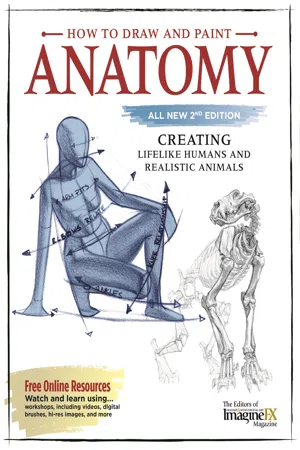
Understanding anatomy is the foundation of great art, and this new collection of workshops from the world's best professional artists enables artists of all levels to bring their work to life. How to Draw and Paint Anatomy, 2nd Edition is the complete artist's guide on how to draw the structures and forms of humans and animals in easy-to-follow steps. In this superb collection of human and animal anatomy workshops, the finest artists in the world share their essential figure-drawing techniques, to ensure that readers of all skill levels will create fantastic images every time. Art students, professional illustrators, and creative amateurs alike will find inspiration and encouragement to develop their core skills and embrace innovative digital techniques. This second edition is filled to the bursting point with the best anatomy advice around. Every page is packed with easy-to-follow, step-by-step guidance on how to create better human and creature figures, written and illustrated by professionals. Essentially, it's years of art college training, distilled into one place! Eight detailed workshops are devoted to drawing and painting the human body. They present easy ways to master the art of human anatomy, with practical advice from head to toe. Readers learn how to create basic forms, and improve figure drawings by establishing the underlying structure of the human body. Clear instructions are provided for depicting all of the most challenging areas, from feet, hands and torsos to legs, heads and arms. Six workshops provide practical guides to animal anatomy. Starting with the basic forms of beasts, they offer the building blocks for better animal art and creature design. The authors describe how to discern the shapes beneath skin and fur, revealing how the core of the animal body operates and how to use it to bring life to animal art. Readers find out what animal faces have in common with human faces, and the crucial ways in which they differ. An accompanying CD supports the anatomy and painting workshops with the opportunity to get closer to the annotated sketches, watch videos of anatomy drawing in action, and examine high-resolution art files that illustrate how develop digital software skills.
eBook - ePub
How to Draw and Paint Anatomy, All New 2nd Edition
Creating Lifelike Humans and Realistic Animals
- 250 pages
- English
- ePUB (mobile friendly)
- Available on iOS & Android
eBook - ePub
How to Draw and Paint Anatomy, All New 2nd Edition
Creating Lifelike Humans and Realistic Animals
About this book
Trusted by 375,005 students
Access to over 1.5 million titles for a fair monthly price.
Study more efficiently using our study tools.
Information
Drawing anatomy
Learn the simple shapes, forms, and structures to understand how to draw the human figure


“It’s important to understand how to draw the human figure, both in a static pose and in action.” (Ron Lemen)
Workshops
How to draw the human anatomy

Creating basic forms
Learn the body’s core shapes, forms, and basic structures to master drawing the human figure

Light and form sketching
Chris Legaspi shares some strategies for creating beautiful and believable lighting in your figure sketches

Get better at figure drawing
Patrick J. Jones shows us how to draw life from life-drawing workshops and turn them into fantasy masterpieces

How to draw imagined figures
Memorizing, observation, and structures of composition that will help you take your anatomy knowledge a step further

Compose multiple figures in a scene
Jack Bosson puts together an engaging crowd scene involving two dancers as the main center of interest

Draw the torso
With the figure framework in place, it’s time to focus on the core of the human body – the torso

Drawing the legs
Master your depiction of the limbs that drive the rest of the body — get these right and your figure will follow

Drawing feet
Discover how to use form to create solid-looking feet – and why you shouldn’t use too much detail when you draw them

Drawing the shoulder and upper arm
The complex interaction of muscles and anatomy’s guiding principles

Drawing the forearms
It may seem like a simple area of the body, but the forearm is more sophisticated – and elegant – than you suspect

Drawing the hands
Applying the principles you’ve learned to understand the anatomy, making the process much easier

Drawing the head
Break the skull and features into simple forms to get the proportions right, with Ron Lemen’s simple tutorial

Take an anatomy master class
Glenn Vilppu shows how focusing on the use of “icons” of basic rendering are the keys to creating expressive anatomy
CREATING BASIC FORMS
Improve the way you draw figures by learning easy ways to establish the underlying structure of the human body
If you want to illustrate stories or book covers, design conceptually for games, or draw storyboards, it’s vital to grasp the foundations of representational art. With most stories you’ll want to involve people; it’s key to understand how to draw the human figure, in a static pose and in action.
There are several techniques for drawing the human body, all leading to a similar goal: a three-dimensional, realistic figure. While it’s not necessary to be an expert on anatomy to produce illustrations, the more knowledge you have, the easier it will be to solve problems and reach clear-cut solutions for any drawing you make.
What you lack in the foundations of your knowledge will show up in your work – in other words, the lack of understanding of certain key principles will be all too apparent in your finished piece. An artist’s style can be reflective of a lack of understanding just as much as it can be a showcase for the total sum of his or her knowledge. Avoid that trap.

Figuring it out: two ways to draw
There are two distinct approaches to figure drawing: observational and formulaic. It pays to master both…

Learning to draw the human form can be a daunting prospect for any fledgling artist. Therefore, it’s important to know what methods are available to you. The two approaches to figure drawing that I feel to be distinct are the observational approach and the formulaic approach.
Observational drawing has its origins in the sight-size methodology, which trains the eye to view a subject with accuracy, placing the object and the drawing side by side for comparative analysis. Plumb lines, levels, a fixed point, and a measuring line are used to help the artist in understanding dimensional and spatial measuring.
Observational drawing is a complex process that requires a great deal of reference material to accompany the words to be fully explained. In this part of our anatomy workshop, I’m going to take a detailed look at two of my favored methods of formulaic drawing.
Formulaic figure drawing uses abstract rhythms or interlocking shapes – basically design concepts – to build on. Once these formulas are memorized by drawing from life, you have a set of tools to recall, enabling you to design from your imagination if you wish.
It’s important to have a solid understanding of both approaches if you truly want to be free as an artist. Observational drawing sharpens the eye and mind to capturing a likeness without using abstract concepts; formulaic drawing gives you a set of tools to develop both from life and, more importantly, from your mind’s eye.
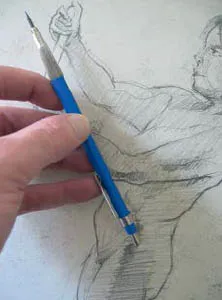
Observational drawing in practice: using a pencil to measure the body’s dimensions.
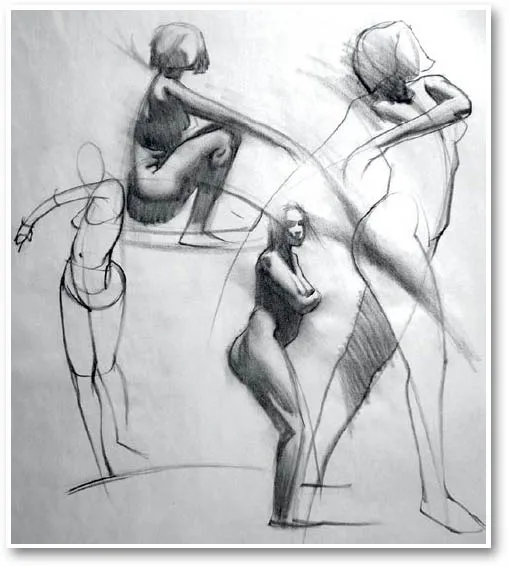
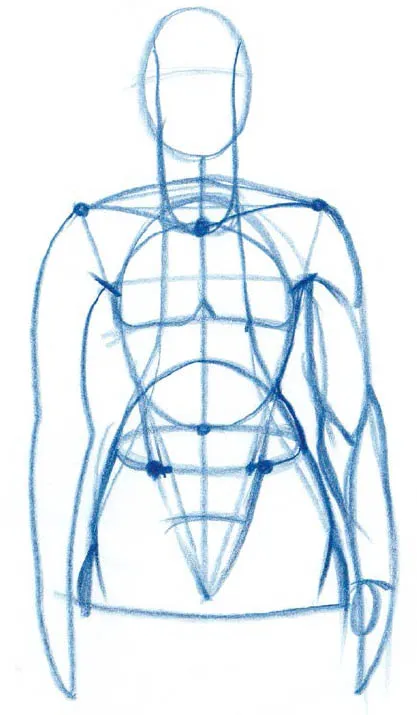
Formulaic figure drawing systems involve using abstract rhythms or, as shown here, interlocking shapes, to construct the human body. Those shapes can then be built upon and fleshed out for a full human figure.
1. REILLY’S SIX LINES TO THE TORSO

Here’s an illustrated guide to the Reilly method of drawing the human torso. Starting with the head, lines are systematically added to build a template that forms the basis of your figure.
Exploring the Reilly method for figures
In this drawing system, you build a framework of overlapping lines to create the basis of your figure
There are as many ways to construct a human figure as there are artists, but two systems in particular form the basis of many artists’ working practices. On here and here, you’ll explore the Industrial Design method; but first, let’s look at the Reilly method.
Frank Reilly was an illustrator and instructor in the early and mid-20th century. He created a system of teaching that enabled students to quickly and easily digest the problems of drawing and painting, giving abstract concepts labels and definable schematics, and building a noteworthy step-by-step c...
Table of contents
- Cover
- Title
- Copyrights
- Contents
- Drawing anatomy
- Muscle anatomy
- Movement anatomy
- Animal anatomy
- Digital art
- Artist Q&A: The digital tips and tricks of our artist panel
Frequently asked questions
Yes, you can cancel anytime from the Subscription tab in your account settings on the Perlego website. Your subscription will stay active until the end of your current billing period. Learn how to cancel your subscription
No, books cannot be downloaded as external files, such as PDFs, for use outside of Perlego. However, you can download books within the Perlego app for offline reading on mobile or tablet. Learn how to download books offline
Perlego offers two plans: Essential and Complete
- Essential is ideal for learners and professionals who enjoy exploring a wide range of subjects. Access the Essential Library with 800,000+ trusted titles and best-sellers across business, personal growth, and the humanities. Includes unlimited reading time and Standard Read Aloud voice.
- Complete: Perfect for advanced learners and researchers needing full, unrestricted access. Unlock 1.5M+ books across hundreds of subjects, including academic and specialized titles. The Complete Plan also includes advanced features like Premium Read Aloud and Research Assistant.
We are an online textbook subscription service, where you can get access to an entire online library for less than the price of a single book per month. With over 1.5 million books across 990+ topics, we’ve got you covered! Learn about our mission
Look out for the read-aloud symbol on your next book to see if you can listen to it. The read-aloud tool reads text aloud for you, highlighting the text as it is being read. You can pause it, speed it up and slow it down. Learn more about Read Aloud
Yes! You can use the Perlego app on both iOS and Android devices to read anytime, anywhere — even offline. Perfect for commutes or when you’re on the go.
Please note we cannot support devices running on iOS 13 and Android 7 or earlier. Learn more about using the app
Please note we cannot support devices running on iOS 13 and Android 7 or earlier. Learn more about using the app
Yes, you can access How to Draw and Paint Anatomy, All New 2nd Edition by Editors of ImagineFX Magazine in PDF and/or ePUB format, as well as other popular books in Art & Art General. We have over 1.5 million books available in our catalogue for you to explore.