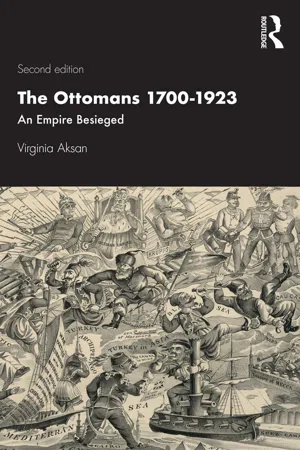
Originally conceived as a military history, this second edition completes the story of the Middle Eastern populations that underwent significant transformation in the nineteenth century, finally imploding in communal violence, paramilitary activity, and genocide after the Berlin Treaty of 1878.
Now called The Ottomans 1700-1923: An Empire Besieged, the book charts the evolution of a military system in the era of shrinking borders, global consciousness, financial collapse, and revolutionary fervour. The focus of the text is on those who fought, defended, and finally challenged the sultan and the system, leaving long-lasting legacies in the contemporary Middle East. Richly illustrated, the text is accompanied by brief portraits of the friends and foes of the Ottoman house.
Written by a foremost scholar of the Ottoman Empire and featuring illustrations that have not been seen in print before, this second edition is essential reading for both students and scholars of the Ottoman Empire, Ottoman society, military and political history, and Ottoman-European relations.
“War does not determine who is right—only who is left.” Attributed to Bertrand Russell
Empires rise and fall in violence. Nations too, arise from empires mired in violence and turn those catastrophes into national myths. Just over 100 years ago, the 600-year-old Ottoman Empire collapsed. The victorious powers, Entente partners Britain and France, along with the newly established League of Nations, immediately began deliberations concerning the future map of the Middle East. The lines of the map that finally emerged in the 1923 Treaty of Lausanne were the product of Britain and France’s thinly cloaked colonial ambitions for control of the remaining Ottoman territories in Anatolia, Mesopotamia, Greater Syria and the Hijaz. Their territorial negotiations were tempered by demands of the young nation states of Bulgaria, Serbia, Romania, and Greece, where unsolved borders and violence continued to be part of the legacy of the war settlements. So too the calls for self-determination of Armenians, Kurds and Arabs might have made for a different map, but it was not to be.
In the midst of these deliberations, while Britain was in occupation of Istanbul, home of the defeated Ottoman sultan, Greek and Ottoman/Turkish forces faced one another in a final thrust to determine sovereignty over Istanbul and the straits. Mustafa Kemal Atatürk (“father” of the Turks), and his nation under arms upended international expectations, drawing a new line around Anatolia, home to countless ancient civilizations, and declared it the homeland of the Turks. The practice of imaginary map-making based on ethnicity and sectarianism has continued since 1923 in the creation of some 40 countries that derive from the original Ottoman territories.
The Middle East/East Europe suffered more casualties (death, disease and wounded) than any other region of the world in that period. The United States’ losses in WWI amounted to 0.1% of its population, and Canada’s 0.8% to 0.9%; the United Kingdom and colonies lost 1.9% to 2.23% of their populations; Russia 1.6% to 1.9%; and Germany 3.3% to 4.32%. By contrast, Serbia lost 17 to 28%; Bulgaria 3.4%; Greece 3.0–3.7%; and Turkey and Arab countries, former Ottoman territories (now Syria, Lebanon, Egypt, Iraq etc.) suffered 13–15%. Behind those numbers is a story about the earliest constructions of the twentieth century’s system of international relations and humanitarian intervention.1
A passage from the London Observer on 18 November 1922, conveys the ongoing horror four years after the armistice that ended World War I:
It is estimated that more than a million bushels of human and inhuman bones were imported last year from the continent of Europe into the port of Hull. The neighborhood of Leipzig, Austerlitz, Waterloo, and of all the places where, during the late bloody war, the principal battles were fought, have been swept alike of the bones of the hero and the horse which he rode. Thus, collected from every quarter, they have been shipped to the port of Hull and thence forwarded to the Yorkshire bone grinders who have erected steam-engines and powerful machinery for the purpose of reducing them to a granularly state. In this condition they are sold to the farmers to manure their lands…. It is now ascertained beyond a doubt that upon actual experiment of an extensive scale, a dead soldier is a most valuable article of commerce, and for aught known to the contrary, the good farmers of Yorkshire are, in a great measure, indebted to the bones of their children for their daily bread.2
In its centennial years, historians of World War I have produced a plethora of new books. These new writings bring, in some instances, the Middle East battlefronts more directly into the story, moving beyond the great heroic tales of Gallipoli or of Lawrence of Arabia, which heretofore have served as the primary story of the Middle East from 1914 to 1918. Military historians now consider the 1912–1913 events in the Balkans—when the Ottomans fought Greece, Bulgaria and Serbia—as the crucible of WWI, equally as important as the assassination of Archduke Franz Ferdinand in Sarajevo on 28 June 1914 that prompted Austria to declare war on Serbia.
Enlightenment thinkers proposed that the civilizational, progressive teleology of human history was naturally tending toward an end of violence, and that wars were simply interruptions of a peaceful, rational society in the making. Historians have long tended to locate violence outside of historical projects, as military history in the Anglo-American tradition was mostly relegated to a space outside the academy (only nominally present in political history, sociology and philosophy courses). Writing modern military history was often given over to retired generals, whose reading of history included a grounding in the classical Greco-Roman military campaigns and celebrated military heroes as Alexander the Great. Campaign histories emphasizing regimental battles, strategy, and medals continue to be celebratory ways of justifying the sacrifice of generations of young people and the perpetuation of the relationship between conscripted military service and citizenship.
In historical narratives, wars and revolutions have persisted as world-turning, globe-stopping events, but the aptitude to violence is generally assigned to the losers. It is a cliché that the victors write history, but not less valid. Either the losers are presented as turning inwards on their own subjects, or they become militant, militaristic or barbaric, ethnically and religiously designated as innately violent.
For my generation, the Vietnam war upended many of most treasured assumptions about warfare, patriotism and humanitarianism. As with the Crimean War (1853–1856) and American Civil War (1861–1865), when citizens had daily news and pictures of battlefields for the first time, the horrors of the Vietnam War entered American living rooms viscerally as embedded photographers and journalists broke through the carefully scripted White House story of victory and just war. As World War I produced a generation of eulogies and critiques of the awfulness of death in Europe, so too the Vietnam debacle complicated the study of war by a plethora of remarkable literature by veterans. Witnesses to the pointlessness of such colonial wars, they spurred calls for social justice and equity that challenged narratives of good versus evil and civilized versus uncivilized.
Violence became a topic worth studying, considered part of the incomplete revolutions for equity and justice across world-wide spectrums of gender, race, and class. The study of violence in universities has been given further impetus in the past few decades, in part because of the unspeakable violence against peoples evident all over the globe, where neo-liberalism capitalism continues to disrupt relations between governments and citizens, resulting in spontaneous, often leaderless resistance and revolts.
The international human rights movement and genocide studies—both ongoing efforts to deal with the calamities of WWII—also suffered isolation from the academy in part because they were based in victimhood, and most often prompted by or investigated in United Nations organizations, supported by member states, philanthropic institutions, or private citizens groups. As Chris Hedges’ trenchant commentary demonstrates
The ethnic conflicts and insurgencies of our times, whether between Serbs and Muslims or Hutus and Tutsis, are not religious wars. They are not clashes between cultures or civilizations, nor are they the result of ancient ethnic hatreds. They are manufactured w...
Table of contents
Cover
Half Title
Series Page
Title Page
Copyright Page
Dedication
Contents
List of figures
List of maps
Acknowledgements
Chronology
Maps 0.1–0.5
Introduction
Part I: The Ottoman World pre-1800
Part II: The revolutionary moment 1800–1840
Part III: The new Muslim absolutism 1840–1870
Part IV: The final curtain: Imperial reordering and collapse 1870-1923
Epilogue 1914–1923
Glossary of places
Glossary of terms
Index
Frequently asked questions
Yes, you can cancel anytime from the Subscription tab in your account settings on the Perlego website. Your subscription will stay active until the end of your current billing period. Learn how to cancel your subscription
No, books cannot be downloaded as external files, such as PDFs, for use outside of Perlego. However, you can download books within the Perlego app for offline reading on mobile or tablet. Learn how to download books offline
Perlego offers two plans: Essential and Complete
Essential is ideal for learners and professionals who enjoy exploring a wide range of subjects. Access the Essential Library with 800,000+ trusted titles and best-sellers across business, personal growth, and the humanities. Includes unlimited reading time and Standard Read Aloud voice.
Complete: Perfect for advanced learners and researchers needing full, unrestricted access. Unlock 1.4M+ books across hundreds of subjects, including academic and specialized titles. The Complete Plan also includes advanced features like Premium Read Aloud and Research Assistant.
Both plans are available with monthly, semester, or annual billing cycles.
We are an online textbook subscription service, where you can get access to an entire online library for less than the price of a single book per month. With over 1 million books across 990+ topics, we’ve got you covered! Learn about our mission
Look out for the read-aloud symbol on your next book to see if you can listen to it. The read-aloud tool reads text aloud for you, highlighting the text as it is being read. You can pause it, speed it up and slow it down. Learn more about Read Aloud
Yes! You can use the Perlego app on both iOS and Android devices to read anytime, anywhere — even offline. Perfect for commutes or when you’re on the go. Please note we cannot support devices running on iOS 13 and Android 7 or earlier. Learn more about using the app
Yes, you can access The Ottomans 1700-1923 by Virginia Aksan in PDF and/or ePUB format, as well as other popular books in History & Middle Eastern History. We have over one million books available in our catalogue for you to explore.