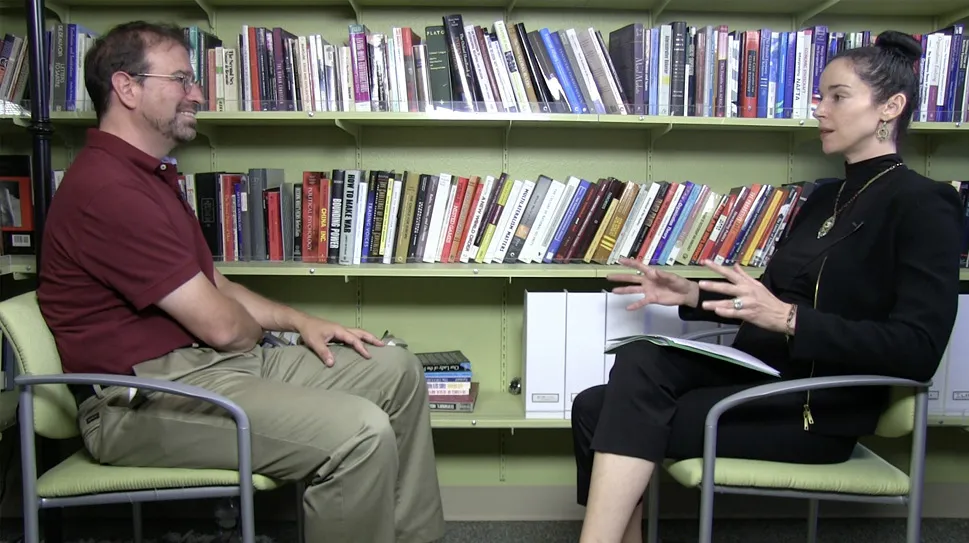
This book is based on an in-depth conversation between Howard Burton and Emilie Hafner-Burton, the John D. and Catherine T. MacArthur Professor of International Justice and Human Rights at UC San Diego and co-director of the Laboratory on International Law and Regulation at the School. This extensive conversation covers topics such international law, when and why international laws work and don't work, the international human rights system and concrete measures that could be taken to improve it, the International Criminal Court, and the role of states in the protection of human rights.This carefully-edited book includes an introduction, Making a Difference, and questions for discussion at the end of each chapter: I. Forging a Path - An unconventional route to the UNII. Shifting Perspectives - Considering the dataIII. Who Decides? - The perils of implementationIV. Going Public - Towards an open exchangeV. Fundamental Questions - Incentives and justificationsVI. The International Criminal Court - Past present and futureVII. Norm Saturation - Beyond rules and proceduresVIII. Reform - Marginal and non-marginal changesIX. Getting Concrete - Towards meaningful progressX. Stewardship - How states can have a positive impactXI. Reactions and Responses - Examining opposing viewsXII. Public Engagement - Media bias and joint opportunitiesAbout Ideas Roadshow Conversations Series: This book is part of a series of 100 Ideas Roadshow Conversations. Presented in an accessible, conversational format, Ideas Roadshow books not only explore frontline academic research featuring world-leading researchers, including 3 Nobel Laureates, but also reveal the inspirations and personal journeys behind the research.
- English
- ePUB (mobile friendly)
- Available on iOS & Android
eBook - ePub
Improving Human Rights - A Conversation with Emilie Hafner-Burton
About this book
Trusted by 375,005 students
Access to over 1.5 million titles for a fair monthly price.
Study more efficiently using our study tools.
Information
Subtopic
Criminal LawThe Conversation
I. Forging a Path
An unconventional route to the UN
HB: I’m going to start off by asking you about how you got into the field of human rights, but first I have a slightly different question prompted by reading about your personal history, which is, How on earth did you become a blacksmith?
EHB: Well, I’ll answer the blacksmith question first, and then I’ll tell you about human rights.
It was somewhat by accident. I did an undergraduate degree in philosophy and political science. I loved school, but I wanted to do something else on the side. I loved jewelry and I loved working with my hands.
One day, one of my best friends told me his father was a blacksmith. I thought, This is really interesting. I’d been working with gold and silver and precious metals. As a college student, I didn’t have any money at all. I had a scholarship to pay my way through school.
HB: Where did you go to school?
EHB: I went to a very small Jesuit university called Seattle University located in Capitol Hill, in Seattle. It was great.
Anyway, I thought, Why don’t I try working in steel, because it will be so much cheaper. How should I do this? So I called this father of a friend of mine, whom I had never met, and said, “I’m one of your son’s best friends. He tells me that you’re a blacksmith, and I’m interested.”
He said, “Okay, do you know how this works?”
And I replied, “I have no idea.”
HB: This was to make jewelry? Because, when I think of a blacksmith, I think of shoeing horses and stuff like that.
EHB: That’s a farrier. He did that too, but, while he didn’t call himself an artist, he was an extraordinary artist. He did large-scale fences—just amazing pieces of art. He was married to a woman who had an MFA and did goddess sculpture. He was doing horseshoes, machinery, and fences, and she was doing goddess sculpture.
He essentially said, “You move here, come to my shop, work for $10 an hour, sweep my floors, and I’ll teach you the trade.”
HB: You were an apprentice.
EHB: Exactly, I apprenticed with both of them over the summer and in the fall I went back to school. Then, the following summer, I went back and apprenticed again. I also apprenticed with a very funny guy who did Renaissance festivals, so he did all the blacksmithing but with the original tools—a coal forge instead of a gas forge, no power hammers, everything by hand, and so forth.
Then, when I finished my undergraduate degree, I wasn’t entirely certain what I wanted to do, but I had these skills. So I ended up working for a blacksmith shop for one year, full-time. I did blacksmithing. I did all the metal finishing. We did the interior of Bill Gates’ home, for example. This was large-scale, structural work. I was no longer making goddess sculptures and bracelets, and so forth. It was large-scale structural beds and chandeliers, and that kind of thing.
Eventually I came to the conclusion that—and I knew this in advance —that this wasn’t what I wanted to do for the rest of my life. So I made a career choice, which is ultimately how I got to human rights.
HB: I’d like to get to that of course, but just indulge me for a moment. I could imagine somebody doing a degree in philosophy and political science and then taking a bit of a turn and getting into this artisan world.
But then I can imagine naturally getting deeper and deeper into that world, as opposed to, all of the sudden, saying, “That’s enough,” or, “I’m not stimulating myself enough intellectually,” or what have you. What was going through your mind when you decided to make that change out of the blacksmithing world?
EHB: Many different things. My intellectual life is very important to me, and I had very little of it at that period of time. It was really fatiguing to do that job. I would get up at six o’clock in the morning, work physical, manual labour, come home at five o’clock exhausted, and the last thing I was going to do was pick up a philosophy book and think about Plato’s ruminations on the world. I missed that.
Another aspect of it was that I didn’t always enjoy serving the needs of people who would sometimes come in with crazy ideas. People would come to us with no appreciation for the art behind what we were doing, and they would ask us to match chandeliers to their client’s wallpaper, for example.
That was great fun for a year or so. It was a challenge to do that. I would make chests look like they had been under the ocean for 3,000 years, and that kind of thing. But, at the end of the day, it wasn’t my artistic creation: it was my handiwork facilitating someone else’s desires. It was great, but I got bored with that after a little while.
I didn’t always appreciate the aesthetic tastes of the clients I was serving, and I wanted to come home and do my own artwork, but I was so tired that I couldn’t do it. I didn’t spend my weekends doing my own sculpture; I spent my weekends recovering from the week. I was too exhausted to do it.
There was another part of it—which I did really appreciate, but was also glad to walk away from—which was that it was a world so different from anything that I knew. I spent my daily breakfast, lunch, and dinner with people whom I would never otherwise have had an opportunity to meet. Half of the shop, for example, were guys who had been fired from Boeing. They were metal fabricators.
Many of them were racist, homophobic people; people whom I would not have a drink with in a bar because our ideological visions were so different and our backgrounds were so different. I actually loved that for the time that I was working there because I was surrounded by such incredible differences. I learned a lot in that period of time.
On the other hand, at the end of a year, I was also pretty glad to remove myself from that environment. I’d learned enough.
It’s also the case that there are very few women in that world, and that became challenging for me after a particular period of time. So I gained a lot from it and then I knew that I was ready to leave.
HB: OK. Now I think I have a pretty clear picture of why you’d want to leave. But how did you end up in Geneva working for an NGO? It was an NGO, right?
EHB: I started at an NGO and then moved to a think tank. I knew I was going to make the transition. I didn’t know what I was going to do, but I knew I wanted to be in politics because that’s where my heart lay. I wasn’t entirely certain in what capacity, but I knew it was going to be global. I knew that I wanted to focus on something international.
So I literally went to the library and applied for every single job and fellowship that I could find. I scoured France, England, Switzerland, the United States—I scoured globally. I applied for dozens and dozens of positions, and I won an extraordinary fellowship.
It was a non-governmental organization, a women’s group dedicated to peace and disarmament. They hired me. They flew me to Geneva and they put me in charge of advocating for disarmament, especially in the area of non-proliferation.
The job involved going to the United Nations Office at Geneva (UNOG) where there was the conference on disarmament and various treaties were being negotiated. That’s where the Treaty on Non-Proliferation of Nuclear Weapons (NPT) is constantly being renegotiated. That’s where the first chemical weapons treaty was created—the Geneva Protocol—and so forth.
I would go to the conference and observe the proceedings. Then I would spend my evenings being invited to the various ambassadors’ homes and delegations where all of the actual work would occur. Everything is translated in the United Nations, so not much is happening during the actual proceedings: all the business happens at the end of the day....
Table of contents
- A Note on the Text
- Introduction
- The Conversation
- Continuing the Conversation
Frequently asked questions
Yes, you can cancel anytime from the Subscription tab in your account settings on the Perlego website. Your subscription will stay active until the end of your current billing period. Learn how to cancel your subscription
No, books cannot be downloaded as external files, such as PDFs, for use outside of Perlego. However, you can download books within the Perlego app for offline reading on mobile or tablet. Learn how to download books offline
Perlego offers two plans: Essential and Complete
- Essential is ideal for learners and professionals who enjoy exploring a wide range of subjects. Access the Essential Library with 800,000+ trusted titles and best-sellers across business, personal growth, and the humanities. Includes unlimited reading time and Standard Read Aloud voice.
- Complete: Perfect for advanced learners and researchers needing full, unrestricted access. Unlock 1.5M+ books across hundreds of subjects, including academic and specialized titles. The Complete Plan also includes advanced features like Premium Read Aloud and Research Assistant.
We are an online textbook subscription service, where you can get access to an entire online library for less than the price of a single book per month. With over 1.5 million books across 990+ topics, we’ve got you covered! Learn about our mission
Look out for the read-aloud symbol on your next book to see if you can listen to it. The read-aloud tool reads text aloud for you, highlighting the text as it is being read. You can pause it, speed it up and slow it down. Learn more about Read Aloud
Yes! You can use the Perlego app on both iOS and Android devices to read anytime, anywhere — even offline. Perfect for commutes or when you’re on the go.
Please note we cannot support devices running on iOS 13 and Android 7 or earlier. Learn more about using the app
Please note we cannot support devices running on iOS 13 and Android 7 or earlier. Learn more about using the app
Yes, you can access Improving Human Rights - A Conversation with Emilie Hafner-Burton by Howard Burton in PDF and/or ePUB format, as well as other popular books in Politics & International Relations & Criminal Law. We have over 1.5 million books available in our catalogue for you to explore.