Develop your skills in evaluation and dental treatment planning for all types of patients! Diagnosis and Treatment Planning in Dentistry, 3rd Edition provides a full-color guide to creating treatment plans based on a comprehensive patient assessment. Using evidence-based research, this book shows how risk assessment, prognosis, and expected treatment outcomes factor into the planning process. New chapters cover patient diagnosis and team-based treatment planning, and a new Evolve website includes videos and decision-making algorithms. Written by experienced dentistry educators Stephen Stefanac and Samuel Nesbit, this book is the only dental resource that combines patient examination and oral diagnosis with treatment planning.- Clear, logical organization builds your understanding with sections on comprehensive patient evaluation, key treatment planning concepts, a detailed review of the five phases of planning treatment and guidelines for selecting the appropriate plan of care, and care planning for patients with special needs.- In Clinical Practice boxes highlight situations that may be faced by the general dentist.- What's the Evidence? boxes cite research articles affecting clinical decision-making and treatment planning strategies.- Ethics in Dentistry boxes address ethical issues you may encounter in treatment planning.- Review exercises in each chapter let you apply concepts to clinical practice.- Expert authors and contributors provide a current, authoritative resource for effective treatment planning.- Key Terms and a Glossary highlight and define important terminology.- Evidence-based coverage demonstrates how to use research and clinical evidence in making treatment planning decisions.- NEW Common Diagnoses in Dentistry chapter provides guidelines to making an accurate patient diagnosis prior to beginning treatment.- NEW Interprofessional Treatment Planning chapter describes dental care in the context of a team-based collaborative approach, so that the dental treatment plan aligns with the overall treatment goals of the patient.- NEW! Full-color photographs illustrate clinical principles and pathologies, and a colorful design highlights key content.- Updated content reflects advances in dental techniques, materials, and patient treatment options based on research, clinical experience, and current literature.- NEW resources on an Evolve website include videos and decision-making algorithms.
eBook - ePub
Diagnosis and Treatment Planning in Dentistry - E-Book
Diagnosis and Treatment Planning in Dentistry - E-Book
- 459 pages
- English
- ePUB (mobile friendly)
- Available on iOS & Android
eBook - ePub
Diagnosis and Treatment Planning in Dentistry - E-Book
Diagnosis and Treatment Planning in Dentistry - E-Book
About this book
Trusted by 375,005 students
Access to over 1.5 million titles for a fair monthly price.
Study more efficiently using our study tools.
Section 1
Patient Examination and Diagnosis
Outline
1. Patient evaluation and assessment
2. Common diagnoses in dentistry
Chapter 1
Patient evaluation and assessment
Stephen J. Stefanac, Margherita Fontana

Accurate diagnostic information forms the foundation of any treatment plan. This information comes from several sources: the patient history and physical examination, the clinical and radiographic examination, and other diagnostic sources. The dentist must critically analyze the information before recommending treatment options to the patient. The goal of this chapter is to discuss both the types of data that the dentist in general practice typically collects and the ways in which the dentist evaluates and documents this information in preparation for creating a treatment plan. There are several types of examinations (Box 1-1), and the focus of this chapter is on the comprehensive assessment of a patient.
Overview of the diagnostic process
The diagnostic process is begun by gathering information about the patient and creating a patient database that will serve as the basis for all future patient care decisions. Although the components of each patient’s database vary, each includes pieces of relatively standard information, or findings, that come from asking questions, reviewing information on forms, observing and examining structures, performing diagnostic tests, and consulting with physicians and other dentists.
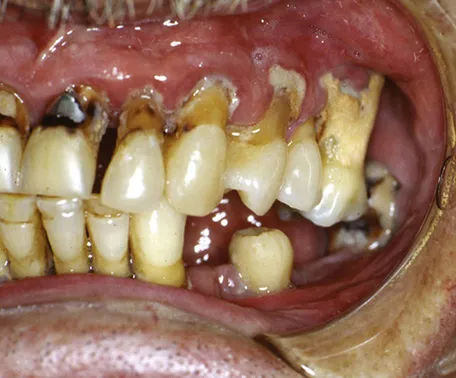
Findings fall into several categories. Signs are findings discovered by the dentist during an examination. For instance, the practitioner may observe that a patient has swollen ankles and difficulty in breathing when reclined, signs suggestive of congestive heart failure. Findings verbally revealed by the patients themselves, usually because they are causing problems, are referred to as symptoms. Patients may report such common symptoms as pain, swelling, broken teeth, loose teeth, bleeding gums, or esthetic concerns. When a symptom becomes the motivating factor for a patient to seek dental treatment, it is referred to as the chief complaint or chief concern. Patients who are new to a practice or presenting for emergency dental care often have one or more chief concerns (Figure 1-1).
The clinician must evaluate findings individually and in conjunction with other findings to determine whether the finding is significant. For example, the finding that a patient is being treated for hypertension may be not be significant alone, but when accompanied by another finding of blood pressure measuring 180/110 mm Hg, the level of importance of the first finding increases. Questions arise as to whether the patient’s hypertension is being managed appropriately or whether the patient is even taking the prescribed medication regularly. Obviously, further questioning of the patient is in order, generating even more findings to evaluate for significance. The process of differentiating significant from insignificant findings can be challenging for dental students and recent graduates. For example, a student may believe a dark s...
Table of contents
- Cover image
- Title page
- Disclaimer
- Table of Contents
- Copyright
- Contributors
- Dedication
- Preface
- About evolve
- Acknowledgments
- 1. Patient Examination and Diagnosis
- 2. The Treatment Planning Process
- 3. Phases of the Treatment Plan
- 4. Planning Treatment for Unique Patient Populations
- Glossary
- Index
Frequently asked questions
Yes, you can cancel anytime from the Subscription tab in your account settings on the Perlego website. Your subscription will stay active until the end of your current billing period. Learn how to cancel your subscription
No, books cannot be downloaded as external files, such as PDFs, for use outside of Perlego. However, you can download books within the Perlego app for offline reading on mobile or tablet. Learn how to download books offline
We are an online textbook subscription service, where you can get access to an entire online library for less than the price of a single book per month. With over 1.5 million books across 990+ topics, we’ve got you covered! Learn about our mission
Look out for the read-aloud symbol on your next book to see if you can listen to it. The read-aloud tool reads text aloud for you, highlighting the text as it is being read. You can pause it, speed it up and slow it down. Learn more about Read Aloud
Yes! You can use the Perlego app on both iOS and Android devices to read anytime, anywhere — even offline. Perfect for commutes or when you’re on the go.
Please note we cannot support devices running on iOS 13 and Android 7 or earlier. Learn more about using the app
Please note we cannot support devices running on iOS 13 and Android 7 or earlier. Learn more about using the app
Yes, you can access Diagnosis and Treatment Planning in Dentistry - E-Book by Stephen J. Stefanac,Samuel P. Nesbit in PDF and/or ePUB format, as well as other popular books in Medicine & Dentistry. We have over 1.5 million books available in our catalogue for you to explore.