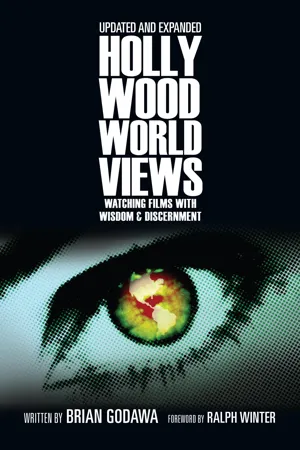
Do you watch movies with your eyes open?You buy your tickets and concessions, and you walk into the theater. Celluloid images flash at twenty-four frames per second, and the hypnotic sequence of moving pictures coaxes you to suspend disbelief andbe entertained by the implausible.Unfortunately, many often suspend their beliefs as well, succumbing to subtle lessons in how to behave, think and even perceive reality. Do you find yourself hoping that a sister will succeed in seducing her sibling's husband, that a thief will get away with his crime, that a serial killer will escape judgment? Do you, too, laugh at the bumbling priest and seethe at the intolerant and abusive evangelist? Do you embrace worldviews that infect your faith and wonder, after your head is clear, whether your faith can survive the infection?Brian Godawa guides you through the place of redemption in film, the tricks screenwriters use to communicate their messages, and the mental and spiritual discipline required for watching movies. Hollywood Worldviews helps you enter a dialogue with Hollywood that leads to a happier ending, one that keeps you aware of your culture and awake to your faith.
- 261 pages
- English
- ePUB (mobile friendly)
- Available on iOS & Android
eBook - ePub
About this book
Trusted by 375,005 students
Access to over 1.5 million titles for a fair monthly price.
Study more efficiently using our study tools.
Information

WORLDVIEWS IN THE MOVIES

EXISTENTIALISM
Many people consider philosophy to be irrelevant to our everyday lives: it is something practiced by academic eggheads in remote ivory towers, but certainly not something that results in practical living or “real life.”
Contrary to this negative perception, the late Francis Schaeffer often pointed out that philosophy, though considered irrelevant by many people, was often a pertinent driving force of culture. The ideas generated by academic thinkers filter down through the high arts into the popular arts and are thus consumed by the masses, often without self-conscious recognition of their philosophical nature.1
People may not call their philosophical beliefs by their academic names of metaphysics (reality), epistemology (knowledge) and ethics (morality), but they operate upon them nevertheless. When a person says that someone ought not to butt in line at a movie theater (ethics) because everyone knows (epistemology) that “first come, first served” is the way the world works and that “what goes around, comes around” (metaphysics), then knowingly or unknowingly she is expressing a philosophy. When a kid watches the animated movie Shrek, he probably doesn’t know about Carl Jung’s theories of psychological types and the collective unconscious, but he is ingesting them nonetheless through those characters and that story adapted after the Jungian model.2
Everybody operates upon a philosophy in life, a worldview that defines for them the way the world works and how they know things and how they ought to behave. So philosophy is ultimately a practical reality for all of us. In this sense, everyone is a philosopher; some are just more aware of it than others.
One of the dominant influences on movies today is the philosophy of existentialism. In order to understand this influence, it is helpful to see the philosophy in its historical origins and context. In Postmodern Times: A Christian Guide to Contemporary Thought and Culture, Gene Edward Veith Jr. gives a brief outline to historical stages of thought in our Western civilization in order to show us how we got where we are now. He explains that the “premodern” phase, which included the Greek, Roman and early Christian empires, was marked by a recognition that reality was created and sustained by a supernatural realm beyond the senses. People believed in the supernatural and considered themselves subservient to it.3
By the 1700s, with the rise of the Renaissance culminating in the Enlightenment, society became “modern.” That is, it began to see religion as ignorant, magical interpretations of a universe that is actually generated and sustained by naturalistic, machinelike laws, understood without any relation to deity. Enlightenment was the self-designation by this generation of humanists, who perceived the previous medieval era to be the “Dark Ages” precisely because religion was the dominant worldview, the “queen of the sciences.” So their prejudices produced the oppressive term “Dark Ages,” which served to demonize their enemies. The socalled Age of Reason was marked by naturalistic science and autonomous reason as absolute tools for truth. Man was the measure of all things, and reason was his god.4
Voices of dissent against the juggernaut of Enlightenment tradition were raised in the Romanticism of the early nineteenth century. And Romantic ideas became the seeds of our current postmodern condition. As Veith explains,
Whereas the Enlightenment assumed that reason is the most important human faculty, romanticism assumed that emotion is at the essence of our humanness. The romantics exalted the individual over impersonal, abstract systems. Self-fulfillment, not practicality was the basis for morality. . . . Romantics criticized “civilization” as reflecting the artificial abstractions of the human intellect. Children are born free, innocent, and one with nature. “Society” then corrupts them with the bonds of civilization. . . . Romanticism cultivated subjectivity, personal experience, irrationalism, and intense emotion. . . . The romantics drew on Kant, who argued that the external world owes its very shape and structure to the organizing power of the human mind, which imposes order on the chaotic data of the senses. Some romantics took this to imply that the self, in effect, is the creator of the universe.5
Within this romantic milieu, existentialism was born.
A NECESSARILY OVERSIMPLIFIED BRIEF INTRODUCTION TO EXISTENTIALISM
Existentialism is a worldview that has many heads. So many varieties exist that it would take a book to define them all. There are even religious forms of existentialism to which some Christians lay claim. Famous translator and historian of existentialist philosophy Walter Kaufmann sums it up:
Existentialism is not a school of thought nor reducible to any set of tenets . . . . The refusal to belong to any school of thought, the repudiation of the adequacy of any body of beliefs whatever, and especially of systems, and a marked dissatisfaction with traditional philosophy as superficial, academic, and remote from life—that is the heart of existentialism.6
Though some of the best-known modern thinkers who have espoused existentialism are Jean-Paul Sartre, Albert Camus and Karl Jaspers,7 its roots can largely be traced back to two men: Søren Kierkegaard (1813-1855), a Christian, and Friedrich Nietzsche (1844-1900), an atheist. We will address some of the specific beliefs of these men later in relation to particular films. For now I would like to focus on three emphases of the existential worldview in films today: (1) chance over destiny, (2) freedom over rules and (3) action over contemplation.
CHANCE OVER DESTINY
Existentialism accepts the Enlightenment notion of an eternally existing materialistic universe with no underlying meaning or purpose. While it does not deny the laws of nature, it sees these laws as order without purpose or meaning. This is what “the death of God” concept means—God does not “die” in the traditional sense, rather he ceases to be relevant because, without meaning behind the universe, the concept of God is unnecessary.8
The universe may be uniform, but its uniformity appears to our human perspective as a product of chance. And chance ultimately defies any notion of destiny or a fixed purpose toward which things are headed. Within our human perspective, anything, in this sense, is ultimately possible.
With the advent of quantum physics, the notion of chance as the underlying reality of our mechanistic universe has become even more fashionable. The uniformity of nature then becomes something that the mind imposes on a chaotic universe. Since this universe has no inherent meaning, we lead ourselves to despair (angst) if we try to find any meaning within it. The mechanical cause-and-effect universe does not fit our human desires and thus appears to us as absurd.
Forrest Gump and its predecessor Being There are both popular movies that communicate the idea of a chance world in which events occur without purpose. The use of mentally challenged men in both films is a metaphor for chance itself. They have no “intelligent design” to their lives, and yet both of them become important figures in history without even realizing it.
In Being There Chance the gardener (a name chosen without coincidence) influences the president of the United States because Chance’s simple-minded regurgitations of television platitudes are misinterpreted by accident as profound mysteries of genius. Forrest Gump has basically the same effect, with a simple-minded Forrest changing American history without even knowing it in a virtual exploration of the dual opposites of chance and destiny.
The title for the movie Being There is an English translation of the German word dasein, used by German existentialist Martin Heidegger (1889-1976) to define a human being as a field of probability, as opposed to the rationalist view of us as clear and distinct entities. At the last shot of Being There, just when we think there is some rational explanation for why this simple man has attained such status and impact on the world, he walks away from us on the surface of a lake—an allusion to the concept that mindless chance does in fact mysteriously guide the universe, like a god.
Lawrence Kasdan’s Grand Canyon is another strong picture of a chance-ruled universe. In the very first scene Steve Martin’s character, a Hollywood director of mindless, violent action movies, tells Kevin Kline’s character, Mack, “Nothing can be controlled. We live in chaos, the central issue in everyone’s life.” This sets the stage for the rest of the movie, which is filled with the random evils of life. Police search helicopters and siren-screaming ambulances (symbols of the chaos) are ubiquitously in the background. The film concludes with one character’s personal vision of standing on the edge of the Grand Canyon, where “we realize what a big joke we all are, our big heads thinking what we do is going to matter all that much.” His conclusion is that we are all like gnats that land on the rump of a cow chewing its cud next to a road you ride by at seventy miles an hour. A pretty concise summary of the existential dilemma of meaninglessness (absurdity).
As in Heidegger’s “being unto death,” Sartre’s “nausea” and Kierkegaard’s “crisis of dread,” these characters, through their near-death experiences, face the anxiety of their meaningless existence. And this is what the existentialist term “dread” (angst) means. It is not merely fear itself or a specific fear, even of death, but rather the general, overwhelming revelation of the meaninglessness of our existence. A specific encounter with death merely triggers this self-revelation.
The characters at moments wonder if all the chance happenings are miracles or messages from somewhere, maybe even sent by angels. But no answer is forthcoming from the supernatural. God is silent, because he is dead. They struggle with trying to make sense out of the pain and suffering in their lives but can ultimately find no rational answer. Fate and luck are ultimately what they believe in, condemning them to freedom in a random universe. Only by making individual choices to love other human beings do the characters find personal redemption in the midst of chaos. It is through their choices that they free themselves.
The existentialist writer Albert Camus wrote of the Greek myth of Sisyphus, condemned to endlessly rolling a stone up a hill, only to have it roll back down again. He says of this quest that “his passion for life won him that unspeakable penalty in which the whole being is exerted in accomplishing nothing.”9 That realization of insignificance becomes an important impetus for the existentialist storyteller.
Written by Zach Helm, Stranger Than Fiction embodies the eternal struggle of the existentialist to find meaning in an absurd universe of natural law and freedom from controlling destiny. Harold Crick (played by Will Ferrell) is an IRS auditor whose life has become a monotonous repetition of the same thing over and over (Sisyphus, anyone?). One day he hears a voice narrating his life with extraordinary accuracy, as if it were a novel. And only he can hear the voice. He visits a professor of literature (Dustin Hoffman), who tries to figure out if Harold’s story is a comedy or a tragedy. When Harold discovers that the voice is that of a famous tragedist, Karen Eiffel (played by Emma Thompson), he realizes that the new novel she is writing is somehow the life he is living. But when the narrator reveals that he is going to die in a freak accident (chance), he has an existential crisis of dread. He watches nature documentary programs on TV that reinforce his dilemma. The documentary speaks of a seagull being attacked by fiddler crabs, “The wounded bird knows its fate. Its desperate attempts to escape only underscores the hopelessness of its plight”—illustrating Harold’s own dread to a T.
The lit professor tells Harold to accept his death because it result...
Table of contents
- Cover
- Title Page
- Dedication Page
- Contents
- Foreword
- Preface: God loves movies
- Introduction
- Act One: Storytelling in the movies
- Act Two: Worldviews in the movies
- Act Three: Spirituality in the movies
- Dénouement: Watching movies with eyes wide open
- Index
- Notes
- Praise for Hollywood Worldviews
- About the Author
- More Titles from InterVarsity Press
- Copyright Page
Frequently asked questions
Yes, you can cancel anytime from the Subscription tab in your account settings on the Perlego website. Your subscription will stay active until the end of your current billing period. Learn how to cancel your subscription
No, books cannot be downloaded as external files, such as PDFs, for use outside of Perlego. However, you can download books within the Perlego app for offline reading on mobile or tablet. Learn how to download books offline
Perlego offers two plans: Essential and Complete
- Essential is ideal for learners and professionals who enjoy exploring a wide range of subjects. Access the Essential Library with 800,000+ trusted titles and best-sellers across business, personal growth, and the humanities. Includes unlimited reading time and Standard Read Aloud voice.
- Complete: Perfect for advanced learners and researchers needing full, unrestricted access. Unlock 1.5M+ books across hundreds of subjects, including academic and specialized titles. The Complete Plan also includes advanced features like Premium Read Aloud and Research Assistant.
We are an online textbook subscription service, where you can get access to an entire online library for less than the price of a single book per month. With over 1.5 million books across 990+ topics, we’ve got you covered! Learn about our mission
Look out for the read-aloud symbol on your next book to see if you can listen to it. The read-aloud tool reads text aloud for you, highlighting the text as it is being read. You can pause it, speed it up and slow it down. Learn more about Read Aloud
Yes! You can use the Perlego app on both iOS and Android devices to read anytime, anywhere — even offline. Perfect for commutes or when you’re on the go.
Please note we cannot support devices running on iOS 13 and Android 7 or earlier. Learn more about using the app
Please note we cannot support devices running on iOS 13 and Android 7 or earlier. Learn more about using the app
Yes, you can access Hollywood Worldviews by Brian Godawa in PDF and/or ePUB format, as well as other popular books in Theology & Religion & Literature & the Arts in Christianity. We have over 1.5 million books available in our catalogue for you to explore.