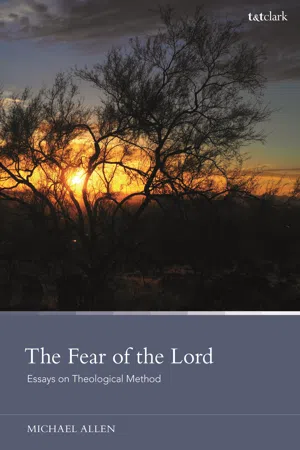
This volume examines what it means to proceed in the path of wisdom by beginning with fear of God, that is, mindfulness always and everywhere of God's being and presence.
Michael Allen describes the praxis of fearing the Lord, how that posture of contemplative pursuit marks the theological task and defines our theological method; in so doing it takes up the significant topics of divine revelation, theological exegesis, intellectual asceticism, and retrieval/ressourcement from a distinctly doctrinal perspective. In each of these conversations, doing theology in the presence of God functions as a consistent thread. God is not mere object but truly functions as subject in the process of theological growth, though God's presence and agency fund rather than negate creaturely theological responsibility.
The Fear of the Lord: Essays on Theological Method explores some of the most central questions of contemporary theological method – revelation, Scripture, theological interpretation, retrieval, intellectual asceticism, scholastic method – by asking in each and every case what it means to think fundamentally of the perfect and present God involved and active in these spheres.
- 224 pages
- English
- ePUB (mobile friendly)
- Available on iOS & Android
eBook - ePub
About this book
Trusted by 375,005 students
Access to over 1.5 million titles for a fair monthly price.
Study more efficiently using our study tools.
Information
Chapter 1
“IN YOUR LIGHT DO WE SEE LIGHT”: THE FUTURE AND THE PROMISE OF THEOLOGY
Theology and the Future
The future is uncertain for so many things. Pundits and predictions fail left and right. The Scriptures should have prepared us for such: “Come now, you who say, ‘Today or tomorrow we will go into such and such a town and spend a year there and trade and make a profit’—yet you do not know what tomorrow will bring. What is your life? For you are a mist that appears for a little time and then vanishes” (Jas. 4.13-14). The mist appears; then like vapor (the very “vanity of vanities” in Ecclesiastes) it vanishes. No, the future is not certain.
Yet the future is bright for theology. By theology I adopt a definition roughly similar to that of Thomas Aquinas, who believed this intellectual study to involve God and the works of God (or, otherwise put, all things in relation to God).1 This kind of reflection has a promising future, where the complexities of modern life will need to be viewed in light of God’s luminosity and the challenges of humanity will require consideration from the perspective of God’s truth.
The path of theology in the future is not owing to the intellectual sophistication or moral fortitude of theologians. A scan of the theological field over the last several decades includes a number of movements or emphases that have come and gone (e.g., the death of God theology). There have been hopeless detours and hapless mistakes, and even the most faithful of theologians err in their listening and testifying to God’s Word. Theology is always done East of Eden. The promise and potential of theology, then, cannot be premised on institutional vitality, academic sophistication, moral clarity, or ecclesial power alone.
The promise of theology follows from the electing love of the triune God. “How precious is your steadfast love, O God! The children of mankind take refuge in the shadow of your wings. They feast on the abundance of your house, and you give them drink from the river of your delights. For with you is the fountain of life; in your light do we see light” (Ps. 36.7-9). God is “the fountain of life”—“in his presence is fullness of joy; at his right hand are pleasures forevermore” (Ps. 16.11). The rest we find in God involves his illumining work that we might see and know both him and life in him: “you will show me the path of life” (Ps. 16.11); “in your light do we see light” (Ps. 36.9). God brings life and light to our world—humans have hope not only for existence but for knowledge being gained and truth being known.
The goodness of the triune God gives promise and a future to theology. It is of this glorious one that we say “in your light do we see light.” The potential of human knowledge of God is entirely premised on the gratuity of God. We live in an ek-centric fashion, wherein we constantly receive life from the outside and live on borrowed breath. More specifically, we might say that we live in light of the resurrection of Jesus Christ. He is alive and luminous: in his light we do see light. As John Webster has reminded us: “He is that from which we move, not that towards which we strive; he is not that which we posit (rationally, experientially), but the one whose unqualified self-existence posits us.”2 This Word is “living and active”.3 Karl Barth spoke of him as “eloquent and radiant,” reminding us that he compels with beauty, truth, and goodness.4
Not only does theology have a future because of the triune God but theology can help shape the human future more broadly. “Nature commends grace; grace emends nature.”5 The communicative presence of God brings grace, and this grace transforms or transfigures human creatureliness in its particularity and specificity. Herman Bavinck expands on this idea: “Human beings are in every respect dependent on the world outside of them. In no area are we autonomous; we live by what is given, i.e., by grace. But, reciprocally, we are made and designed for that whole world outside of us and connected to it by a whole spectrum of relations.”6 Theology points to the ways in which God’s grace renews humans.
Theology does so instrumentally: serving as a prompt and aid to the church’s testimony to the life-giving gospel of Jesus. It is Christian testimony in worship and witness that is the church’s primary calling. Theology serves as a critical tool meant to render this testimony more faithful and, hence, effective. The distinction between first- and second-order language proves helpful here: while the praise and proclamation of the church is first-order language, the tools of theological analysis are second-order language meant to help critique and commend the church’s primary calling.
A primary way in which theology will serve the church is by offering critique of idolatry. Nicholas Lash views doctrine in this way: “one of the principal functions of doctrine, as regulative of Christian speech and action, would be to help protect correct reference, by disciplining our manifold propensity toward idolatry.”7 Lash further identified this “stripping away of the veils of self-assurance by which we seek to protect our faces from exposure to the mystery of God’ as the prompt for viewing theology as a critical practice.”8 Idolatry is nothing new—Israel of old and the ekklēsia of today are lured into its traps. Theological reflection serves as a prophetic check to this tendency of our religious culture and character.
Theology and Biblical Interpretation
We have seen that God’s goodness is determined to fill all things with his glory (Eph. 4.10). God’s sharing his life with us involves his shedding abroad the knowledge of his love. Thus, we have wonderful news to proclaim to the enslaved: because there is a living God revealed in Jesus Christ, there really can be life for those caught in the pangs of death. God not only promises such life, he sees fit to provide for our knowledge of this promise. The Lord not only acts but he speaks testimony about his deeds. In short: because Jesus is alive, theology has a future.
God’s self-revelation has taken particular shape: among Israel, in Jesus of Nazareth, by his prophets and apostles. Dietrich Bonhoeffer was well aware of the need to consider God in his particularity:
In Jesus Christ the reality of God has entered into the reality of this world. The place where the questions about the reality of God and about the reality of the world are answered at the same time is characterized solely by the name: Jesus Christ. God and the world are enclosed in this name … we cannot speak rightly of either God or the world without speaking of Jesus Christ. All concepts of reality that ignore Jesus Christ are abstractions.9
Bonhoeffer knew full well the danger of fuzzy religion and natural theology unconstrained by Christological revelation and creedal convictions. He had seen the use of religious language in the Nazi propaganda, and so he was concerned that Jesus and the triune God shape our convictions and our very selves, rather than simply caring about our social formation according to the status quo of one’s religious pedigree or dominant religious subculture. Terms like “kingdom,” “hope,” and “righteousness” have very particular meaning given by the Christian God. Human nature as well as divine being has been revealed in the face of Jesus Christ (Jn. 1.18). Like the disciples on the mount of transfiguration, then, we are summoned to “listen to him” (Mt. 17.5).
Now we turn to find sustenance in the Word of God. “The holy, Christian Church, whose only Head is Christ, is born of the Word of God, abides in the same, and does not listen to the voice of a stranger.”10 Jesus Christ is alive and he speaks through his prophetic auxiliaries; Jesus Christ is risen and he sanctifies by his Holy Spirit. The Epistle to the Hebrews offers a concluding benediction that is apropos: “Now may the God of peace who brought again from the dead our Lord Jesus, the great shepherd of the sheep, by the blood of the eternal covenant, equip you with everything good that you may do his will, working in us that which is pleasing in his sight, through Jesus Christ, to whom be glory forever and ever” (Heb. 13.20-21). Notice that the risen one is “the great shepherd of the sheep”—there is gospel in the present tense here: he tends the sheep; his Father equips for every good work; by him God works in us that which is pleasing to his Father. And this benediction sums up the spiritual exercise of listening to or (now) of reading this apostolic scripture: it is in this auxiliary or instrument that Jesus exercises his pastoral care for his sheep.
The Scriptures do not come to us bare; they are texts, but they are not mere texts. They have been sanctified by God for a specific calling; hence the tendency to refer to them as “Holy Scripture.”11 They function within a nexus of the triune God’s communicative presence. In discussions of dogmatic prolegomena, theologians often speak of the principles of theology to express this communicative matrix. Herman Bavinck is illustrative. He speaks of three foundations or principles of theology: “first, God as the essential foundation (principium essendi), the source of theology”; “second, the external cognitive foundation (principium cognoscendi externum), viz., the self-revelation of God, which, insofar as it is recorded in Holy Scripture, bears an instrumental and temporary character”; “finally, the internal principle of knowing (principium cognoscendi internum), the illumination of human beings by God’s Spirit.”12 He insists: “They may and can, therefore, never be separated and detached from each other. On the other hand, they do need to be distinguished.”13 God is the principle of being, and God’s agency as “source of theology” functions in two ways: externally and internally. Christ speaks through his written Word, and the Holy Spirit illumines human reception of the same.
Perhaps no passage of Scripture so exemplifies this location of the Bible in the economy of grace as 2 Timothy 3–4. Oftentimes this text is quoted for what it says directly of the Bible: “All Scripture is breathed out by God and profitable for teaching, for reproof, for correction, and for training in righteousness, that the man of God may be competent, equipped for every good work” (2 Tim. 3.16-17). Taking Paul’s reference to what we would now call the “Old Testament” Scriptures (graphe) as extended to the apostolic “New Testament” writings as well, theologians argue that this passage speaks of their inspiration and effectiveness. Notice, however, that the passage continues: “I charge you in the presence of God and of Christ Jesus, who is to judge the living and the dead, and by his appearing and his kingdom: preach the word” (2 Tim. 4.1-2). The emphasis upon the written Word comes in the midst of a declaration that Paul and Timothy exist “in the presence of God and of Christ Jesus.” The scriptural embassy functions only in the administration of its sovereign speaker: the risen Christ. Because Christ is communicatively and redemptively present to us through these Scriptures, they are to be to us as a means of grace.
When thinking about God’s work outside and inside us, it is helpful to reflect on our deep need. In an early letter Franz Kafka identified what we sorely lack and, if we are honest, should want:
If the book we are reading does not wake us, as with a fist hammering on our skull, why then do we read it? Good God, we would also be happy if we had no books, and such books as make us happy we could, if need be, write ourselves. But what we must have are those books which come upon us like ill-fortune, and distress us deeply, like the death of one we love better than ourselves, like suicide. A book must be an ice-axe to break the sea frozen inside us.14
We need words of life. We require the burning coal placed to our lips and the transfigured glory presented before our very eyes. Like those who have traipsed through the temples of this age, we require a bath (baptism), a word (the Word of God), and a meal (the Eucharist). We need to be renamed, reclaimed, and resourced, and God provides for all these needs through his Word proclaimed and made visible in the sacraments. The key is that God does this: “For God, who said, ‘Let light shine out of darkness’, has shone in our hearts to give the light of the knowledge of the glory of God in the face of Jesus Christ” (2 Cor. 4.6).
The future of theology is pegged to its close tie with God’s Word, because here God is present with all his sanctifying beauty. Here our desires and practices are recalibrated by God and to God. It is just this—our intentionality and our direction—that can go so terribly awry. Nicholas Lash has defined idolatry as taking many forms, yet “common to them all is setting our hearts on something less than God.”15 This takes shape in “getting the reference wrong: of taking that to be God which is not God, of mistaking some fact or thing or nation or person or dream or possession or ideal for our heart’s need and the mystery ‘that moves the sun and other stars’.”16 Our problem is not to lack passion for the divine or a will to wor...
Table of contents
- Cover
- Halftitle Page
- Title Page
- Contents
- Preface: “The Fear of the Lord Is the Beginning of Wisdom”
- Chapter 1 “IN YOUR LIGHT DO WE SEE LIGHT”: THE FUTURE AND THE PROMISE OF THEOLOGY
- Chapter 2 LIVING AND ACTIVE: THE EXALTED PROPHET IN THE EPISTLE TO THE HEBREWS
- Chapter 3 THE CREATURE OF THE WORD
- Chapter 4 DIVINE TRANSCENDENCE AND THE READING OF SCRIPTURE
- Chapter 5 SYSTEMATIC THEOLOGY AND BIBLICAL THEOLOGY
- Chapter 6 ON APOCALYPTIC THEOLOGY
- Chapter 7 DISPUTATION FOR SCHOLASTIC THEOLOGY: ENGAGING LUTHER’S 97 THESES
- Chapter 8 DOGMATICS AS ASCETICS
- Chapter 9 THE CONTEMPLATIVE AND THE ACTIVE LIFE
- Chapter 10 REFORMED RETRIEVAL
- Chapter 11 RETRIEVAL AND THE PROPHETIC IMAGINATION
- Acknowledgments
- Index
- Imprint
Frequently asked questions
Yes, you can cancel anytime from the Subscription tab in your account settings on the Perlego website. Your subscription will stay active until the end of your current billing period. Learn how to cancel your subscription
No, books cannot be downloaded as external files, such as PDFs, for use outside of Perlego. However, you can download books within the Perlego app for offline reading on mobile or tablet. Learn how to download books offline
Perlego offers two plans: Essential and Complete
- Essential is ideal for learners and professionals who enjoy exploring a wide range of subjects. Access the Essential Library with 800,000+ trusted titles and best-sellers across business, personal growth, and the humanities. Includes unlimited reading time and Standard Read Aloud voice.
- Complete: Perfect for advanced learners and researchers needing full, unrestricted access. Unlock 1.5M+ books across hundreds of subjects, including academic and specialized titles. The Complete Plan also includes advanced features like Premium Read Aloud and Research Assistant.
We are an online textbook subscription service, where you can get access to an entire online library for less than the price of a single book per month. With over 1.5 million books across 990+ topics, we’ve got you covered! Learn about our mission
Look out for the read-aloud symbol on your next book to see if you can listen to it. The read-aloud tool reads text aloud for you, highlighting the text as it is being read. You can pause it, speed it up and slow it down. Learn more about Read Aloud
Yes! You can use the Perlego app on both iOS and Android devices to read anytime, anywhere — even offline. Perfect for commutes or when you’re on the go.
Please note we cannot support devices running on iOS 13 and Android 7 or earlier. Learn more about using the app
Please note we cannot support devices running on iOS 13 and Android 7 or earlier. Learn more about using the app
Yes, you can access The Fear of the Lord by Michael Allen in PDF and/or ePUB format, as well as other popular books in Theology & Religion & Christian Theology. We have over 1.5 million books available in our catalogue for you to explore.