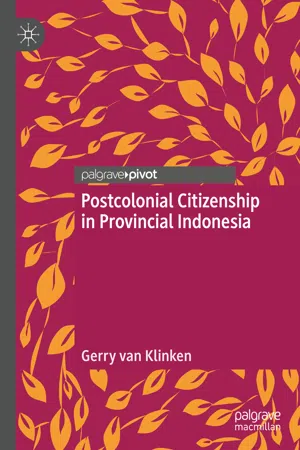
This book examines the history of state formation in postcolonial Indonesia by starting with the death of Jan Djong, an activist and a former village head in the little town of Maumere. It historicizes contemporary debates on citizenship in the postcolonial world.
Citizenship has been called the "organizing principle of state-society relations in modern states". Democratization is today most intense in the non-Western, post-colonial world. Yet "real" citizenship seems largely absent there. Only a few rights-claiming, autonomous, and individualistic citizens celebrated in mainstream literature exist in post-colonial countries.
In reflecting on one concrete story to examine the core dilemmas facing the study of citizenship in postcolonial settings, this book challenges ethnocentricity found within current scholarly work on citizenship in Europe and North America and addresses issues of institutional fragility, political violence, as well as legitimacy and aspirations to freedom in non-Western cultures.
Trusted by 375,005 students
Access to over 1.5 million titles for a fair monthly price.
A citizen is one who shares in governing and being governed.
Aristotle, Politics
Abstract
It is 1966 in the town of Maumere, Flores, Indonesia. A man named Jan Djong is murdered in the jail by people he knew personally. Two little-known local documents written shortly afterwards trace the 20-year history leading up to that murder. Both depict Djong as a hazardous individual, yet both place the citizenship struggles he led at the centre of their narrative about him.
His story exemplifies the agonistic twentieth-century struggles that people in many postcolonial countries have waged to be treated as citizens. Conventional citizenship theory has not known what to do with these struggles, which hardly fit the ideal mold of civic, deliberative movements for rights. This book aims to rethink citizenship theory, so that it can explain popular politics in most of the world.
Jan Djong expired from his wounds in the jail of Maumere on Tuesday, 1 March 1966.1 Maumere is a small town on the north coast of Flores, an island in eastern Indonesia. It then had a population of just 2000. Djong was 48 years old. He had been the rural district’s most energetic politician. After his arrest late in January or early in February 1966, he had been beaten and then paraded around the sweltering little town on foot together with some other prominent figures. They had stripped him of his clothes. Indonesian male underpants then had drawstrings instead of elastic. His drawstrings had been removed, so they kept dropping. From time to time during the month that followed, the detainees were frog-marched in line from the jail behind the police station to the local military office (Kodim) a few hundred metres eastwards for interrogation. Out in the morning, back in the afternoon. Told by their mocking tormentors to sing and dance along the way, the bruised men managed only a pathetic stagger. Eventually, feeling the end was nigh, the Catholic Djong asked his jailers for a pastor to make his confession and receive the extreme unction. They refused. One of them urinated in his face. They buried him in the bank of the river just outside the jail walls. Djong’s torturers had been civilians, Catholic local men like himself, officials in various government departments. They all knew each other. After this, between 800 and 1500 others were rounded up around the rural Sikka district. Trucks carried them to their deaths in mass graves prepared for them in every subdistrict. One was in the middle of the coconut plantation belonging to the Catholic mission of Maumere. They were all murdered without interrogation.
Now we rewind more than 12 years, to 19 June 1953. Djong was 36, and death was far from his mind. He was fully engaged in a project, not of his own making, but one that fascinated him: the republican transformation of rural, colonial society. Maumere was a strip of low buildings about three kilometres long on the north coast of central Flores. It had become part of the Republic of Indonesia three years earlier. That Republic had declared itself at the moment of the Japanese surrender in August 1945 and had then fought itself free of Dutch attempts to reassert colonial control. Indonesia thus became part of a great wave of democratisation that swept Southeast Asia immediately after World War II. Maumere was capital of the administrative district called Sikka. Almost half its workers were military and civil servants. The other half worked in trade and small industries that served the town’s agrarian hinterland—mainly coconut oil processing. In colonial times Maumere had been the seat of the raja of Sikka. The Dutch appointed such ‘traditional’ kings as a money-saving alternative to modern governance. They thought the kings would be popular, but in reality the kings behaved in autocratic ways increasingly out of step with democratising times. The Republic of Indonesia had maintained the hereditary raja of Sikka, but only as an interim measure; his very existence contradicted its ideals. All the politics in the little town revolved around that contradiction.
Djong was angry. During the Japanese occupation, he had risen to the position of the village head. But after the Japanese defeat in August 1945, the raja had sacked him from this position. Now that a new regime in Jakarta was against rajas too, he began to agitate against the one that had tormented him. In June 1953, he organised a ‘demonstration.’2 He got the idea from a young man called Sentis da Costa, a student of law in the big city of Makassar, a day’s sailing away. Sentis da Costa was home on holidays and he liked Djong’s chutzpah. The demonstrators were subsistence farmers who had walked down from the mountains southeast of Maumere—a region called Iwang Gete centred on Djong’s home village of Hewokloang. Later, people remembered there had been 700 participants. It was the first demonstration ever held in the town. They bought cheap coconut-leaf mats at the old markets just east of the Maumere town centre, cut them in two to save money, and painted their slogans on them with whitewash. The Latin came from Sentis da Costa’s law classes.
Motto: Regnat Populus (= the People rule)
Eliminate the raja
Where there is a raja = there is colonialism
Where there is a raja = there is slavery
Democracy + raja = nearly 0
What did these demonstrators want? Clearly, they identified the raja as a vestige of Dutchcolonialism. His oppressive rule was incompatible with the democracy offered by the Republic. The new republic was much larger than the little kingdom of Sikka, and they wanted to be part of it because it offered them something new. A cousin of Djong still living in Hewokloang today, who was a child at the time, recalled the purpose of the demonstration to me: ‘It was so that the Dutch and the Sikka know that we in Iwang can stand alone. Iwang people can also do things—do religion, do schooling’ (Fig. 1.1). It was in the first place about recognition as free human beings, perhaps also about jobs and prosperity. And it wasn’t just them. All over the country of (then) 80 million inhabitants, people were rising up in response to mobilisation, demanding rights and resisting traditional local rulers, as well as resisting the Dutch army then trying to recapture the colony after the Pacific War.
Fig. 1.1
Laurensius Bela’an, cousin of Jan Djong (in concrete house replacing the one where Djong was born), at Hewokloang. ‘Iwang people can also do things.’ (Photo taken in 2017 by author)
Why did Djong have to die? The disaster that struck him 12 years later also killed around half a million others throughout the country. Why did Indonesia as a nation move so precipitately from high hopes to mass murder? The answer takes us to that most fundamental of political drives throughout the global south: the desire for citizenship, which is an insurrectionary desire. The contrast between the two vignettes recounted above raises many questions, which are relevant to Indonesia as a whole. Why was it OK in Maumere to talk like a militant republican in 1953, but not in 1966? Some simple possibilities suggest themselves. Was there perhaps something wrong with Maumere that wreaked itself in the 1960s? Was its culture too rural and conservative to sustain republican ideas for long? Or were its institutions too weak to maintain law and order? Conceivably, yes to both. But no. The murders in Maumere were no local anomaly. They also took place in places with liberal cultures and effective state institutions. Was there then perhaps something wrong with the Republic of Indonesia itself? Had it stopped mobilising its citizens by 1965 and become instead prepared to murder them? No doubt, yes to that, too. But if so, why did Djong’s fellow citizens derive so much sadistic pleasure from this particular murder? The answer must lie deeper. It involves both the state and society. Citizenship is about the relationships straddling those two realms. To solve the murders in Maumere, we need to link a history of citizenship in this postcolonial country with a history of state formation.
The Maumere story represents a fragment of Indonesia’s history of citizenship, which remains largely unwritten. The climactic moments in 1953 and 1965 were each part of tumultuous national citizenship struggles. The first flowed directly out of the national revolution for freedom of 1945–1949. The second was part of a nationwide counter-revolutionary bloodbath against citizens holding modern republican or leftist ideas. The story of Djong thus mirrors the transformation of the nation over its first 20 years since independence. Paralleling the elite institutional manoeuvrings in Jakarta were the events created by ‘ordinary’ people in this little provincial town. Taken together we sense an agonistic, postcolonial citizenship drama involving both elites and large numbers of unexceptional townsfolk.
Such a drama was not unique to Indonesia. Great hopes of participation have crashed often on the rocks of violence variously described as ‘internecine’ or ‘repressive’ in twentieth-century societies seeking to escape from colonial or other forms of authoritarianism. Jan Djongs keep on dying all over the world. Years later they were still dying in Baby Doc Duvalier’s Fort Dimanche in Haiti, in the camps of an ethnic militia in the Democratic Republic of Congo, and in Cairo police stations after the collapse of the Arab Spring. Their stories demand an explanation and a future in which such things happen less. Prominent in many accounts have been recommendations for reform to the state. Samuel Huntington (1968) achieved enormous influence with his proposal that developing countries should prioritise ‘political order’ over the endless politics citizens like Djong wanted. Of course, a healthy, rule-based, political order in which rights and obligations are observed is worth striving for. But such a tidy utopia is not readily brought to life by policing methods, which are essentially methods of neutering citizenship desires. Djong’s murder was itself justified in such Huntingtonian terms, as we shall see, though it had little to do with any notion of legal order. Too often, the security studies to which Huntington’s recommendations gave such a boost begin by assuming there is only chaos in poor, postcolonial societies like 1950s Indonesia. This is not only lazy thinking, but it is positively dangerous. It threatens to add retrospectively to the toll of victims by justifying the morally unjustifiable. Much better to press our noses into the story that links citizenship desires with the history of state formation and see where it leads.
Two Texts
I found the story of Djong in two remarkable local texts. They form the basis for the present study. Their narratives span the entire turbulent period between the hope of 1945 and the desolation of the genocidal violence of 1965, between the birth of the republic and the establishment of a military-backed, Huntingtonian ‘...
Table of contents
Cover
Front Matter
1. Murder in Maumere
2. Rajas Rule
3. Postcolonial Citizens
4. Factions and Faith
5. That Chilling Moment
6. Citizenship and State Formation in Postcolonial Indonesia
Back Matter
Frequently asked questions
Yes, you can cancel anytime from the Subscription tab in your account settings on the Perlego website. Your subscription will stay active until the end of your current billing period. Learn how to cancel your subscription
No, books cannot be downloaded as external files, such as PDFs, for use outside of Perlego. However, you can download books within the Perlego app for offline reading on mobile or tablet. Learn how to download books offline
Perlego offers two plans: Essential and Complete
Essential is ideal for learners and professionals who enjoy exploring a wide range of subjects. Access the Essential Library with 800,000+ trusted titles and best-sellers across business, personal growth, and the humanities. Includes unlimited reading time and Standard Read Aloud voice.
Complete: Perfect for advanced learners and researchers needing full, unrestricted access. Unlock 1.5M+ books across hundreds of subjects, including academic and specialized titles. The Complete Plan also includes advanced features like Premium Read Aloud and Research Assistant.
Both plans are available with monthly, semester, or annual billing cycles.
We are an online textbook subscription service, where you can get access to an entire online library for less than the price of a single book per month. With over 1.5 million books across 990+ topics, we’ve got you covered! Learn about our mission
Look out for the read-aloud symbol on your next book to see if you can listen to it. The read-aloud tool reads text aloud for you, highlighting the text as it is being read. You can pause it, speed it up and slow it down. Learn more about Read Aloud
Yes! You can use the Perlego app on both iOS and Android devices to read anytime, anywhere — even offline. Perfect for commutes or when you’re on the go. Please note we cannot support devices running on iOS 13 and Android 7 or earlier. Learn more about using the app
Yes, you can access Postcolonial Citizenship in Provincial Indonesia by Gerry van Klinken in PDF and/or ePUB format, as well as other popular books in Politics & International Relations & Asian History. We have over 1.5 million books available in our catalogue for you to explore.