This volume is a collection of paper by colleagues, friends and students, in honor of Jeffrey Chadwick. The papers cover the various topic that he has dealt with in his career, including biblical historical geography, and the archaeology and history of the Levant and its environs during the Bronze and Iron Ages, and the Second Temple Period.
Following a preface and introduction about the honoree, the volume is divided into 4 sections: Biblical Historical Geography; Bronze Age Canaan and its Neighbors; Iron Age Israel and its Neighbors; Second Temple Israel.
eBook - ePub
To Explore the Land of Canaan
Studies in Biblical Archaeology in Honor of Jeffrey R. Chadwick
- 385 pages
- English
- ePUB (mobile friendly)
- Available on iOS & Android
eBook - ePub
To Explore the Land of Canaan
Studies in Biblical Archaeology in Honor of Jeffrey R. Chadwick
About this book
Trusted by 375,005 students
Access to over 1 million titles for a fair monthly price.
Study more efficiently using our study tools.
Information
Topic
Theology & ReligionSubtopic
Ancient HistoryIron Age Israel and Its Neighbors
A Tale of Two Looms – Domestic Weaving at Tell eṣ-Ṣâfī/Gath
Deborah R. Cassuto
Bar-Ilan University, Israel
Introduction
The ubiquity of loom weights found in Iron Age contexts throughout the Southern Levant underscores the significance of textile production in antiquity. The systematic study of these weights and their findspots furthers our understandings of how textiles were made and how production was organized. Their contexts demonstrate a range of manufacturing modes from small-scale household production for domestic consumption to large-scale specialized production for elite and cultic consumption, as wells as trade. They provide important clues to identifying the people and their stories behind the production: who they were, where they worked, what they wove and who they were weaving for.1 The various contexts for the more than 600 loom weighs discovered at Tell eṣ-Ṣâfī/Gath (Fig. 1),2 present a unique opportunity to study the diverse production modes and the centrality of textile production in the daily lives of this Iron Age city’s inhabitants.3

Fig. 1: General plan of site. With the permission of Aren Maeir, Tell es-Safi/Gath Archaeological Project.
This paper, honoring Jeffery R. Chadwick, deals with the “stories” gleaned from the contexts of two groups of loom weights found in Area F on the upper-west side of the summit, excavated under Jeff’s direction. The excavations in Area F revealed a series of domestic occupational phases from the Middle Bronze Age to the Persian period. As such, this area is the prime location on the tell for investigating household activities, thust providing a glimpse into the daily lives of the residents, and, relevant to this contribution, to the role of textile production in their lives. Those of us fortunate to have excavated under Jeff’s guidance at Tell eṣ-Ṣâfī/Gath have learned that the finds – stratigraphy, artifacts, architecture, and everything in-between – tells a tale, and as archaeologists, we must open our eyes and study the evidence with this in mind in order to reconstruct these stories.
The Warp-Weighted Loom
Clay loom weights4 are the nonorganic remains of warp-weighted looms (Fig. 2), which when found in archaeological contexts, constitute the primary evidence for weaving in the archaeological record. Tied to the warp threads attached to the upper beam of a loom5 they are used to create the tension necessary through which the weaver passes the weft threads in order to produced woven textiles (Crowfoot 1936–37; Broudy 1979; Vogelsang-Eastwood 1989; Sheffer 1981; Barber 1991; Shamir 1996). The earliest evidence for this loom has been found in Neolithic excavations in present-day Hungary (Barber 1991: 91–113), from which its use seems to have spread eventually reaching the northern Mediterranean. While, the ubiquity of loom weight finds across the northern Mediterranean (e.g., Mycenae, Crete, and Cyprus) demonstrates a regional preponderance of this particular weaving technology (Barber 1991; Andersson-Strand and Nosch 2015), farther to the east, in Late Bronze Age Canaan, the absence of loom weights suggests that different looms were being used here at the time. These were most likely the ground looms (two-beam horizontal looms), as depicted in Egyptian iconography from as early as the Neolithic period (Barber 1991: 83), or the two-beam vertical looms, which were most likely introduced to the region around the time they appear in New Kingdom Egyptian wall paintings, or both (Barber 1991: 114).6 Whereas these looms employ two beams to fix the warp threads, the warp-weighted loom employs rows of clay weights in the place of the lower or second beam; these weights, while providing sufficient tension, enable a degree of flexibility, and, hence, the ability to produce more intricate weaves in the cloth, such as tapestries and twills.7
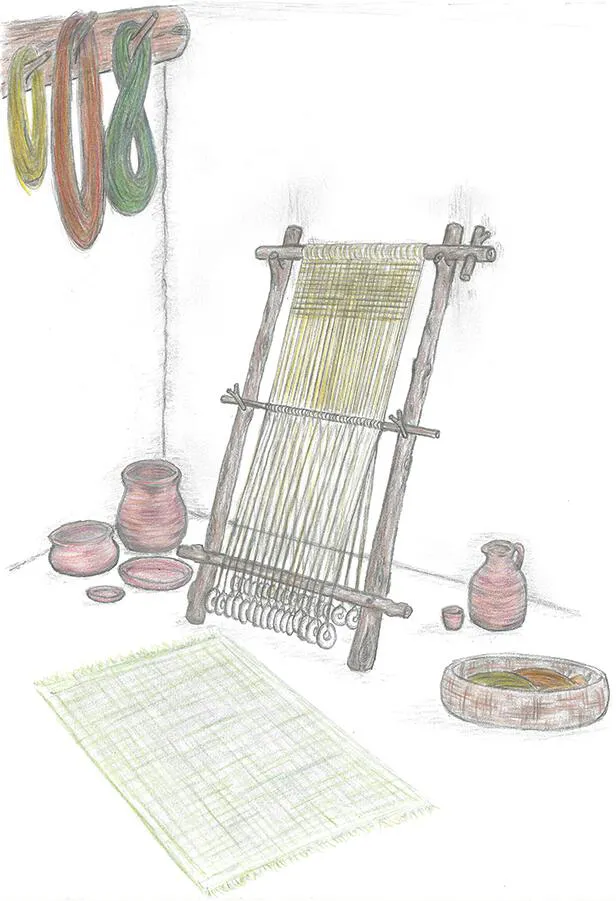
Fig. 2: Warp-weighted loom. Drawing by Shoshana Cassuto.
At the beginning of the Iron Age, the evidence for the warp-weighted loom in the Southern Levant initially appears in two centers: the Beth Shean Valley in the north (Browning 2001; Rahmstorf 2005; Mazar 2020) and Philistia in the south (see Stager 1991, 1995; Killebrew 2005; Yasur-Landau 2009; Cassuto 2018, 2019; Maeir et al. 2019: 97–99; Walton and Aja 2020). Rahmstorf (2005: 158–60) and Mazar (2020) maintain that these phenomena were the outcome of the widespread changes taking place in the 12th century B.C.E. eastern Mediterranean associated with the Sea Peoples’ activities.8 Subsequently, during the course of the Iron Age, based on the increasing dispersion and quantities of loom weight finds throughout the Southern Levant, weaving on the warp-weighted loom became ubiquitous (Barber 1991; Shamir 1996; Mazar 2018, 2020; for Transjordan Boertien 2013).
Textile Production in a Domestic Quarter at Tell eṣ-Ṣâfī/Gath
The excavations in Area F (Fig. 3), on the upper-west slope of the summit of Tell eṣ-Ṣâfī/Gath, revealed a domestic neighborhood dating from the Iron Age I (Philistine 1/Monochrome) to Iron Age IIB (Strata F12–F7; Chadwick and Maeir 2020: Table 5.1).9 Evidence for domestic weaving was found in two structures (Fig. 4) where loom weights were discovered clustered together (Chadwick and Maeir 2020: 315–21, 2012; Cassuto 2019: 36–45, 2018: 56).10 Within the overall corpus of more than 600 loom weights found across the site, the contexts for those found in Area F provide the best examples for investigating household weaving at Iron Age Tell eṣ-Ṣâfī/Gath.11

Fig. 3: Aerial View of Area F. With the permission of Aren Maeir, Tell es-Safi/Gath Archaeological Project.

Fig. 4: Iron Age I–II Schematic loom weight contexts. With the permission of Aren Maeir, Tell es-Safi/Gath Archaeological Project.
The earlier of the two groups of loom weights consisted of nine weights found on the surface of Room 106450 (Stratum F11). All the weights were perforated; however, their shapes varied – square, tear-drop, spherical, and conical (Fig. 5). Despite the fact that there was no standardization in their form, their weights and thicknesses were similar enough that they would have technically functioned well set up together on a warp-weighted loom.12 Artifacts found in the vicinity of the loom weights in Room 106450 included a Philistine cooking jug and a Philistine 2 bowl, supporting the assumption that the house was inhabited by a Philistine household during the early Iron Age (Chadwick and Maeir 2020: Table 5.1). The second group of loom weights consisted of ten weights, all perforated and spherical (Fig. 6), and were discovered in the courtyard of the four-...
Table of contents
- Title Page
- Copyright
- Contents
- A Retrospective on the Career and Impact of Jeffrey R. Chadwick, Archaeologist and Educator
- Biblical Historical Geography
- Bronze Age Canaan and Its Neighbors
- Iron Age Israel and Its Neighbors
- Second Temple Israel
- Index
Frequently asked questions
Yes, you can cancel anytime from the Subscription tab in your account settings on the Perlego website. Your subscription will stay active until the end of your current billing period. Learn how to cancel your subscription
No, books cannot be downloaded as external files, such as PDFs, for use outside of Perlego. However, you can download books within the Perlego app for offline reading on mobile or tablet. Learn how to download books offline
Perlego offers two plans: Essential and Complete
- Essential is ideal for learners and professionals who enjoy exploring a wide range of subjects. Access the Essential Library with 800,000+ trusted titles and best-sellers across business, personal growth, and the humanities. Includes unlimited reading time and Standard Read Aloud voice.
- Complete: Perfect for advanced learners and researchers needing full, unrestricted access. Unlock 1.4M+ books across hundreds of subjects, including academic and specialized titles. The Complete Plan also includes advanced features like Premium Read Aloud and Research Assistant.
We are an online textbook subscription service, where you can get access to an entire online library for less than the price of a single book per month. With over 1 million books across 990+ topics, we’ve got you covered! Learn about our mission
Look out for the read-aloud symbol on your next book to see if you can listen to it. The read-aloud tool reads text aloud for you, highlighting the text as it is being read. You can pause it, speed it up and slow it down. Learn more about Read Aloud
Yes! You can use the Perlego app on both iOS and Android devices to read anytime, anywhere — even offline. Perfect for commutes or when you’re on the go.
Please note we cannot support devices running on iOS 13 and Android 7 or earlier. Learn more about using the app
Please note we cannot support devices running on iOS 13 and Android 7 or earlier. Learn more about using the app
Yes, you can access To Explore the Land of Canaan by Aren M. Maeir, George A. Pierce, Aren M. Maeir,George A. Pierce in PDF and/or ePUB format, as well as other popular books in Theology & Religion & Ancient History. We have over one million books available in our catalogue for you to explore.