From Pulitzer Prize–winning historian Jill Lepore, the story of the American historical mythology embraced by the far right
Americans have always put the past to political ends. The Union laid claim to the Revolution—so did the Confederacy. Civil rights leaders said they were the true sons of liberty—so did Southern segregationists. This book tells the story of the centuries-long struggle over the meaning of the nation's founding, including the battle waged by the Tea Party, Glenn Beck, Sarah Palin, and evangelical Christians to "take back America."
Jill Lepore, Harvard historian and New Yorker staff writer, offers a careful and concerned look at American history according to the far right, from the "rant heard round the world," which launched the Tea Party, to the Texas School Board's adoption of a social-studies curriculum that teaches that the United States was established as a Christian nation. Along the way, she provides rare insight into the eighteenth-century struggle for independencea history of the Revolution, from the archives. Lepore traces the roots of the far right's reactionary history to the bicentennial in the 1970s, when no one could agree on what story a divided nation should tell about its unruly beginnings. Behind the Tea Party's Revolution, she argues, lies a nostalgic and even heartbreaking yearning for an imagined past—a time less troubled by ambiguity, strife, and uncertainty—a yearning for an America that never was.
The Whites of Their Eyes reveals that the far right has embraced a narrative about America's founding that is not only a fable but is also, finally, a variety of fundamentalism—anti-intellectual, antihistorical, and dangerously antipluralist.
In a new afterword, Lepore addresses both the recent shift in Tea Party rhetoric from the Revolution to the Constitution and the diminished role of scholars as political commentators over the last half century of public debate.
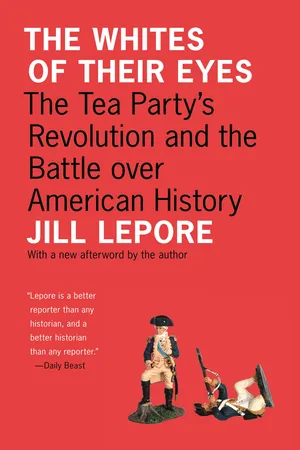
eBook - ePub
The Whites of Their Eyes
The Tea Party's Revolution and the Battle over American History
- 232 pages
- English
- ePUB (mobile friendly)
- Available on iOS & Android
eBook - ePub
About this book
Trusted by 375,005 students
Access to over 1.5 million titles for a fair monthly price.
Study more efficiently using our study tools.
Information
Publisher
Princeton University PressYear
2011Print ISBN
9780691153001
9780691150277
eBook ISBN
9781400839810
CHAPTER 1
Ye Olde Media
CONTAINING REFLECTIONS ON NATIONS FOUNDED IN REVOLUTIONS—AN INTRODUCTION TO OUR CHARACTERS—A HISTORY OF THE STAMP ACT—THE BIRTH, DEATH, AND RESURRECTION OF THE NEWSPAPER—ITS DIRE FATE, OF LATE—AND A VISIT TO THE GREEN DRAGON TAVERN
“Everybody, anywhere I go, always asks me, ‘Where did you get that hat?’ ” Austin Hess told me, when we first met, beside a statue of Samuel Adams in front of Faneuil Hall. Hess, a twenty-six-year-old engineer and member of the steering committee of the Boston Tea Party, was wearing a tricornered hat: not your ordinary felt-and-cardboard fake but the genuine article, wide-brimmed and raffish. In April of 2009, two months after Rick Santelli, outraged by the Obama administration’s stimulus package, called for a new tea party, Hess showed up at a Tax Day rally on the Boston Common. He was carrying a sign that read “I Can Stimulate Myself.” He was much photographed; he appeared on television, a local Fox affiliate. He was wearing his hat. He got it at Pli-moth Plantation. It was made of “distressed faux leather.” You could order it on-line. It was called the Scallywag.1
The importance of the American Revolution to the twenty-first-century Tea Party movement might seem to have been slight—as if the name were mere happenstance, the knee breeches knickknacks, the rhetoric of revolution unthinking—but that was not entirely the case, especially in Boston, where the local chapter of the Tea Party bore a particular burden: it happened here. “Everybody in the movement is interested in the Revolution,” Hess told me. He took his debt to the founders seriously: “We believe that we are carrying on their tradition, and if they were around today, they would be in the streets with us, leading us, and they’d be even angrier than we are. I imagine we’d have to politely ask them to leave their muskets at home.”2
“Who shall write the history of the American revolution?” John Adams once asked Thomas Jefferson. “Who can write it? Who will ever be able to write it?” “Nobody,” was Jefferson’s reply. “The life and soul of history must forever remain unknown.”3 The records were murky, the course of events astonishing, the consequences immeasurable. Nobody could write the history of the Revolution, but everyone would have to try; it was too important not to. There was also this dilemma: a nation born in revolution will always eye its history warily, and with anxiety. It’s good that it happened once; twice could be trouble. The Revolution’s first historian, Peter Oliver, was a Loyalist from Boston. Consumed by bitterness, regret, and rancor, he wrote the “Origin & Progress of the American Rebellion” in 1781, from exile in England. He didn’t think the Revolution should have happened even once.4 The first patriot historian of the Revolution, David Ramsay, a physician who had been a delegate to the Continental Congress from South Carolina and whose two-volume history was published in 1789, stated the problem as well as anyone. “The right of the people to resist their rulers, when invading their liberties, forms the corner stone of the American republic,” Ramsay wrote in The History of the American Revolution, but “this principle, though just in itself, is not favourable to the tranquility of present establishments.”5 Ramsay appreciated the acuteness of the difficulty: celebrating the birth of the nation, and carrying on in its spirit, risked promoting still more revolution, unrest, impermanence, and instability, when what the new nation needed was calm. “A little rebellion, now and then, is a good thing,” Jefferson wrote from Paris in 1786, on hearing word of Shays’s Rebellion, an armed uprising by farmers from Massachusetts struggling to stay out of debtors’ prison. “The Tree of Liberty must be refreshed from time to time with the blood of patriots and tyrants,” Jefferson wrote then.6 (This menacing line sometimes appeared on Tea Party paraphernalia, but it was far more popular in the 1990s, among members of that decade’s militia movement. On April 19, 1995, the 220th anniversary of the Battle of Lexington and Concord, Timothy McVeigh, who liked to wear a Tree of Liberty T-shirt, blew up the Alfred P. Murrah Federal Building, in Oklahoma City, killing 168 people, including 19 very young children.)7 But aside from Jefferson, whose enthusiasm for revolution did not survive Robespierre, most everyone else came down in favor of order. “In monarchies the crime of treason or rebellion may admit of being pardoned, or lightly punished,” Samuel Adams wrote, during the Shays crisis, “but the man who dares to rebel against the laws of a republic ought to suffer death.”8 James Madison believed America’s was a revolution to end all revolutions. And the Constitution, of course, sought “to form a more perfect Union, establish Justice, insure domestic Tranquility, provide for the common defence, promote the general Welfare, and secure the Blessings of Liberty to ourselves and our Posterity.” Domestic tranquility was what was called for. The Constitution helped contain the unruliness of the Revolution. So did early accounts of the nation’s founding, which tended to emphasize that a revolution had to know when to stop. For the sake of the nation, revolution needed to be a thing of the past.
Meanwhile, though, the Revolution was so brilliant and daring—and, of course, so original and definitive and constitutive—that everyone wanted to claim to have inherited it, especially when running for office or starting a movement or pushing through a piece of legislation. Beginning even before it was over, the Revolution has been put to wildly varying political purposes. Federalists claimed its legacy; so did Anti-Federalists. Supporters of Andrew Jackson’s Democratic Party said they were the true sons of the Revolution. No, Whigs said: we are. The Union claimed the Revolution; so, just as fervently, did the Confederacy.9 In the 1950s, southern segregationists insisted that they were upholding the legacy of the Founding Fathers by adhering to the Constitution. “There is nothing in the United States Constitution that gives the Congress, the President, or the Supreme Court the right to declare that white and colored children must attend the same public schools,” said Mississippi senator James Eastland. Advocates of civil rights countered that their movement carried the banner of the Revolution. “Our nation in a sense came into being through a massive act of civil disobedience,” Martin Luther King Jr. wrote, “for the Boston Tea Party was nothing but a massive act of civil disobedience.” A lot of people talked about the 1964 Civil Rights Act as realizing, at long last, the promise of the Declaration of Independence. Lyndon Johnson compared Selma to Lexington and Concord. The 1965 Voting Rights Act was said to be an end to taxation without representation. “Black people are rebelling in the same way Americans did in the Boston Massacre,” Stokely Carmichael said in 1966.10 That same year, when Johnson signed into law a bill establishing an American Revolution Bicentennial Commission, he used the opportunity to argue for American involvement in Southeast Asia. “Today, the Vietnamese people are fighting for their freedom in South Vietnam. We are carrying forward our great heritage by helping to sustain their efforts.”11 One year later, at the Southern Christian Leadership Conference in Atlanta, King said, “We still need some Paul Revere of conscience to alert every hamlet and every village of America that revolution is still at hand.”12 What all these people meant by “revolution,” of course, was different.
“What do We Mean by the Revolution?” Adams asked Jefferson. “The War? That was no part of the revolution. It was only an Effect and Consequence of it. The Revolution was in the Minds of the People, and this was effected from 1760–1775, in the course of fifteen Years, before a drop of blood was shed at Lexington.”13 Adams, like many people, had no doubt that the Revolution had begun in Boston. Oliver thought Massachusetts was “the Volcano from whence issued all the Smoak, Flame & Lava, which has since enveloped the whole British american continent.”14 Adams believed the Revolution began in 1760 because, in August of that year, Massachusetts’ new, royally appointed governor, Francis Bernard, arrived to find a city in ruins, ravaged, just months before, by the worst fire in any colonial American city, ever. But the city was suffering from worse than fire. Massachusetts had sent more men to fight in the French and Indian War than all of the other colonies combined. Known in Europe as the Seven Years’ War, the fighting had started in 1756. Many Massachusetts men had fallen; many more were still to die, buried in unmarked graves, far from home. Boston in 1760 was a city of widows and orphans and wounded soldiers, of struggling artisans and smuggling merchants. Its newspapers were filled with notices of runaway apprentices, of slaves for sale, of bankrupted estates.15 That December, Boston’s James Otis Jr., a thirty-six-year-old lawyer, the most brilliant legal mind of his generation, agreed to take a case arguing against Bernard that the government had acted with arbitrary authority in using an instrument known as writs of assistance to search and seize city merchants’ property as part of a campaign against illicit trade.16 (Otis had another beef with Bernard, who had passed over his father, James Otis Sr., to appoint Thomas Hutchinson as chief of the colony’s Superior Court.) The following February, Otis argued the writs of assistance case, which is why Peter Oliver, who also served on the Superior Court, and was Hutchinson’s brother-in-law, started his history in 1761. The showdown took place in Boston’s Town House (now the Old State House), a three-story Georgian whose east-end gable was topped with gilt statues of the lion and the unicorn, mythical symbols of the British Crown. The Town House sat in the middle of King Street (now State Street), in the heart of the city. The case was heard in the Governor’s Council Chamber, on the second floor, a room that boasted an elegant prospect, a wondrous view, straight down the Long Wharf and across the harbor, looking wistfully and a little desperately back to London. John Adams, who was, at the time, an assistant of Otis’s law partner, sat among the spectators, in a room tricked out with every trapping of luxury—red velvet–covered mahogany chairs and even ornamented brass spittoons—and of royal authority: Bernard had brought with him full-length portraits of George II and George III to hang alongside the king’s arms and a vast map of London.17 Of Otis’s fiery performance that day, Adams later wrote, “American independence was then and there born.”18
Meanwhile, an ocean away, the Phillis, a two-masted, square-rigged ship piloted by Peter Gwin, was cruising the Guinea coast of Africa. After trading English goods for African slaves, Gwin prepared to head to New England. He had sailed to Boston before. He knew how to navigate through the perilous entrance to Boston’s harbor, dotted with rocks and shoals and more than thirty islands, tiny and treacherous. Once he got past Castle William, the water would be calmer and the hazards fewer. And then, what beauty, what depths. Wrote one traveler, “within the harbor there is room enough for five hundred sail to lie at an anchor.”19 A sea captain’s paradise.
The Phillis reached Boston in July of 1761, dropping anchor alongside the Long Wharf, the longest wharf—and the biggest commercial structure—in all of America: 150 feet wide and an audacious 2,000 feet long. On eighteenth-century maps, it looks like a finger pointing across the ocean, pointing home. Gwin’s first order of business was to carry his bill of lading the length of the wharf, covered with warehouses and shops, and up the hill to the Customs House, built of rough-hewn stone. To get there, he had to make his way through the dockside bustle of sailors and shipwrights, hawkers and shopkeepers, fishwives and whores, artisans and merchants, the sons and daughters of Europe, Africa, and America. In a city of fifteen thousand people, about a thousand were black, and of that thousand, only eighteen were free.20 The day Gwin’s Phillis cleared customs, twenty-two other ships had dropped anchor offshore or tied their leading ropes to the town’s fifty-seven wharves. They had sailed from the north: Newfoundland, Quebec; from the south: Connecticut, Rhode Island, New York, Philadelphia, Maryland, Virginia, St. Kitts, Nevis, Bermuda; and from the east, all the way across the wide water: Liverpool and London. Gwin went to the print shop of Benjamin Edes and John Gill, on Queen Street, next door to the town jail, to place an ad in the Boston Gazette:
JUST Imported,
From A F R I C A.
From A F R I C A.
A Number of prime young S L A V E S, from the Windward
Coast, and to be Sold on board Capt. Gwin lying at
New-Boston.
Coast, and to be Sold on board Capt. Gwin lying at
New-Boston.
This notice caught the eye of a tailor named John Wheatley, who kept a shop on the corner of King Street and Mackerel Lane. Wheatley and his wife, Susanna, took a chaise to the wharf, boarded the ship, and inspected the cargo, men, women, and children brought out of the fetid obscurity below decks to squint against the sun glinting off the water. The girl had lost her two front teeth. That put her at about seven years old. Maybe eight. She was skinny and sick and nearly naked. She was half dead. The captain wanted her off his hands. Wheatley bought her “for a trifle.” His wife named her after the ship.21
That girl would one day chronicle the birth of the United Sta...
Table of contents
- Cover
- Half title
- Title
- Copyright
- Dedication
- Contents
- Foreword by Ruth O’Brien
- Prologue Party Like It’s 1773
- 1 Ye Olde Media
- 2 The Book of Ages
- 3 How to Commit Revolution
- 4 The Past upon Its Throne
- 5 Your Superexcellent Age
- Epilogue Revering America
- Afterword to the Paperback Edition
- Acknowledgments
- Notes
- Index
Frequently asked questions
Yes, you can cancel anytime from the Subscription tab in your account settings on the Perlego website. Your subscription will stay active until the end of your current billing period. Learn how to cancel your subscription
No, books cannot be downloaded as external files, such as PDFs, for use outside of Perlego. However, you can download books within the Perlego app for offline reading on mobile or tablet. Learn how to download books offline
Perlego offers two plans: Essential and Complete
- Essential is ideal for learners and professionals who enjoy exploring a wide range of subjects. Access the Essential Library with 800,000+ trusted titles and best-sellers across business, personal growth, and the humanities. Includes unlimited reading time and Standard Read Aloud voice.
- Complete: Perfect for advanced learners and researchers needing full, unrestricted access. Unlock 1.5M+ books across hundreds of subjects, including academic and specialized titles. The Complete Plan also includes advanced features like Premium Read Aloud and Research Assistant.
We are an online textbook subscription service, where you can get access to an entire online library for less than the price of a single book per month. With over 1.5 million books across 990+ topics, we’ve got you covered! Learn about our mission
Look out for the read-aloud symbol on your next book to see if you can listen to it. The read-aloud tool reads text aloud for you, highlighting the text as it is being read. You can pause it, speed it up and slow it down. Learn more about Read Aloud
Yes! You can use the Perlego app on both iOS and Android devices to read anytime, anywhere — even offline. Perfect for commutes or when you’re on the go.
Please note we cannot support devices running on iOS 13 and Android 7 or earlier. Learn more about using the app
Please note we cannot support devices running on iOS 13 and Android 7 or earlier. Learn more about using the app
Yes, you can access The Whites of Their Eyes by Jill Lepore in PDF and/or ePUB format, as well as other popular books in History & Early American History. We have over 1.5 million books available in our catalogue for you to explore.