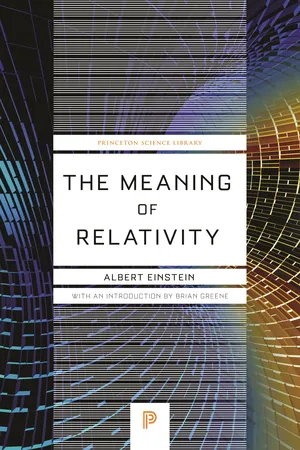
In 1921, five years after the appearance of his comprehensive paper on general relativity and twelve years before he left Europe permanently to join the Institute for Advanced Study, Albert Einstein visited Princeton University, where he delivered the Stafford Little Lectures for that year. These four lectures constituted an overview of his then-controversial theory of relativity. Princeton University Press made the lectures available under the title The Meaning of Relativity, the first book by Einstein to be produced by an American publisher. As subsequent editions were brought out by the Press, Einstein included new material amplifying the theory. A revised version of the appendix "Relativistic Theory of the Non-Symmetric Field," added to the posthumous edition of 1956, was Einstein's last scientific paper.
Trusted by 375,005 students
Access to over 1.5 million titles for a fair monthly price.
BEFORE starting with the subject proper I am first going to discuss the “strength” of systems of field equations in general. This discussion is of intrinsic interest quite apart from the particular theory presented here. For a deeper understanding of our problem, however, it is almost indispensable.
ON THE “COMPATIBILITY” AND THE “STRENGTH” OF SYSTEMS OF FIELD EQUATIONS
Given certain field variables and a system of field equations for them, the latter will not in general determine the field completely. There still remain certain free data for a solution of the field equations. The smaller the number of free data consistent with the system of field equations, the “stronger” is the system. It is clear that in the absence of any other viewpoint from which to select the equations, one will prefer a “stronger” system to a less strong one. It is our aim to find a measure for this strength of systems of equations. It will turn out that such a measure can be defined which will even enable us to compare with each other the strengths of systems whose field variables differ with respect to number and kind.
We shall present the concepts and methods involved here in examples of increasing complexity, restricting ourselves to four-dimensional fields, and in the course of these examples we shall successively introduce the relevant concepts.
First example: The scalar wave equation*
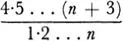
Here the system consists of only one differential equation for one field variable. We assume ϕ to be expanded in a Taylor series in the neighborhood of a point P (which presupposes the analytic character of ϕ). The totality of its coefficients describes then the function completely. The number of nth order coefficients (that is, the nth order derivatives of ϕ at the point P) is equal to
(abbreviated
), and all these coefficients could be freely chosen if the differential equation did not imply certain relations between them. Since the equation is of second order, these relations are found by (n − 2) fold differentiation of the equation. We thus obtain for the nth order coefficients
conditions. The number of nth order coefficients remaining free is therefore
This number is positive for any n. Hence, if the free coefficients for all orders smaller than n have been fixed, the conditions for the coefficients of order n can always be satisfied without changing the coefficients already chosen.
Analogous reasoning can be applied to systems consisting of several equations. If the number of free nth order coefficients does not become smaller than zero, we call the system of equations absolutely compatible. We shall restrict ourselves to such systems of equations. All systems known to me which are used in physics are of this kind.
Let us now rewrite equation (1). We have
where z1 = +6.
If we restrict ourselves to large values of n, we may neglect the terms
etc. in the parenthesis, and we obtain for (1) asymptotically
We call z1 the “coefficient of freedom,” which in our case has the value 6. The larger this coefficient, the weaker is the corresponding system of equations.
Second example: Maxwell’s equations for empty space
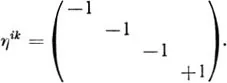
ϕik results from the antisymmetric tensor ϕik by raising the covariant indices with the help of
These are 4 + 4 field equations for six field variables. Among these eight equations, there exist two identities. If the left-hand sides of the field equations are denoted by Gi and Hikl respectively, the identities have the form
In this case we reason as follows.
The Taylor expansion of the six field components furnishes
coefficients of the nth order. The co...
Table of contents
Cover Page
Title Page
Copyright Page
Contents
Introduction
A Note on the Fifth Edition
Space and Time in Pre-Relativity Physics
The Theory of Special Relativity
The General Theory of Relativity
The General Theory of Relativity (Continued)
Appendix for the Second Edition
Appendix II. Relativistic Theory of the Non-Symmetric Field
Index
Frequently asked questions
Yes, you can cancel anytime from the Subscription tab in your account settings on the Perlego website. Your subscription will stay active until the end of your current billing period. Learn how to cancel your subscription
No, books cannot be downloaded as external files, such as PDFs, for use outside of Perlego. However, you can download books within the Perlego app for offline reading on mobile or tablet. Learn how to download books offline
Perlego offers two plans: Essential and Complete
Essential is ideal for learners and professionals who enjoy exploring a wide range of subjects. Access the Essential Library with 800,000+ trusted titles and best-sellers across business, personal growth, and the humanities. Includes unlimited reading time and Standard Read Aloud voice.
Complete: Perfect for advanced learners and researchers needing full, unrestricted access. Unlock 1.5M+ books across hundreds of subjects, including academic and specialized titles. The Complete Plan also includes advanced features like Premium Read Aloud and Research Assistant.
Both plans are available with monthly, semester, or annual billing cycles.
We are an online textbook subscription service, where you can get access to an entire online library for less than the price of a single book per month. With over 1.5 million books across 990+ topics, we’ve got you covered! Learn about our mission
Look out for the read-aloud symbol on your next book to see if you can listen to it. The read-aloud tool reads text aloud for you, highlighting the text as it is being read. You can pause it, speed it up and slow it down. Learn more about Read Aloud
Yes! You can use the Perlego app on both iOS and Android devices to read anytime, anywhere — even offline. Perfect for commutes or when you’re on the go. Please note we cannot support devices running on iOS 13 and Android 7 or earlier. Learn more about using the app
Yes, you can access The Meaning of Relativity by Albert Einstein in PDF and/or ePUB format, as well as other popular books in Physical Sciences & Relativity in Physics. We have over 1.5 million books available in our catalogue for you to explore.