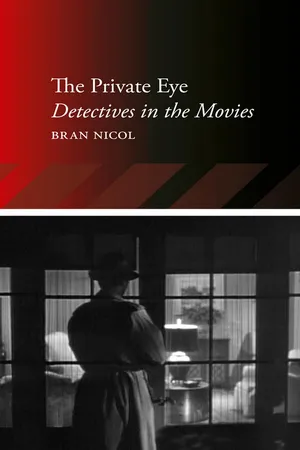
Since the early days of cinema, the private eye has been one of its most memorable characters, often viewed as a romantic hero, a ‘lone wolf’ who confronts and tries to make sense of a violent and chaotic modern world. In The Private Eye Bran Nicol challenges this stereotype, offering a fresh take on iconic figures such as Sam Spade, Philip Marlowe and Jake Gittes, and a cogent reappraisal of film noir.
Analysing a wide range of films, including classics such as The Maltese Falcon, The Big Sleep, Chinatown, and The Long Goodbye, Nicol traces the history of the private eye movie from the influential film noirs of the 1940s, through innovative 1970s neo-noir cinema, to the presence of the private eye in movie mythology today. He reveals that although these films are exciting thrillers, they are nevertheless preoccupied by ‘domestic’ issues: work, home and love. Rather than fearless investigation, Nicol argues, the private eye’s job is really about unveiling the private lives and private spaces of others, an achievement which comes at the expense of his own private life.
Combining a lucid introduction to an under-explored tradition in movie history with a novel approach to the detective in film, this book casts new light on the private worlds of the private eye.
- English
- ePUB (mobile friendly)
- Available on iOS & Android
eBook - ePub
About this book
Trusted by 375,005 students
Access to over 1.5 million titles for a fair monthly price.
Study more efficiently using our study tools.
Information
Subtopic
Film & Video1
History: The Private Eye Film
‘So you’re a private detective,’ she said. ‘I didn’t know they really existed, except in books.’
– Raymond Chandler, The Big Sleep (1939)1
Literary Origins and the ‘Armchair’ Detective
Detectives in literature and film fall into one of two main types: the armchair detective and the private eye. The former is essentially a nineteenth-century phenomenon, dating back to the pioneering crime fiction published by the American writer Edgar Allan Poe in the early 1840s, which gathered together a series of motifs and characteristics from earlier Gothic and urban tales to create a new kind of story glorifying the systematic processes of detection.
Poe’s stories, ‘The Murders in the Rue Morgue’ (1841), ‘The Mystery of Marie Rôget’ (1842) and ‘The Purloined Letter’ (1845), originate the ‘logic-and-deduction’ (or ‘clue-puzzle’ or ‘whodunnit’) tradition of detective fiction. They introduce the enigmatic detective, Chevalier Auguste Dupin, an eccentric man of aristocratic descent who solves crimes – at night, usually in the comfort of his own room while reading the newspapers for clues, essentially for the pleasure of exercising his intellect and exposing the weaknesses of the Paris police. However, it was not until forty years later, with the advent of Conan Doyle’s Sherlock Holmes – ‘the most perfect reasoning and observing machine that the world has seen’, as his sidekick Watson puts it2 – that the conventions of ‘logic-and-deduction’ detective fiction stabilized into a genre. The genre was formalized further by the Agatha Christie-led golden age of whodunnit detective fiction in the 1920s and ’30s.
The origins of private eye fiction are not quite so easy to pinpoint, given that Dupin, Holmes, and Christie’s Poirot and Miss Marple are all ‘private investigators’, working independently of the police. But the private eye tradition begins properly in the 1920s in the U.S., with the appearance of a new breed of ‘tough guy’ detective, who featured in pulp magazines such as Black Mask, Dime Detective, Detective Fiction Weekly and Black Aces, publications which specialized in a new kind of ‘hard-boiled’ crime story. The figure then appeared in novels from the late 1920s until the ’50s by writers such as Dashiell Hammett, Raymond Chandler and Ross MacDonald. This kind of fiction clearly descended from the Anglo-American classical tradition of Poe and Doyle, given its emphasis on mystery-solving by a single, heroic figure. Yet it also styled itself aggressively as an alternative to what it perceived as the insipid championing of the norms of polite society found in nineteenth-century fiction and, especially, the formulaic mysteries of the classic detective story’s heyday.
The hard-boiled detective novel dramatized crime in the style of a thriller rather than as an elaborate parlour game, drawing on the conventions of the romance and adventure story. It also sought to inject a greater degree of realism into its pages by detailing the modern urban world in all its grimy disorder, and featuring a range of characters – low-lifes, dangerously alluring women, corrupt authority figures – who spoke in the street-smart vernacular of contemporary America. This realism and its emphasis on explosive action meant that, without doubt, hard-boiled detective fiction was the crucial influence on private eye cinema. The private eye films dealt with in this book are all descended in some way from the hard-boiled detective story.
Before we begin surveying them, however, it is important to note that, just as the ‘logic-and-deduction’ form of the detective novel has endured, indeed continued to flourish alongside the hard-boiled variety right up to the present day, so the equivalent cinematic mode has continued to be used in crime films, though much less often. There have been detectives in cinema who are not private eyes, even though they are, technically speaking, ‘private detectives’.
Any full survey of detective films would have to begin with Sherlock Holmes. Not surprisingly, because the advent of cinema in the 1890s coincided with the highpoint of Doyle’s character’s popularity,3 and because early cinema looked to literature for inspiration, Holmes is the first cinematic detective. He initially appeared on screen in 1903, in Sherlock Holmes Baffled, made by the American Biograph Company, and featured in numerous other silent movies made in Denmark, France and Germany (for example, The Adventures of Sherlock Holmes, 1905, Sherlock Holmes and the Great Murder Mystery, 1908, Sherlock Holmes in Deathly Danger and The Secret Document, both 1908). The first talking Holmes film was The Return of Sherlock Holmes (1929) and this was followed by Doyle-inspired adventures such as The Scarlet Claw (1933) and The House of Fear (1945). The most famous Holmes film is Twentieth Century Fox’s The Hound of the Baskervilles (1939), starring Basil Rathbone and Nigel Bruce, a film which actually comes close to noir in some of its lighting effects and atmosphere.
The Christie-style model of ‘logic-and-deduction’ detective fiction has also been well served by the cinema, especially in the 1960s and ’70s which saw successful adaptations of Christie novels such as The Alphabet Murders (1965), Murder on the Orient Express (1974) and Death on the Nile (1978). Even though, oddly, direct adapations of Christie’s work seldom featured in the great advent of Hollywood cinema in the 1930s and ’40s (with the exception of And Then There Were None, 1945) this period did specialize in gimmicky, light-hearted whodunnits, such as The Secret of the Blue Room (1933), Murder by an Aristocrat (1936), and Dr Broadway (1942). The most successful pre-noir private detective franchises feature the debonair detectives Philo Vance and Nick Charles. Vance, who featured in the novels by ‘S. S. Van Dine’ (nom de plume of Willard Huntington Wright), and in films such as The Greene Murder Case (1929) and The Gracie Allen Murder Case (1939), was a self-assured, well-spoken, elegantly dressed descendent of Sherlock Holmes, someone who reasons aloud and mocks the police, who plod in his wake.
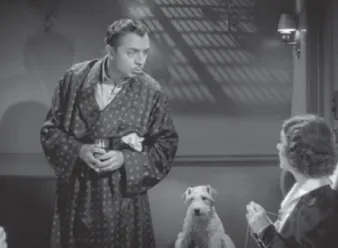
Debonaire detective: the private eye before film noir. William Powell as Nick Charles in After the Thin Man (1936).
Alongside ‘armchair’ sleuths, early cinema also features a more direct ancestor of the hard-boiled detective. This kind of private investigator, still cultured, ironic, and rather two-dimensional, but with more of a fondness for violence, appeared in cinema with increasing regularity during the rise of the B-movie in the 1930s,4 especially in various series of ‘light-entertainment’ mysteries featuring amateur sleuths like Nick Carter (Nick Carter, Master Detective, 1939) or Nero Wolfe (Meet Nero Wolfe, 1936), investigative figures such as the lawyer Perry Mason, or quasi-mythical crime-solvers such as The Lone Wolf (The Lone Wolf, 1924) or The Saint (The Saint Takes Over, 1940). Other ‘franchises’ include the Thatcher Colt series in the early 1930s, the East Asian detectives Charlie Chan and Mr Moto, British detectives like The Falcon, and tough-guy American detectives such as Bulldog Drummond and Boston Blackie.
The Noir Detective
The enduring cinematic version of the private eye emerged with the advent of film noir in the early 1940s. Here is not the place to analyse the historical and aesthetic origins of noir at any length, nor to consider whether or not it is a film genre, a mode, or a more general ‘sensibility’. These questions have been explored in exhaustive depth by a large number of critics over the past few decades,5 and there is a sense that to grapple with them further is to risk becoming lost in a kind of labyrinth of claim and counter-claim which parallels the plight of the typical noir protagonist.
The consensus is that film noir emerged in the U.S. in the 1940s as a reflection of social malaise and economic uncertainty resulting from the Second World War and the impact on cinema of experimental, emotive, aesthetic movements such as German Expressionism. Crucially, the new 1940s ‘crime psychology’ films (as they were intially termed) were championed by French critics.6 It is often noted that ‘the Americans made [noir] and then the French invented it’.7 These critics, caught up in the dark mood of their own nation’s social and political climate after the war, felt an affinity with the bleak, violent films being produced in the U.S., and began to analyse their stylistic features and themes, recognizing the link not simply with crime novels by American writers such as Hammett, which provided the source texts of many of the films, but the atmosphere of the hard-boiled literary tradition as a whole. Another contemporary writer, Marcel Duhamel, the promoter of the série noire (a series of hard-boiled thrillers, often American fiction in translation, which inspired the label ‘film noir’), argued that in these stories we find ‘violence – in all its forms, and especially the most shameful – beatings, killings . . . Immorality is as much at home here as noble feelings . . . There is also love – preferably vile – violent passion, implacable hatred.’8
Noir is of course French for ‘black’ and the ‘blackness’ of noir refers to a number of things. It points to the tradition’s roots in Gothic fiction (also called noir in French) and its associations with the style of popular narrative that James Naremore calls ‘blood melodrama’.9 It denotes the tradition’s overall mood of brooding, existential uncertainty, its moral ambivalence, and refusal to provide any form of ‘redemption’, any ‘glimmer of resistance to the dark side’ or ‘re-vindication of society’.10 It also captures the tenor of the distinctive stylistic features which struck early film critics, such as noir’s use of shadows and chiaroscuro lighting, and distorting visual effects.
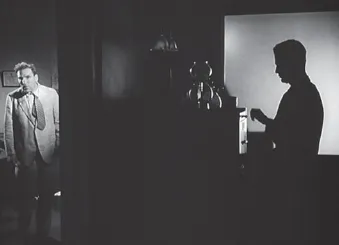
Dectective noir: danger lurks in the private eye’s office in The Dark Corner.
A fact that cannot be ignored in any analysis of film noir is its stark and provocative sexual politics. Critics recognize that one of the principal motivating factors behind the body of films which make up the category is the need to express a deep anxiety about gender which could not easily be expressed in other ways, especially a crisis in masculine identity. The crisis is usually explained by the shift in gender roles occasioned by America’s entry into the Second World War, when women were required to enter the factories to replace the men despatched to the home front, and were then returned to their domestic sphere after the war. This produced in the cultural imaginary a need for cautionary tales about assertive, independent women – a negative fantasy most memorably embodied in another of noir’s most enduring character types, the femme fatale. As well as being the product of unique historical factors, this attitude to women conforms to a long-established tendency in Western art and culture to define women in relation to men, and to base this definition on their sexual identity.11 Essays by feminist critics on noir remind us that the vast majority of women in film noir conform to only two types: ‘the excit...
Table of contents
- Front Cover
- Half Title
- Title Page
- Copyright
- Contents
- Introduction
- 1 History: The Private Eye Film
- 2 Seeing: Literature, Film and the World of the Private Eye
- 3 Working: The Private Eye and the Spaces of Noir
- 4 Policing: Gender and Desire ‘in the Private Eye’
- Conclusion
- REFERENCES
- SELECT BIBLIOGRAPHY
- ACKNOWLEDGEMENTS
- INDEX
Frequently asked questions
Yes, you can cancel anytime from the Subscription tab in your account settings on the Perlego website. Your subscription will stay active until the end of your current billing period. Learn how to cancel your subscription
No, books cannot be downloaded as external files, such as PDFs, for use outside of Perlego. However, you can download books within the Perlego app for offline reading on mobile or tablet. Learn how to download books offline
Perlego offers two plans: Essential and Complete
- Essential is ideal for learners and professionals who enjoy exploring a wide range of subjects. Access the Essential Library with 800,000+ trusted titles and best-sellers across business, personal growth, and the humanities. Includes unlimited reading time and Standard Read Aloud voice.
- Complete: Perfect for advanced learners and researchers needing full, unrestricted access. Unlock 1.5M+ books across hundreds of subjects, including academic and specialized titles. The Complete Plan also includes advanced features like Premium Read Aloud and Research Assistant.
We are an online textbook subscription service, where you can get access to an entire online library for less than the price of a single book per month. With over 1.5 million books across 990+ topics, we’ve got you covered! Learn about our mission
Look out for the read-aloud symbol on your next book to see if you can listen to it. The read-aloud tool reads text aloud for you, highlighting the text as it is being read. You can pause it, speed it up and slow it down. Learn more about Read Aloud
Yes! You can use the Perlego app on both iOS and Android devices to read anytime, anywhere — even offline. Perfect for commutes or when you’re on the go.
Please note we cannot support devices running on iOS 13 and Android 7 or earlier. Learn more about using the app
Please note we cannot support devices running on iOS 13 and Android 7 or earlier. Learn more about using the app
Yes, you can access The Private Eye by Bran Nicol in PDF and/or ePUB format, as well as other popular books in Medien & darstellende Kunst & Film & Video. We have over 1.5 million books available in our catalogue for you to explore.