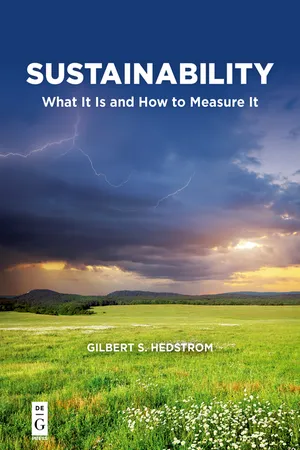
Sustainability: What It Is and How to Measure It begins with a succinct business-focused summary of how to think about the risks and opportunities associated with sustainability. The author then includes his proprietary framework, The Corporate Sustainability Scorecard TM C-suite rating system, including the over 140 key sustainability indicators that are used to rate an organization's sustainability efforts. Each KSI includes examples from organizations around the world, giving the reader a complete and unbiased understanding of all aspects of sustainability. The Scorecard has been developed over the past 20 years and used by more than 70 corporations to rate themselves on sustainability.
Gilbert S. Hedstrom illustrates the use of the Scorecard with hundreds of examples. He discusses sustainability transformation, governance, and strategy and execution. Social responsibility and environmental stewardship form important parts of his discourse in this important contribution to the debate on sustainability that will benefit business executives and those interested in sustainability and business.
Read the author's related article on the NACD blog here: https://blog.nacdonline.org/posts/pge-lessons-oversight
Part 1 provides an overview of sustainability from a business practitioner’s perspective. For those new to the subject, this part begins by answering the basic questions:
–What’s it all about? How does it really relate to businesses working to increase shareholder value?
–Why bother with this stuff at all? Is it required by law? Is it just the new version of corporate philanthropy and environment, health, and safety (EHS)?
–How do I make sense of all this terminology? Is sustainability the same as environmental, social, and governance (ESG)? What about carbon footprint—how does that fit in? Some companies talk about becoming “net positive”—what’s that about?
–What does it mean for my industry sector? I get that the coal industry is under the gun and that Nike and Apple have responsibility for working conditions in their supply chains. But this sustainability stuff must mean very different things for companies in the automotive, chemical, healthcare, and utility sectors—to name a few.
This part then gives an overview of each of the four main “buckets” of sustainability: governance and leadership; strategy and execution; environmental stewardship; and social responsibility. Part 1 ends with a brief overview of how to think about the new ESG requirements being imposed on businesses globally.
Chapter 1 Sustainability in 2020 and Beyond
The transformation of companies—even entire industries—is not new. DHL and FedEx reinvented shipping in the 1970s.i Apple created new products seemingly before individuals knew they wanted them.
The transformation happening today is underpinned by a profound realization. Across industries today, companies increasingly recognize that the “take–make– waste” industrial model is no longer viable. That model is being replaced by a new circular economy that offers significant business opportunity by creating wealth from waste.”ii
The Drivers: Economics 101
In a nutshell, here is the problem—and opportunity: Human society has bumped up against the limits of economic and natural systems.
Modern industrialism developed in a world far different from the one we live in today: people were few, while natural resources were plentiful. What emerged was a highly productive, take-make-waste system. Take resources out of the earth; make stuff; and throw it away. That system worked for a long time until stuff started to pile up—either visibly or invisibly (like carbon in the atmosphere).
Not anymore. The current model is simply not sustainable; that is, not able to be maintained at a certain rate or level, and not able to be upheld or defended.
The basic laws of supply and demand will wreak havoc for many companies while presenting significant opportunities for others. This transformation largely will transpire between now and 2030, driven by the economics of “supply and demand” (as Figure 1.1 illustrates).
Figure 1.1: Growing Demand
–Demand: From 2015 to 2030, the global middle class will double in size from 2.5 billion to about 5 billion.iii Stop and think about that—particularly if you have spent time in Beijing, Shanghai, Mexico City, or a similar city. Unless things change dramatically, the demand will double for food, cars, soda, diapers, and other “stuff” that today is purchased and discarded.
–Supply: Every company and industry requires a baseload supply of a stable physical environment within which to operate. Yet, to support this rapidly growing middle class demand, with a fixed amount of land, forest cover, fresh water, and other nonrenewable resources on the planet, the environmental stability is dwindling.iv
–Prices: What happens when demand grows while supply is fixed or declining? Economics 101 teaches us that prices increase (at least in the absence of other market forces, such as tax incentives). Unfortunately, the powerful forces of supply and demand have been constrained by inadequate market pricing signals, especially related to carbon and water. (Water is more expensive in Flint, Michigan—adjacent to the Great Lakes which hold one fifth of the global fresh water supply—than it is in the dessert-like conditions around Phoenix, Arizona.)
With respect to carbon, leading companies manage this situation by placing an internal price on carbon. A study by CDP (formerly Carbon Disclosure Project) noted that in 2016, 517 companies were using internal carbon pricing as an accounting and risk management tool (19 percent increase from 2015), and an additional 732 companies planned to implement one by 2018 (26 percent increase from 2015).v
Author’s advice: In my dozens of meetings in corporate boardrooms, I find that eyes glaze over when executives hear about global population growth (the left side of Figure 1.1). But the right side of this figure grabs their attention. Every CEO is thinking about the next decade.
Sustainability: Four Big Buckets
In the 1990s, sustainability was often characterized as the triple bottom line of people, planet, and profits. A number of years later, the phrase ESG took over, referring to the environmental, social, and governance factors impacting an investment decision. Taken together, these define the four big buckets of the sustainability conversation:
–Environmental Stewardship: Reducing waste; cutting carbon and other emissions; managing water quality and quantity; ensuring the materials used in our products are nontoxic, recyclable, reusable, etc.; reducing packaging; owning responsibility for products at the end of their useful life.
–Social Responsibility: Taking responsibility for the labor situation that your suppliers (and their suppliers) engage in; eliminating human rights abuses (e.g., child labor, forced labor, etc.); ensuring diversity and inclusion not only in your company but also throughout your value chain; being a good neighbor.
–Governance: Defined broadly as “how we run the place”—meaning the organization, structure, culture from the boardroom to the shop floor; the goals and metrics that incent behavior; engagement with internal and external stakeholders; disclosure and reporting.
–Strategy and Execution: Determining how our company can actually grow and be profitable while also reducing our full life-cycle (negative) impacts—and helping our customers do the same; creating value for society as well as for shareholders.
The sustainability conversation, as depicted on the left side of Figure 1.2, has been long dominated by environmental and social headlines. Indeed, the vast majority of articles and books written about sustainability over the past thirty years have focused largely on the environment: degradation, resource limits, externalities, climate change, pesticides, toxics, and waste. How depressing!
Dozens of books describe the global environmental challenges, while too many business-oriented books paint a picture that sustainability is all about “win-win” and “green is gold.” This is far too simplistic and often just not true. Moreover, not only has the subject been beaten to death, it is the wrong conversation.
Figure 1.2: The Changing Sustainability Conversation
The Huge Business Opportunity
With the supply and demand curves converging, the world is on the cusp of a resource revolution.
This new industrial revolution will enable strong economic growth at an environmental “cost” (in terms of externalities such as pollution, CO2 emissions, etc.) far lower than in the past. Realistically, achieving high-productivity economic growth to support the 2.5 billion new members of the middle class presents the largest wealth-creation opportunity since the dawn of the industrial revolution.vi
Because sustainability is fundamentally about industry transformation, board members and C-suite executives have found it helpful to assess their company’s current corporate sustainability position in terms of four stages—depicted in Figure 1.3. The four-stage transformation model described below refers to Hedstrom Associates’ Corporate Sustainability ScorecardTM.
The four-stage transformation model helps companies assess and manage progress proactively through the “messy transformation.” During the early stages, this involves engaging deeply with (and learning about) sustainability. Toward Stage 3 and Stage 4, it often involves disruptive innovation—in the way that Airbnb, Tesla, a...
Table of contents
Cover
Title Page
Copyright
Dedication
Contents
Part 1
Part 2
Appendix A: Definitions
Index
Frequently asked questions
Yes, you can cancel anytime from the Subscription tab in your account settings on the Perlego website. Your subscription will stay active until the end of your current billing period. Learn how to cancel your subscription
No, books cannot be downloaded as external files, such as PDFs, for use outside of Perlego. However, you can download books within the Perlego app for offline reading on mobile or tablet. Learn how to download books offline
Perlego offers two plans: Essential and Complete
Essential is ideal for learners and professionals who enjoy exploring a wide range of subjects. Access the Essential Library with 800,000+ trusted titles and best-sellers across business, personal growth, and the humanities. Includes unlimited reading time and Standard Read Aloud voice.
Complete: Perfect for advanced learners and researchers needing full, unrestricted access. Unlock 1.4M+ books across hundreds of subjects, including academic and specialized titles. The Complete Plan also includes advanced features like Premium Read Aloud and Research Assistant.
Both plans are available with monthly, semester, or annual billing cycles.
We are an online textbook subscription service, where you can get access to an entire online library for less than the price of a single book per month. With over 1 million books across 990+ topics, we’ve got you covered! Learn about our mission
Look out for the read-aloud symbol on your next book to see if you can listen to it. The read-aloud tool reads text aloud for you, highlighting the text as it is being read. You can pause it, speed it up and slow it down. Learn more about Read Aloud
Yes! You can use the Perlego app on both iOS and Android devices to read anytime, anywhere — even offline. Perfect for commutes or when you’re on the go. Please note we cannot support devices running on iOS 13 and Android 7 or earlier. Learn more about using the app
Yes, you can access Sustainability by Gilbert S. Hedstrom in PDF and/or ePUB format, as well as other popular books in Economia & Imprenditoria. We have over one million books available in our catalogue for you to explore.