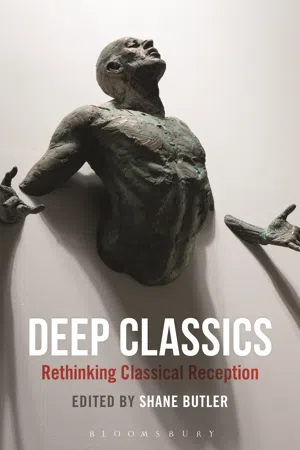
Fragmented, buried, and largely lost, the classical past presents formidable obstacles to anyone who would seek to know it. 'Deep Classics' is the study of these obstacles and, in particular, of the way in which the contemplation of the classical past resembles – and has even provided a model for – other kinds of human endeavor. This volume offers a new way to understand the modalities and aims of Classics itself, through the ages. Its individual chapters draw fruitful connections between the reception of the classical and current concerns in philosophy of mind, cognitive theory, epistemology, media studies, sense studies, aesthetics, queer theory and eco-criticism.
What does the study of the ancient past teach us about our encounters with our own more recent but still elusive memories? What do our always partial reconstructions of ancient sites tell us about the limits of our ability to know our own world, or to imagine our future? What does the reader of the lacunose and corrupted literatures of antiquity learn thereby about literature and language themselves? What does a shattered statue reveal about art, matter, sensation, experience, life? Does the way in which these vestiges of the past are encountered – sitting in a library, standing in a gallery, moving through a ruin – condition our responses to them and alter their significance? And finally, how has the contemplation of antiquity helped to shape seemingly unrelated disciplines, including not only other humanistic and scientific epistemologies but also non-scholarly modes and practices? In asking these and similar questions, Deep Classics makes a pointed intervention in the study of the classical tradition, now more widely known as 'reception studies'.
- 368 pages
- English
- ePUB (mobile friendly)
- Available on iOS & Android
eBook - ePub
About this book
Trusted by 375,005 students
Access to over 1.5 million titles for a fair monthly price.
Study more efficiently using our study tools.
Information
1
Homer’s Deep*
Shane Butler
When we speak of “the wine-dark sea,” we think of Homer and of the thirty centuries that lie between us and him.
Borges, ‘The Riddle of Poetry’1
Achilles, on the beach, stares out at a word. What does he see, in the sea? This turns out to be hard to say. His eyes choked with tears, perhaps he does not really ‘see’ anything at all, like the blind poet who has put him there. Of course, Homer himself may never have been seen except in the mind’s eye of those who, in some distant age, felt moved to invent him, as the author of poems that, for them, were already ancient. Nevertheless, someone was there as the Iliad came into being, however long that took, and he or she or they must have found a soul mate in the passionate hero who is as much a lover of words as he is of deeds. For after storming away from the Greek camp in disgust, Achilles has whiled away much of the poem on this very beach, ‘gladdening his heart’2 by singing and strumming the lyre he learned to play, as a boy, from a centaur. There is no gladness now, but if, in the grief-stricken silence that he is about to break, he could hear the poet who has crafted him, or the readers who still conjure him, we can be sure that his musical ear would know that what he is made to look at is not just a sight, but a sound. It is, in fact, a familiar sound, as familiar as the waves that strike the shore, a phrase repeated over and over in the Iliad, and again in the Odyssey, always at the end of the line, crashing into the margin (before our eyes recede towards the start of the next verse), forever churning away at the same vowels and consonants: oinopa ponton, oinopa ponton, oinopa ponton.
‘And sore troubled spake he, looking forth across the wine-dark sea’ (ὀχθήσας δ᾽ἄρα εἶπεν ἰδὼν ἐπὶ οἴνοπα πόντον).3 As his lips part, however, all that Achilles can really see and hear is the one thing he can no longer see or hear – except in haunting dreams, where, to his despair, the more important sense of touch has eluded him. For all his thoughts are on Patroclus, whose lifeless body still awaits reluctant flames nearby. And it is of Patroclus that, upon the dying syllables of the narrator’s oinopa ponton, Achilles himself is about to speak. Or rather, of Patroclus he is about to sing, for all of Homer’s poem was originally meant for the music we now mostly hear only in the dactyls and spondees of its meter, long short short, long long, oinopa ponton, the same metrical pattern out of which Beethoven crafts the entire second movement of his haunting seventh symphony. The meaning of this sweetly sonorous phrase, however, confronts us with a puzzle. There is nothing mysterious about the second word, the accusative case of pontos, ‘sea’. It is instead the first that gives us pause. What does oinopa mean? In ancient word lists and modern dictionaries of Ancient Greek, we find it under oinops, though such a form appears nowhere else, for it is now and probably was then no more than a reconstruction of the nominative form of a word that Homer never uses in that case, a reconstruction that partly depends on the word’s evident derivation from oinos, ‘wine’, and ops, a root designating vision that, as a standalone word, can mean ‘face’. What presumably is the same word also appears as a proper name, not only in Homer but in tablets written in Linear B, meaning that it is as old as the oldest known form of Greek, spoken centuries before Homer – indeed, at the notional time of the Trojan War itself.4 In other words, oinops fell out of common use after stable shape was given to the Homeric epics, which thus preserved a word destined for extinction while the living language continued to evolve.
Regarding this spectacular fossil, far more ancient than what we normally mean when we say ‘Ancient Greek’, the dictionary offers ‘wine-dark’ as the ‘conventional’ English equivalent,5 though the hyphenated adjective is no older than 1882, when it first appeared in the English translation of the Iliad quoted above. The rendering has been remarkably influential, so much so that ‘wine-dark’ may well now be the most famous ‘word’ in Homeric English. Nevertheless, the trio of translators who coined it, two Englishmen and a Scot, were used to vistas very different from those of the eastern Mediterranean, and their solution can hardly be said to have settled the matter. Long before them, and still today, the fraught question of how the sea, to Greek eyes, might have looked like wine has exercised the imaginations of philologists, poets, and even a prime minister, William Gladstone.6 These have sought to explain the word in terms of hue (possibly under a crimson sunset), saturation (a sea as blue as wine is red), or surface (the froth and foam of fermenting wine, or else, as Ezra Pound stops to suggest in a couple of Cantos, the ‘gloss’ of wine in the cup7) – or perhaps even as evidence that the Ancient Greeks had not yet evolved a capacity to see colors. (This last theory was the prime minister’s.) Recent investigations of Greek color words observe instead that they often function in complex networks of synesthetic reference; accordingly it has been suggested that oinops does not mean that the sea looks like wine but, rather, that looking at the sea, alluring but dangerous, is like tasting wine and drinking deeply.8 One can expand this suggestion by noting that, whatever the actual etymology of oinops, a Greek listener would also have heard in its last letters, ops, not just a word for ‘face’ but a homonym meaning ‘voice’ and might therefore have brought to mind the inebriating sounds of the sea.9 But just when this seems to make good sense of things, we face a vexing complication: Homer uses the same adjective of cattle, looking at or listening to which can perhaps be soothing – but intoxicating? How now, wine-dark cow? And so we are back more or less where we started, really none the wiser. What is oinops? It is what Homer calls the sea. And it is not entirely impossible that not even he or his singers, for whom oinopa ponton may well have been an inherited formula, i.e., a ready-made building block for epic songs, could have told us clearly and consistently what its thoroughly ancient adjective meant. Want to know exactly what Achilles saw? You would have to ask Achilles. And as Odysseus learns when he interrogates the hero’s shade in the Iliad’s sequel, all Achilles is likely to tell us is that to survey eternally, even as a king, the vast, dark realm of the dead is something he would gladly trade for the chance to look once more upon the land of the living:
Though absent long,
These forms of beauty have not been to me,
As is a landscape to a blind man’s eye …
What he never again will see, we ourselves still struggle to remember. Short-sighted readers of a blind poet, dwarves who stand not so much on the shoulders of giant Achilles as in his shadow, we seem condemned to remain forever in the dark, because we never have been anywhere else.
There is, however, another way to look at things. The indecipherability of oinopa ponton may indeed seem a serious defect to the literally minded. But let us consider the point of view of a more sensitive reader, perhaps one romantic (and Romantic) enough to recognize that the lines I have just foisted on Achilles come not from Homer, but from Wordsworth, from a poem in which a ruin embodies the enduring truth of time itself.10 In the eyes of such a reader, the lexical mystery about what face of the sea confronts Achilles and his unspeakable grief cannot but perfect the scene, like a veil thrown over a mirror as Jewish mourners sit shiva, or better, like the one with which the ancient painter Timanthes concealed the unrepresentable face of Agamemnon at the sacrifice of his daughter Iphigenia, demanded before the Greeks could launch the thousand ships that brought them to the Trojan shore.11 Such a reader stands not in Achilles’ shadow, but side-by-side with him, staring at what neither can really fathom. In fact, Achilles and his reader have been here before, in book 1, after Agamemnon has taken from him the slave-girl Briseis, prompting the ‘wrath’ that already has provided the poem’s very first word. Then too Achilles turns his eyes towards the oinopa ponton.12 Or so one usually reads, though the ancient Alexandrian critic Aristarchus, followed on this point by a few modern editors, thought that the first word there should be the accusative of apeiron, allowing Achilles to stare out at a sea as ‘boundless’ as his fury.13 The substitution is a prosaic one, but it has the merit of suggesting that oinopa occupies the very space of infinitude itself, as if Aristarchus were seeking to literalize the way in which the word had perhaps already begun to resist ‘definition’. In other words, oinops would come not merely to name that which cannot be defined (like apeiron) but actually to enact the condition of indefinability, as a kind of mimetic super-signifier of what defies words, a name for the unnamable. And it is precisely as a ruin, like the ‘steep and lofty cliffs’ of Wordsworth’s Tintern Abbey, that it is able to do so, at least for the Romantic reader, reconnecting human forms and words to a seemingly limitless world. One can explain the basic mechanism here simply as the opening up of the text to the reader’s imagination; alternatively, we can here diagnose an illusion of conscious contact with what Lacan calls the real, that fantastical realm before and beyond language from which each of us already had been banished by the time we learned to speak – which we might find suggestively echoed, in our opening example, by the fact that Achilles is on the verge of words, and facing the watery habitat of his mother, the sea-goddess Thetis. But however explained, what remains key is the fact that this mechanism has been set in motion not so much by the hand of the poet as by the poetic hand of time itself, synchronizing a horizon of knowledge in the text (the limitless grief of Achilles, which not even he can fully grasp) with the reader’s horizon of knowledge of the text (beyond which lies any sure definition of oinops): the reader’s struggle to make sense of things aligns with that of the hero.
Thus...
Table of contents
- Cover
- Series Text
- Title Page
- Contents
- Acknowledgements
- List of Contributors
- Introduction On the Origin of ‘Deep Classics’
- 1 Homer’s Deep
- 2 The Sigh of Philhellenism
- 3 Feeling on the Surface: Touch and Emotion in Fuseli and Homer
- 4 Perceiving (in) Depth: Landscape, Sculpture, Ruin
- 5 Etymological ‘Alterity’: Depths and Heights
- 6 Shut Your Eyes and See: Digesting the Past with Nietzsche and Joyce
- 7 The Loss of Telos: Pasolini, Fugard, and the Oresteia
- 8 Kings of the Stone Age, or How to Read an Ancient Inscription
- 9 Queer Unhistoricism: Scholars, Metalepsis, and Interventions of the Unruly Past
- 10 Medea’s Erotic Jealousy
- 11 Ghostwritten Classics
- 12 Relic | channel | ghost: Centaurs in Algernon Blackwood’s The Centaur
- 13 Circulation of Spectres: Ghosts and Spells
- 14 Cosmopoiesis in the Field of ‘The Classical’
- 15 Borges and the Disclosure of Antiquity
- Bibliography
- Index
- Copyright
Frequently asked questions
Yes, you can cancel anytime from the Subscription tab in your account settings on the Perlego website. Your subscription will stay active until the end of your current billing period. Learn how to cancel your subscription
No, books cannot be downloaded as external files, such as PDFs, for use outside of Perlego. However, you can download books within the Perlego app for offline reading on mobile or tablet. Learn how to download books offline
Perlego offers two plans: Essential and Complete
- Essential is ideal for learners and professionals who enjoy exploring a wide range of subjects. Access the Essential Library with 800,000+ trusted titles and best-sellers across business, personal growth, and the humanities. Includes unlimited reading time and Standard Read Aloud voice.
- Complete: Perfect for advanced learners and researchers needing full, unrestricted access. Unlock 1.5M+ books across hundreds of subjects, including academic and specialized titles. The Complete Plan also includes advanced features like Premium Read Aloud and Research Assistant.
We are an online textbook subscription service, where you can get access to an entire online library for less than the price of a single book per month. With over 1.5 million books across 990+ topics, we’ve got you covered! Learn about our mission
Look out for the read-aloud symbol on your next book to see if you can listen to it. The read-aloud tool reads text aloud for you, highlighting the text as it is being read. You can pause it, speed it up and slow it down. Learn more about Read Aloud
Yes! You can use the Perlego app on both iOS and Android devices to read anytime, anywhere — even offline. Perfect for commutes or when you’re on the go.
Please note we cannot support devices running on iOS 13 and Android 7 or earlier. Learn more about using the app
Please note we cannot support devices running on iOS 13 and Android 7 or earlier. Learn more about using the app
Yes, you can access Deep Classics by Shane Butler in PDF and/or ePUB format, as well as other popular books in Art & History of Ancient Art. We have over 1.5 million books available in our catalogue for you to explore.