![]()
Chapter 1
THE EARLY HISTORY
THIS CHAPTER CONTAINS an informal account of the early history of the issue of solvability of equations of degrees one, two, and three in a single unknown. The formulas that provide the solutions lead in a natural way to the discussion of the origins of complex numbers. We also take this opportunity to review some well-known information about the quadratic equation.
1.1 The Breakthrough
There is a general agreement among historians of mathematics that modern mathematics came into being in the mid sixteenth century when the combined efforts of the Italian mathematicians Scipione del Ferro, Niccolò Tartaglia, and Gerolamo Cardano produced a formula for the solution of cubic equations. For the first time ever west European mathematicians succeeded in cracking a problem whose solution eluded the best mathematical minds of antiquity. Archimedes, one of the greatest mathematicians, scientists, and engineers of all times, had solved some cubic equations in terms of the intersections of a suitable parabola and hyperbola. Omar Khayyam, one of the most prominent of the Arab mathematicians and poets, also expended much effort on his geometrical solutions of special cases of the cubic equation but could not find the general formula. However, the significance of this accomplishment of the Renaissance mathematicians is not limited to the difficulty of the problem that was solved. We shall try to show how the issues raised by this solution eventually led to the creation of modern algebra and the discovery of mathematical landscapes that were undreamt of, even by such imaginative investigators as Archimedes and Khayyam.
The interest in algebraic equations goes back to the beginnings of written history. The Rhind Mathematical Papyrus, found in Egypt circa 1856 is a copy of a list of mathematical problems compiled some time during the second half of the nineteenth century BCE, or possibly even earlier. The twenty-fourth of these problems reads: “A quantity and its 1/7 added become 19. What is the quantity?” In other words, what is the solution to the equation
The method employed by the scribe has come to be known as the method of false position. He replaces the unknown by 7 and observes that
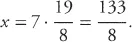
From this he concludes that the correct answer is obtained upon multiplying the first guess of 7 by 19/8:
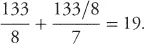
Interestingly enough, the scribe does double check his solution by substituting it into the original problem and verifying that
We will not discuss the merits and limitations of the method of false position except to note that the idea of obtaining a correct solution to an equation by starting out with a possibly false guess and then modifying that guess has been refined into powerful techniques for finding numerical solutions, one of which will be described in Section 3.3. We do, however, wish to point out that the general first-degree equation is today defined as
and that the rules of algebra yield
as its unique solution.
The Mesopotamian mathematicians of that time could solve much more intricate equations, and had in fact already developed techniques for solving what we nowadays call quadratic equations. These techniques employed the geometrical method of “completing the square.” The Greeks, Indians, and Arabs all were aware of this method, having either derived them independently or perhaps learnt them from their predecessors and/or neighbors. In the ninth century the Persian mathematician al-Khwarizmi
wrote the book
Hisab al-jabr w’al-muqa-balah in which he carefully explained a compendium of algebraic techniques learnt from several past civilizations. The clarity of his exposition won both him and his book immortality in that the portion
al-jabr of the title evolved into the word
algebra, and the author’s name is the source of the word
algorithm. An excerpt from this book expounding the solution to the quadratic equation
appears in Appendix A. The modern solution of the quadratic also relies on the completion of the square. The general quadratic equation has the f...