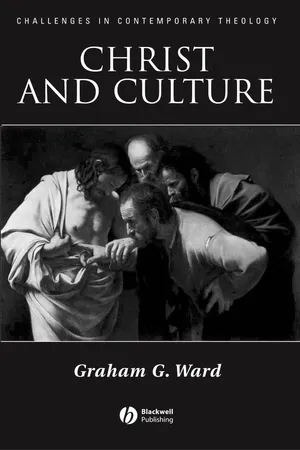
- Takes as its starting point Niebuhr's famous volume on 'Christ and Culture' published in the 1970s
- Explores representations of Christ from sources as diverse as the New Testament and twentieth-century continental philosophy
- Considers Christ and culture in the light of contemporary categories such as the body, gender, desire, politics and the sublime
- Develops an original and imaginative Christology rooted in Scriptural exegesis and concerned with today's cultural issues
- The author has been described as 'the most visionary theologian of his generation'.
eBook - ePub
Christ and Culture
About this book
Leading theologian Graham Ward presents a stimulating series of reflections on Christ and contemporary culture.
Trusted by 375,005 students
Access to over 1 million titles for a fair monthly price.
Study more efficiently using our study tools.
Information
Part One
THE ECONOMY OF RESPONSE
Chapter One
CHRISTOLOGY AND MIMESIS
En ho metro metreite metrethesetai umin kai prostethesetai umin. (Mark 4.24)
The Economy of Response
No commentator has adequately been able to ‘explain’ it. ‘The difficulty about 4.24 still remains; [Mark] must have brought it in, though it is hardly relevant, because he wished to use the latter saying [v.25]’.1 Most commentators look outside the text to an alleged source in the scattered sayings of Q in order to expand upon their difficulty in commentating upon it and their difficulty in understanding it within its context.2 A number of commentators have drawn attention to its obscurity.3 Several have assumed that its rewrite in Matthew 7.2 and Luke 6.38, where it is understood as a proverb about judgement, is the closest we get to understanding Mark’s original intention.4 So that, overall, this verse could be said to sum up Mark’s clumsiness as an editor.5
What I wish to draw attention to are three ambiguities in this verse and how the writer relates (and represses) them through his style. For the verse has a distinct rhythm that arises from the writer’s use of assonance, alliteration and balanced clausing.
First, there is the problem of understanding the character of the en, which is often interpreted as an instrumental dative. But I would suggest that the en bears something of a locative connotation also – that the measure (or the measuring) is understood both instrumentally and as a state or condition that can be inhabited.6 The measure is not simply an object to be applied (in order to facilitate judgement), it is a state within which we are already located. It is an active state which, should we continue to participate in it, will affect where and who we will be.
Secondly, there is the difficulty of identifying the umin, the you that is the subject of the sentence. The umin is always already within the process of a measuring that is locating and identifying it. Who are the umin? Jesus, who is set apart (kata monas), is speaking in the midst of his twelve appointed ones, but at the request of ‘those around him with [sun] the twelve’ (4.10). Umin could then refer to several communities of listeners, including the congregation of the church listening to the reading of the gospel. The Markan text is scattered throughout with what might be called suspended pronouns, pronouns referring to subjects that are not stably identified (see 1.45, 2.15 and 3.2 for others). This umin reaches out concentrically, passing through and beyond several referents. It is always being added to (and prostethesetai carries with it the sense of ‘to continue to do something’).
Thirdly, there is the question of the verb ‘to measure’. What is the act of measuring within the context of understanding parables; within the context also of listening as an act of obedience (akouete)? Listening for what, to what? We hear not a proposition but a carefully orchestrated set of phonemes. The verse performs far more than it states. What we obey is the call to perform (by listening) the rhythm of the sentence. What we obey is the call to participate in, by responding to, a poetic economy, a metre. Metron can, of course mean ‘metre’ – metre in the context of melos (tune) and rhythmos (time) in classical poetics. And the sentence has a distinctive anapaestic rhythm.
The effect of these three ambiguities is to render prepositional logic subservient to (because subverted by) rhetoric.7 Of course the sentence refers to an intelligible object and process; it is not nonsense. But its reference is neither simple nor single and, in the absence of a determinative context, its semantic openness promotes a crisis of representation. For its meaning cannot be decoded; we understand nothing specific beyond the fact that it seems to describe an apodictic law (moral? spiritual? existential?) of response, of responding. It points to, without elaborating, an economy of response. It presents and performs the experience of circling back upon oneself, of being caught up with a repetition of what one is already familiar with. We are already ‘measuring’, we have already measured, as we participate in the ongoing process of Mark’s narrative that bears us towards some promised eschatological judgement – that future, final and absolute measurement.
What we have in this little phrase, I suggest, is a parable of the readers of/listeners to the Gospel, who correspond to the ones who sat and listened to Jesus himself. It is, in cameo, the mimetic process whereby the hermeneut, the one engaged in hearing and re-creating the story, moves out towards that which has already been given and will now be reappropriated anew. The ‘measuring’ is the act of engagement in an economy of response. The ‘measure’ is the rhythm of the mimetic process (linked to metre) that enables one to judge and to understand, but not as one who is outside; only as one who is inside, who, by participating, moves towards that which will be given to him or her. Mimesis is the measure. Jesus kata monas does not simply speak but generates the call to be involved, to interpret, interpret from within the process. The call is therefore an empowering – of the twelve, those vaguely suggested ones who are with the twelve, the writer himself, Mark’s own listeners (the Christian Church in its local particularity and its universal extension). We are all caught up in the representational process, within a mimetic schema that calls forth and calls for interpretation and reinterpretation. Mimesis, I suggest, is the nature of revelation itself (a revelation inseparable from its mediation).
What follows in this chapter is an argument for the rootedness of both the character of Mark’s Christ (who has been sent as God’s representative) and the character of Mark’s Gospel in a theology of mimesis and poiesis.8
Mimesis and Narrative
The approach being adopted needs some clarification, at this point. Mimesis has the body of an eel and a literary/reader–response analysis of the Gospel is far from original.9
Mimesis concerns the character of representation. That character can be understood in three inseparable ways: the kind of world presented in the narrative; the way that world is portrayed and communicated to the readers/listeners; and the way that kind of world and its portrayal is reconstituted and reportrayed in the minds and imaginations of those who read/listen.10 Mimesis is, then, both a literary and a social praxis. Aristotle already saw this: ‘imitation’ was both what the text did vis-à-vis the world ‘out there’ (Poetics 1448a) and an anthropological a priori whereby human beings were educated and socialised (Poetics 1448b5). It is the nature of the correspondence between aesthetic/rhetorical activity and social activity that has provoked so much debate over the centuries since Aristotle. The work today of René Girard, Paul Ricœur, Jean-François Lyotard and Philippe Lacoue-Labarthe indicates that mimesis remains at the forefront of contemporary debates on representation or the symbolic process. For Aristotle, there was an analogical relationship whereby words referred to a world distinct from them and so – ‘art … imitates the works of nature’ (Physics II) – it represents them. But Aristotle also saw that ‘art … completes that which nature is unable to bring to completion’ (ibid.). Art, therefore, idealises and, in this sense, does not strictly mirror what is but imitates what should be or will be. Art here presents rather than represents, for it moves beyond what it represents to the presentation of an ideal form that is otherwise unavailable. The complex character of mimesis begins here – for the aesthetic/rhetorical activity mediates between presentation, representation and absence. Language (or whatever the artistic medium) mediates the natural, the ideal and the unnameable. It mediates several orders of the real.
Mimesis, the character of this mediation, is, then, associated with knowledge and the process whereby we come to know (Aristotle’s imitation). It is also associated with form, for all representation (or presentation) is the representation of something. The form represents an object, but an object caught between the way it acts upon (the one who represents it) and the way it is acted upon (by the one who represents it). The object is always and only imitated through the twin activities of reception and projection – that is, within the economy of response. The form is always of an action, and is, therefore, an element in a narrative. Hence in Poetics all the roads of representation lead into a discussion about drama. Mimesis is inseparable from muthos and poiesis (the process whereby language bodies forth its representation). Some philosophers would take this further and claim narrative as a fundamental category for epistemology – that there is no knowledge that is not mediated and part of ‘the way we tell the story’ of what we know. As John Milbank put it towards the end of his magnum opus: ‘narrative is simply the mode in which the entirety of reality presents itself to us: without the story of the tree, there is no distinguishable, abiding tree’.11 This is a shift in part away from Aristotle who, at one level, maintained that language referred to nature, it did not invent it.12 But it is also a development of Aristotle’s notion that art presents what is otherwise unavailable to us (the idealised reality). It presents by performing, and the negotiation between performance and re...
Table of contents
- Cover
- Challenges in Contemporary Theology
- Title
- Copyright
- Dedication
- ACKNOWLEDGEMENTS
- INTRODUCTION
- Part One: THE ECONOMY OF RESPONSE
- Part Two: ENGENDERING CHRIST
- Part Three: THE LIVING CHRIST: ECONOMIES OF REDEMPTION
- INDEX
- End User License Agreement
Frequently asked questions
Yes, you can cancel anytime from the Subscription tab in your account settings on the Perlego website. Your subscription will stay active until the end of your current billing period. Learn how to cancel your subscription
No, books cannot be downloaded as external files, such as PDFs, for use outside of Perlego. However, you can download books within the Perlego app for offline reading on mobile or tablet. Learn how to download books offline
Perlego offers two plans: Essential and Complete
- Essential is ideal for learners and professionals who enjoy exploring a wide range of subjects. Access the Essential Library with 800,000+ trusted titles and best-sellers across business, personal growth, and the humanities. Includes unlimited reading time and Standard Read Aloud voice.
- Complete: Perfect for advanced learners and researchers needing full, unrestricted access. Unlock 1.4M+ books across hundreds of subjects, including academic and specialized titles. The Complete Plan also includes advanced features like Premium Read Aloud and Research Assistant.
We are an online textbook subscription service, where you can get access to an entire online library for less than the price of a single book per month. With over 1 million books across 990+ topics, we’ve got you covered! Learn about our mission
Look out for the read-aloud symbol on your next book to see if you can listen to it. The read-aloud tool reads text aloud for you, highlighting the text as it is being read. You can pause it, speed it up and slow it down. Learn more about Read Aloud
Yes! You can use the Perlego app on both iOS and Android devices to read anytime, anywhere — even offline. Perfect for commutes or when you’re on the go.
Please note we cannot support devices running on iOS 13 and Android 7 or earlier. Learn more about using the app
Please note we cannot support devices running on iOS 13 and Android 7 or earlier. Learn more about using the app
Yes, you can access Christ and Culture by Graham Ward in PDF and/or ePUB format, as well as other popular books in Theology & Religion & Religion. We have over one million books available in our catalogue for you to explore.