![]()
Chapter 1
Business Vows
What Is a Proposal and Why It Is Necessary
What They Can Do and What They Can’t Do
A proposal is a summation, not an explanation. It is a summary of the conceptual agreement you’ve reached with an economic buyer and not a negotiating document or an attempt to make a sale.
Therefore, it is formed only after conceptual agreement with the buyer has been completed. We talk more about this later in the chapter, but at the outset it’s important to understand that I’m not talking about the generic or stereotypical proposal in this book. Proposals are a summary of what’s come before, to which the buyer has already agreed, and constitute the connection (the synapse from the introduction of this book) to the launch of the project. Proposals are organic documents, which are used to guide and monitor the project, and are not immediately archaic fossils of the Pleistocene Epoch intended for dusty display cases and remote shelves.
Here is what an outstanding proposal can do:
- Summarize and convey formally the conceptual agreements reached in discussions to that point between you and the economic buyer.
- Detail the objectives of the project.
- Provide for the metrics of success.
- Describe the value that will occur once the objectives are met (both personally and professionally).
- Supply options from which the buyer can choose to determine the amount of value sought in return on the investment (ROI) committed.
- Stipulate fees, expense reimbursement, and payment terms.
- Enable immediate acceptance in writing.
My proposals serve as the contract as well as the offer of the contract. They are in plain English, without “third parties shall hold harmless,” because if you include boilerplate legalese, you will ensure that the proposal will wind up in the hands of your prospect’s lawyers, who are so conservative and protective that they’d prefer that the firm not even open the doors every morning in order to prevent any harm from befalling the enterprise.
Here is what proposals cannot and should not do:
- Enable a nonbuyer (gatekeeper, HR, or training person) to proceed to a buyer on your behalf.
- Establish your credibility.
- Establish a relationship with a buyer.
- Serve as a point of comparison for competitors’ proposals.
Case Study: The Federal Reserve
I had submitted my normal 2.5-page proposal to the Fed in New York, the largest of the Federal Reserve Banks. I had been recommended by some of the banks they supervise, which were clients of mine.
It was mandatory to allow legal to review all proposals, and they took two precious weeks, returning a 32-page monstrosity. Once my buyer and I read it—a painful undertaking—we were shocked to find virtually no difference whatsoever, no changes in my aggressive fees or payment terms, but instead an additional 29.5 pages of language worthy of the Rosetta Stone to interpret.
Lawyers are hopeless at two pursuits: running a professional firm based on value, and using the English language to convey meaning.
- Offer vague promises or results and outcomes.
- Include agreements that the buyer has not agreed to prior.
- Serve as a “take it or leave it” alternative.
- Cite legal provisions and covenants.
- Be valid and acceptable without time limits.
- Serve as an agreement for nonvalue relationships, such as pricing by day, participant, materials, labor, and so forth.1
What I’m telling you—and what will influence this entire book—is that proposals have traditionally been viewed incorrectly in professional services. They have been a gallimaufry of credibility, research, consultant’s beliefs and mission, pricing, risk management, and competitive submission.
Glossary
Economic buyer: That individual who can produce a check in return for the value expressed in your proposal without any other approvals from anyone else.
Conceptual agreement: Concurrence with that buyer about the objectives for the project, the metrics that will measure progress and/or success, and the value to the organization and the buyer that will accrue as a result of meeting those objectives.
Gatekeeper: Any person who cannot say yes but can say no and sees it as his or her responsibility to keep you distant from the buyer. In most cases this will include the entire human resources, training, and/or learning and development areas.
All of that is wrong. Those issues need to be covered prior to the proposal being created.
I had been consulting with a pharmaceutical consulting firm in New York for a couple of years, right through a lucrative sale to a larger operation. The most important thing I accomplished was to persuade the firm to stop using a metric of “number of proposals issued per week”! Supposedly, this number was an indicator of sales success (e.g., “27 firms asked for our proposals”) but the “hit rate” was dreadful and an entire back office of resources was wasted creating huge, assembly-line proposals.
Proposals are not the point of the arrow, they are the heft behind the arrow. The penetration and aerodynamics are based on other factors, and we turn to those now to put the positioning and creation of proposals in perspective.
Ironically, most people submit proposals far too early and far too often. They are actually at the conclusion of the sales process, just prior to a project’s launch. When a proposal is accepted, you should be able to begin work immediately.
Their Place in Your Business Model
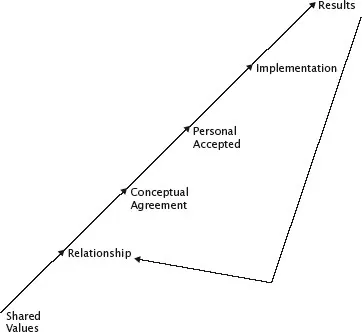
If you don’t know what your business model is, then you have more problems than merely creating better proposals! A relationship with a client is a series of small yeses that culminate in a signed agreement—a proposal that’s accepted. Figure 1.1 is an example of a simple but highly effective business model:
FIGURE 1.1 A consulting business model
You begin with a common value system. I don’t mean a spiritual or religious belief system, but an agreement about business.
For example, I’ve never performed downsizing or “rightsizing” (now there’s a euphemism) because I believe that such actions are simply an attempt to atone for mistakes made in the executive suite. Getting rid of one or two executives who made poor decisions is far better than dumping hundreds of people who have been trying their best. (And experience shows that more than 90 percent of attempts to severely restrict costs and improve profits in downsizing fail to reach their goals.)
That’s what I mean by shared values. If those are in place, you develop a trusting relationship with the buyer. This must be the economic buyer we spoke of earlier. That relationship may take 30 minutes or three meetings. (If it takes several months and you still haven’t achieved it, assume that you two just weren’t meant for each other.) That trusting relationship is essential in my model in order to ensure conceptual agreement.
How you know you have a trusting relationship:
- The buyer shares personal and nonpublic information.
- The buyer asks your advice.
Glossary
Trusting relationship: The buyer and you are comfortable volunteering, questioning, “pushing back,” and sharing issues.
Conceptual agreement: Concurrence between the buyer and the consultant about:
Objectives: Outcome-based business results, not deliverables or tasks.
Metrics: Measures of progress, success, and/or finality.
Value: The impact on the buyer and organization in meeting the objectives.
- You and the buyer challenge each other’s assumptions.
- You feel free to interrupt each other without ill feelings.
- The buyer does not allow interruptions when with you.
- The buyer admits to uncertainty or a welcome new view from you.
The purpose of the trusting relationship is to ensure that the buyer is honest about the next step—the conceptual agreement. This is where you and the buyer jointly frame objectives, metrics, and value.2
An objective is a business result, never a “deliverable” (a favorite word of nonbuyers, primarily in the human resources department). When someone presents you with an input, turn it into an output by asking, “Why is that important?”
Examples:
- Deliverable: Strategy retreat.
- Outcome: New strategy to penetrate overseas markets.
- Deliverable: Coaching for senior vice president.
- Outcome: Improved presence with media to improve company reputation.
- Deliverable: Focus groups.
- Output: Gain customer contributions for best features that will improve sales in product reinvention.
A metric is an observable, detectable indicator of progress or final success.
Examples from above:
- Deliverable: Strategy retreat.
- Outcome: New strategy to penetrate overseas markets.
- Metric: All P&L leaders create support for strategy within two weeks.
- Deliverable: Coaching for senior vice president.
- Outcome: Improved presence with media to improve company reputation.
- Metric: More positive articles appear in trade press resulting from his appearances.
- Deliverable: Focus groups.
- Output: Gain customer contributions for best features that will improve sales in product reinvention.
- Metric: Five innovative ideas that both R&D and sales support with their budgets.
Finally, value is the impact of meeting the objective. It may sometimes be the same, because increased profit is an objective and it can also be considered as the value. But there is additional value from increased profit, such as the ability to reinvest in the business, pay higher dividends, pay down debt, improve credit rating, and so on.
Examples from above:
- Deliverable: Strategy retreat.
- Outcome: New strategy to penetrate overseas markets.
- Metric: All P&L leaders create support for strategy within two weeks.
- Value: Global presence will improve profit, diversify exposure to volatile markets, and attract new labor pools.
- Deliverable: Coaching for senior vice president.
- Outcome: Improved presence with media to improve company reputation.
- Metric: More positive articles appear in trade ...