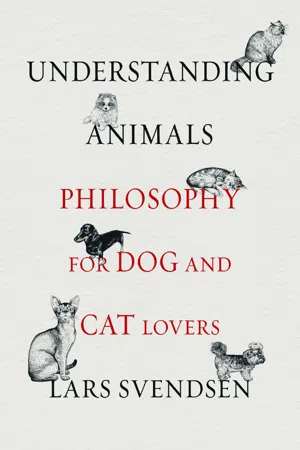
How do animals perceive the world? What does it really feel like to be a cat, or a dog? In Understanding Animals, Lars Svendsen investigates how humans can attempt to understand the lives of other animals. The book delves into animal communication, intelligence, self-awareness, loneliness and grief, but most fundamentally how humans and animals can cohabit and build a form of friendship. Svendsen provides examples from many different animal species, from chimpanzees to octopus, but his main focus is on cats and dogs – the animals that many of us are close to in our daily lives.
Using both philosophical analysis and the latest scientific discoveries, Svendsen argues that an owner's relationship with their pet is as equally valid and insightful as the scientific study of human-animal relations. With this entertaining and thought-provoking book, animal-lovers and pet owners will gain a deeper understanding of what it is like to be an animal, and in turn, a human.
- English
- ePUB (mobile friendly)
- Available on iOS & Android
eBook - ePub
About this book
Trusted by 375,005 students
Access to over 1.5 million titles for a fair monthly price.
Study more efficiently using our study tools.
Information
Topic
PhilosophySubtopic
Philosophy History & TheoryReferences
Introduction
1 Stephen Jay Gould, Leonardo’s Mountain of Clams and the Diet of Worms: Essays on Natural History (Cambridge, MA, 1998), p. 376.
2 Martin Heidegger, Prolegomena zur Geschichte des Zeitbegriffs (Frankfurt am Main, 1988), pp. 409f.
3 Ludwig Wittgenstein, Culture and Value, trans. Peter Winch (Oxford, 1998), p. 24.
1 Wittgenstein’s Lion and Kafka’s Ape
1 Cf. Wittgenstein, Philosophical Investigations, trans. G.E.M. Anscombe (Oxford, 1986), p. 223.
2 For a good account of these signs, see Genevieve von Petzinger, The First Signs: Unlocking the Mysteries of the World’s Oldest Symbols (New York and London, 2016).
3 Cf. Wittgenstein, Philosophical Investigations, § 206.
4 Ibid., p. 223.
5 Franz Kafka, ‘A Report to an Academy’, in The Metamorphosis and Other Stories, trans. Willa and Edwin Muir (New York, 1995).
6 Immanuel Kant, Anthropology from a Pragmatic Point of View, trans. Robert B. Louden (Cambridge, 2006), p. 233n.
7 Julien Offray de La Mettrie, Machine Man and Other Writings, trans. Ann Thomson (Cambridge and New York, 1996), pp. 11f.
2 Language
1 For a good, summarized overview and discussion around the research into the language of apes, see John Dupré, ‘Conversations with Apes’, in Humans and Other Animals (Oxford, 2006), chap. 11.
2 Cf. Kevin N. Laland, Darwin’s Unfinished Symphony: How Culture Made the Human Mind (Princeton, NJ, and Oxford, 2017), p. 178.
3 Marc D. Hauser, Noam Chomsky and W. T. Fitch, ‘The Faculty of Language: What Is It, Who Has It, and How Did It Evolve?’, Science, 298 (2002).
4 Cf. Ernst Cassirer, An Essay on Man: An Introduction to a Philosophy of Human Culture (New Haven, CT, 1944).
5 Ludwig Wittgenstein, Philosophical Occasions, 1912–1951 (Indianapolis, IN, and Cambridge, 1993), p. 394.
6 Wittgenstein, Philosophical Investigations, trans. G.E.M. Anscombe (Oxford, 1986), § 206.
7 Wittgenstein, Zettel, Werkausgabe, vol. VIII (Frankfurt am Main, 1984), § 567.
3 Seeing Animal Consciousness
1 Ludwig Wittgenstein, Philosophical Investigations, trans. G.E.M. Anscombe (Oxford, 1986), p. 178.
2 Ibid., § 357.
3 Cf. ibid., p. 223.
4 Ibid., p. 213.
5 David Hume, A Treatise of Human Nature (London, 1984), p. 316.
6 Wittgenstein, Philosophical Investigations, § 647.
7 Cf. ibid., § 580.
8 Wittgenstein, Bemerkungen über die Philosophie der Psychologie ii, Werkausgabe, vol. VII (Frankfurt am Main, 1984), § 570. Cf. Wittgenstein, Zettel, Werkausgabe, vol. VIII (Frankfurt am Main, 1984), § 225.
9 Cf. Wittgenstein, Philosophical Investigations, § 303.
10 Maurice Merleau-Ponty, Phenomenology of Perception, trans. Colin Smith (London, 1962), p. 184.
11 Wittgenstein, Zettel, § 526.
12 Wittgenstein, Bemerkungen über die Philosophie der Psychologie II, § 328.
13 Wittgenstein, Zettel, § 520.
14 Gregory Berns, What It’s Like to Be a Dog: And Other Adventures in Animal Neuroscience (New York, 2017).
15 Michael S. Gazzaniga, Who’s in Charge? Free Will and the Science of the Brain ( New York, 2011), p. 190.
16 Adam P. Steiner and A. David Redish, ‘Behavioral and Neurophysiological Correlates of Regret in Rat Decision-making on a Neuroeconomic Task’, Nature Neuroscience, 17 (2014).
4 A Human Form
1 Conwy Lloyd Morgan, An Introduction to Comparative Psychology (London, 1894), p. 53.
2 Conwy Lloyd Morgan, Animal Life and Intelligence (London, 1890–91), pp. 398f.
3 Frans B. M. de Waal, ‘Anthropomorphism and Anthropodenial: Consistency in Our Thinking about Humans and Other Animals’, Philosophical Topics, XXVII/1 (1999).
4 Zana Bahl...
Table of contents
- Front Cover
- Half Title
- Title Page
- Copyright
- Contents
- Introduction
- ONE Wittgenstein’s Lion and Kafka’s Ape
- TWO Language
- THREE Seeing Animal Consciousness
- FOUR A Human Form
- FIVE Mind-reading
- SIX Intelligence
- SEVEN For Now We See through a Mirror, Darkly
- EIGHT Time
- NINE Can Animals Be Understood?
- TEN Surroundings
- ELEVEN To Be an Animal
- TWELVE The Dog
- THIRTEEN The Cat
- FOURTEEN The Octopus
- FIFTEEN Loneliness and Grief
- SIXTEEN Do Animals Have Morals?
- SEVENTEEN Humans and Other Animals
- EIGHTEEN Friendship
- REFERENCES
- BIBLIOGRAPHY
- ACKNOWLEDGEMENTS
Frequently asked questions
Yes, you can cancel anytime from the Subscription tab in your account settings on the Perlego website. Your subscription will stay active until the end of your current billing period. Learn how to cancel your subscription
No, books cannot be downloaded as external files, such as PDFs, for use outside of Perlego. However, you can download books within the Perlego app for offline reading on mobile or tablet. Learn how to download books offline
Perlego offers two plans: Essential and Complete
- Essential is ideal for learners and professionals who enjoy exploring a wide range of subjects. Access the Essential Library with 800,000+ trusted titles and best-sellers across business, personal growth, and the humanities. Includes unlimited reading time and Standard Read Aloud voice.
- Complete: Perfect for advanced learners and researchers needing full, unrestricted access. Unlock 1.5M+ books across hundreds of subjects, including academic and specialized titles. The Complete Plan also includes advanced features like Premium Read Aloud and Research Assistant.
We are an online textbook subscription service, where you can get access to an entire online library for less than the price of a single book per month. With over 1.5 million books across 990+ topics, we’ve got you covered! Learn about our mission
Look out for the read-aloud symbol on your next book to see if you can listen to it. The read-aloud tool reads text aloud for you, highlighting the text as it is being read. You can pause it, speed it up and slow it down. Learn more about Read Aloud
Yes! You can use the Perlego app on both iOS and Android devices to read anytime, anywhere — even offline. Perfect for commutes or when you’re on the go.
Please note we cannot support devices running on iOS 13 and Android 7 or earlier. Learn more about using the app
Please note we cannot support devices running on iOS 13 and Android 7 or earlier. Learn more about using the app
Yes, you can access Understanding Animals by Lars Svendsen in PDF and/or ePUB format, as well as other popular books in Philosophy & Philosophy History & Theory. We have over 1.5 million books available in our catalogue for you to explore.