The fantastic has been particularly prolific in Hispanic countries during the twentieth and twenty-first centuries, largely due to the legacy of short-story writers as well as the Latin-American boom that presented alternatives to the model of literary realism. While these writers' works have done much to establish the Hispanic fantastic in the international literary canon, women authors from Spain and Latin America are not always acknowledged, and their work is less well known to readers. The aim of this critical anthology is to render Hispanic female writers of the fantastic visible, to publish a representative selection of their work, and to make it accessible to English-speaking readers. Five short stories are presented by five key authors. They attest to the richness and diversity of fantastic fiction in the Spanish language, and extend from the early twentieth to the twenty-first century, covering a range of nationalities, cultural references and language specificities from Spain, Mexico, Puerto Rico and Argentina.
eBook - ePub
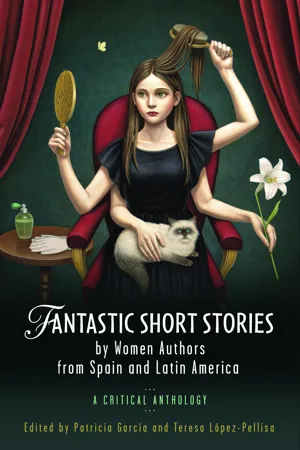
Fantastic Short Stories by Women Authors from Spain and Latin America
A Critical Anthology
- 160 pages
- English
- ePUB (mobile friendly)
- Available on iOS & Android
eBook - ePub
Fantastic Short Stories by Women Authors from Spain and Latin America
A Critical Anthology
About this book
Trusted by 375,005 students
Access to over 1.5 million titles for a fair monthly price.
Study more efficiently using our study tools.
Information
Notes
The Fantastic: Towards a Feminist Perspective
1. Ernst Theodor Amadeus Hoffmann (1776–1822) was a German writer and composer associated with Romanticism. Among his fantastic works are Fantasiestücke (1814), The Devil’s Elixirs (1815) and Nachtstücke (1817). The latter volume contains his well-known story ‘The Sandman’, used by Freud as a basis for his essay Das Unheimliche (1919).
2. ‘The person who experiences the event must opt for one of two possible solutions: either he is a victim of an illusion of the senses, of a product of the imagination – and laws of the world remain what they are; or else the event has indeed taken place, it is an integral part of reality – but then this reality is controlled by forces unknown to us. The fantastic occupies the duration of this uncertainty’ (Todorov, 1975: 25).
3. These two authors are the main referents of fantastic literature written in Spanish. Borges (1899–1986) wrote a large number of fantastic fictions, collected in volumes such as Ficciones (1944), El Aleph (1949) and El libro de arena (1975). Cortázar’s (1914–84) most famous stories, like ‘Casa tomada’, ‘Continuidad de los parques’ and ‘Axolotl’ can be found in Bestiario (1951) and Final del juego (1956).
4. One of the most scandalous examples of this is the publication by Dárcena in 2016 of Reencuentro de personajes, by the Mexican writer Elena Garro. Assuming that Garro would not be known to the readership, the publisher initially promoted her in terms of her relationships with other Latin American male writers: ‘Mujer de Octavio Paz, amante de Bioy Casares, inspiradora de García Márquez y admirada por Borges’.
5. These four English authors are pioneers of the Gothic novel. Walpole (1717–97) is well known for building the eccentric Strawberry Hill House, a villa that became a reference for the revival of Gothic architecture. His novel The Castle of Otranto is regarded as one of the initiators of the Gothic movement in the second half of the eighteenth century. Reeve (1729–1807), Lee (1750–1824) and in particular Radcliffe (1764–1823) also wrote influential Gothic novels, such as The Old English Baron (Reeve, 1777), The Recess (Lee, 1783–5) and The Mysteries of Udolpho (Radcliffe, 1794).
6. In the past few decades, several scholars have provided illuminating readings of the sublime, emphasising the differently gendered connotations of the aesthetic category of ‘beauty’ versus that of ‘the sublime’. Philip Shaw declares: ‘With its ideological stress on sociability and the domestic affections, and its stylistic emphasis on the fleeting, the fanciful, and the pathetic, the beautiful was regarded as secondary to the “manly” vigour and the complexity of the sublime. Too sensual to overcome the bonds of nature, too weak to sustain visionary flight, women were seen as unfit subjects for the trials of the sublime’ (2006: 106). On this subject, see the aforementioned Gothic and Gender (Heiland, 2004), as well as Shaw’s section ‘Feminine Difference’ in The Sublime (2006: 105–13), Christine Battersby’s study Gender and Genius (1989), Anne K. Mellor’s Romanticism and Gender (1993) and Catherine Maxwell’s The Female Sublime from Milton to Swinburne (2001).
7. Mary W. Shelley (1797–1851), daughter of feminist activist and intellectual Mary Wollstonecraft, remains one of the most famous female novelists of the fantastic with her work Frankenstein; or, The Modern Prometheus.
8. Bram Stoker (1847–1912) was an Irish author best known for his horror novel Dracula, which immortalised the character of Count Dracula in the history of vampires in literature and later in cinema. For an interesting typology of vampires in the nineteenth century, see Christopher Frayling’s Vampyres: Lord Byron to Count Dracula (1991).
9. E. A. Poe (1809–49) is one of the fathers of the modern fantastic. He is best known for his short stories, which have been foundational works on the aesthetics of the macabre and but also for providing an innovative psychological dimension to the fantastic, exploring the fringes of sanity and madness. Among his famous fantastic short stories are ‘The Fall of the House of Usher’ (1839), ‘The Oval Portrait’ (1842), ‘The Pit and the Pendulum’ (1842) and the aforementioned ‘The Black Cat’ (1843). He also popularised detective fiction in his tales featuring Auguste Dupin, and wrote influential essays on literary theory, such as The Philosophy of Composition, still considered one of the first essays to theorise the short story as a genre.
10. Maupassant (1850–93) is as acclaimed for his fantastic short stories as he is for his realist novels (for example Bel Ami, 1885). It is in his short story production that we find precious examples of the late nineteenth-century fantastic, with influential pieces such as ‘Le Horla’ (1886, 1887) and ‘Qui Sait?’ (1890). He made of the psychological a defining feature of his fantastic narratives, frequently featuring characters who are mentally deranged and thus whose account of th...
Table of contents
- Cover
- Title Page
- Copyright
- Contents
- Acknowledgements
- The Fantastic: Towards a Feminist Perspective
- Emilia Pardo Bazán (1851–1921): 'La resucitada' (1912)
- Amparo Dávila (1928–): 'El huésped' (1959)
- Rosario Ferré (1938-2016): 'La muñeca menor' (1976)
- Cristina Fernández Cubas (1945-): 'El ángulo del horror' (1990)
- Ana María Shua (1951-): 'Vida de perros' (2000)
- Notes
- References
- General Bibliography
- Temas de debate y discusión
- Selected Vocabulary
Frequently asked questions
Yes, you can cancel anytime from the Subscription tab in your account settings on the Perlego website. Your subscription will stay active until the end of your current billing period. Learn how to cancel your subscription
No, books cannot be downloaded as external files, such as PDFs, for use outside of Perlego. However, you can download books within the Perlego app for offline reading on mobile or tablet. Learn how to download books offline
Perlego offers two plans: Essential and Complete
- Essential is ideal for learners and professionals who enjoy exploring a wide range of subjects. Access the Essential Library with 800,000+ trusted titles and best-sellers across business, personal growth, and the humanities. Includes unlimited reading time and Standard Read Aloud voice.
- Complete: Perfect for advanced learners and researchers needing full, unrestricted access. Unlock 1.5M+ books across hundreds of subjects, including academic and specialized titles. The Complete Plan also includes advanced features like Premium Read Aloud and Research Assistant.
We are an online textbook subscription service, where you can get access to an entire online library for less than the price of a single book per month. With over 1.5 million books across 990+ topics, we’ve got you covered! Learn about our mission
Look out for the read-aloud symbol on your next book to see if you can listen to it. The read-aloud tool reads text aloud for you, highlighting the text as it is being read. You can pause it, speed it up and slow it down. Learn more about Read Aloud
Yes! You can use the Perlego app on both iOS and Android devices to read anytime, anywhere — even offline. Perfect for commutes or when you’re on the go.
Please note we cannot support devices running on iOS 13 and Android 7 or earlier. Learn more about using the app
Please note we cannot support devices running on iOS 13 and Android 7 or earlier. Learn more about using the app
Yes, you can access Fantastic Short Stories by Women Authors from Spain and Latin America by Patricia Garcia,Teresa López-Pellisa in PDF and/or ePUB format, as well as other popular books in Littérature & Langue espagnole. We have over 1.5 million books available in our catalogue for you to explore.