- English
- ePUB (mobile friendly)
- Available on iOS & Android
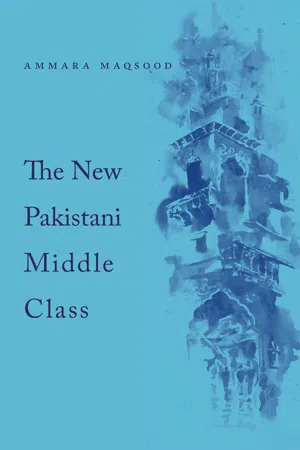
The New Pakistani Middle Class
About this book
Pakistan's presence in the outside world is dominated by images of religious extremism and violence. These images—and the narratives that interpret them—inform events in the international realm, but they also twist back around to shape local class politics. In The New Pakistani Middle Class, Ammara Maqsood focuses on life in contemporary Lahore, where she unravels these narratives to show how central they are for understanding competition and the quest for identity among middle-class groups.
Lahore's traditional middle class has asserted its position in the socioeconomic hierarchy by wielding significant social capital and dominating the politics and economics of urban life. For this traditional middle class, a Muslim identity is about being modern, global, and on the same footing as the West. Recently, however, a more visibly religious, upwardly mobile social group has struggled to distinguish itself against this backdrop of conventional middle-class modernity, by embracing Islamic culture and values. The religious sensibilities of this new middle-class group are often portrayed as Saudi-inspired and Wahhabi.
Through a focus on religious study gatherings and also on consumption in middle-class circles—ranging from the choice of religious music and home décor to debit cards and the cut of a woman's burkha—The New Pakistani Middle Class untangles current trends in piety that both aspire toward, and contest, prevailing ideas of modernity. Maqsood probes how the politics of modernity meets the practices of piety in the struggle among different middle-class groups for social recognition and legitimacy.
Tools to learn more effectively

Saving Books

Keyword Search

Annotating Text

Listen to it instead
Information
Table of contents
- Cover
- Title Page
- Copyright
- Dedication
- Contents
- Note on Transliteration
- Introduction
- 1. Remembering a Modern Pakistan
- 2. Moral Rhetoric, Modernity, and Class
- 3. Piety and New Middle-Class Life
- 4. Islam and Consumption
- Conclusion
- Notes
- Bibliography
- Acknowledgments
- Index
Frequently asked questions
- Essential is ideal for learners and professionals who enjoy exploring a wide range of subjects. Access the Essential Library with 800,000+ trusted titles and best-sellers across business, personal growth, and the humanities. Includes unlimited reading time and Standard Read Aloud voice.
- Complete: Perfect for advanced learners and researchers needing full, unrestricted access. Unlock 1.4M+ books across hundreds of subjects, including academic and specialized titles. The Complete Plan also includes advanced features like Premium Read Aloud and Research Assistant.
Please note we cannot support devices running on iOS 13 and Android 7 or earlier. Learn more about using the app