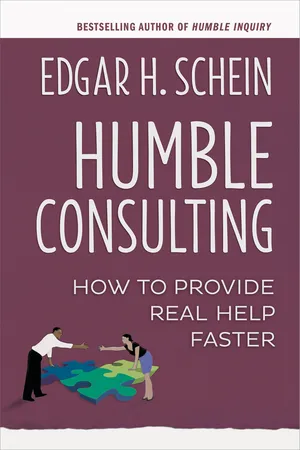
Consulting in Complex and Changing Times Organizations face challenges today that are too messy and complicated for consultants to simply play doctor: run a few tests, offer a neat diagnosis of the "problem, " and recommend a solution. Edgar Schein argues that consultants have to jettison the old idea of professional distance and work with their clients in a more personal way, emphasizing authentic openness, curiosity, and humility. Schein draws deeply on his own decades of experience, offering over two dozen case studies that illuminate each stage of this humble consulting process. Just as he did with Process Consultation nearly fifty years ago, Schein has once again revolutionized the field, enabling consultants to be more genuinely helpful and vastly more effective.
- 240 pages
- English
- ePUB (mobile friendly)
- Available on iOS & Android
eBook - ePub
About this book
Trusted by 375,005 students
Access to over 1.5 million titles for a fair monthly price.
Study more efficiently using our study tools.
Information
ONE
I Am the Consultant, and I Don’t Know What to Do!
I have had a monthly lunch meeting with a group of senior executives and doctors from a large hospital and medical school that are both part of a large academic medical complex. We meet to see how the hospital and medical school can further improve the quality of medical care, patient and employee safety, patient experiences in the hospital, research breakthroughs, and medical education. I have learned that the doctor community includes clinicians, researchers, and teachers who have different ultimate agendas, yet they have to coordinate their efforts and are all dependent on the same sources of financial support from the hospital and the university.
The hospital is the primary source of income for the medical school and for some of the research. The administrators, who may or may not be doctors, have to apportion funds between the needs of research, clinical practice, safety, maintenance, expansion of the delivery system in the community, and a reserve for future building projects. The doctors are all employed by the medical school, but if they are clinicians in the hospital, they also report to the hospital administrators. The senior administrators are working hard at getting everyone on the same page while recognizing that the goals of research, education, and clinical practice are to some degree different, that the individuals pursuing these goals have different personal agendas, and that their leaders are protective of those goals and agendas.
I have been invited to join this group because of my work on organizational culture, my experience as a process consultant, and my growing interest in health care and hospital administration. Over the past several years, I have also met other hospital administrators as part of a small think tank and have learned that this set of problems is shockingly common in large university-based medical centers.
As I approach tomorrow’s lunch, I realize that I don’t know what to do!
My Reflection on This Situation
Over my many years of consulting, I have from time to time found that being the expert and providing information and/or advice works, but only for simple, bounded problems. I have also played “doctor” to organizational clients by doing diagnoses and delivering recommendations. That has worked only occasionally, when I happened to have enough insider information about the organization’s identity, mission, and cultural DNA to be able to make suggestions that would be implementable.
I learned early on to be what I called a “process consultant,” someone who would help a group in the organization do more effectively what it needed to do in terms of its basic function and mission. That usually involved getting into a relationship with the client that would enable us to figure out together what was wrong and how to fix it. But that process also failed if the problem was complex, culturally multifaceted, and constantly changing. To deal with my medical lunch group, I needed yet another way to think about how to be helpful in the face of such complexity and rapid change.
I then thought about the implications of a case that happened a few years ago that I call “my most successful consultation on the perplexing problem of how to change culture.”
CASE 1. Culture Change in Beta Power Company
Potential client on the phone: Hello, Dr. Schein, this is Sue Jones from the Beta Power Company. I am the head of HR and Management Development. Our new CEO asked me to call you to find out if you would be willing to come and help us change what we have discovered to be a rigid, stodgy formal culture. It is hard to get any new programs going because we keep running into these old traditions and ways of doing things. Would you come visit our company to learn more and help us launch some culture change programs?
(As I listened to this proposal and question, I sensed two main reactions in me. First, it sounded interesting and was certainly within the range of the types of projects that I felt I could tackle successfully. But, second, I recalled having had some bad experiences visiting organizations without knowing more, and especially without knowing what the new CEO actually had in mind in what he called “a rigid, stodgy culture.” I also wanted a little more information about the motivation of the CEO. Was he just going to have Sue Jones do this? Or would he involve himself, which would be crucial if culture change was to happen. These thoughts led to the following conversation, which I call personalization.)
Ed S.: That sounds interesting and could be complicated. I think it might be important to talk about this with the CEO away from the company to explore what is going on and what he has in mind. Do you think he would be willing to talk with me separately and maybe visit me in Cambridge?
(This response was the first of what I call adaptive moves to begin to build a more personal relationship with the client to find out what is really on his mind.)
S. J.: You are right that we maybe need to talk this through away from the company, so let me explore with him the possibility of coming to see you. I’ll get back in touch.
(A week later.)
S. J.: I spoke to our CEO, and he was quite enthusiastic about coming to visit you. He will bring his new COO as well, and I will be accompanying them. So when can we set a date for a half-day meeting?
Ed S.: Here are some dates to check out. Also, I presume it is understood that I will be billing you for this half day.
(I had learned from other experiences that sometimes the best help occurs in the early meetings, so I would bill for those early meetings unless it was clearly a short exploratory phone call, lunch, or visit.)
S. J.: That sounds good. We will let you know which date.
(We met two weeks later in the garden at my house at 9 a.m. I chose to meet at my house to provide a setting that could involve food and drinks, and was therefore an invitation to personalize the situation.)
Ed S.: Welcome! Let’s talk about what is on your mind about this “rigid, stodgy culture.”
CEO: OK, Ed. May I call you Ed?
Ed S.: Sure.
CEO: When John [the COO] and I began to try to implement some new programs in the company, we kept finding old habits and traditions that people seemed to want to hold on to, like the culture has kind of fossilized.
Ed S.: Can you give me an example?
(This is almost always a good thing to ask because at this point I have no idea at all what they are talking about, what their concept of culture is, or what is actually bothering them. No sooner had I asked this than John sat up in his chair and jumped into the conversation with great intensity.)
COO: Yes, Ed, I can give you a great example that just happened yesterday. I have a staff group of about fifteen people with whom I meet regularly in this big conference room, and they always sit in the same seats. Okay, so yesterday we met, and there were only five of them there, and they again sat in those same seats, even though that meant they were scattered all over the room!
(John looked at me expectantly, opened his hands in a gesture of “see what I am up against,” and paused. At this moment I was overwhelmed by my curiosity and impulsively gave in to it without considering the possible consequences. Ask yourself what you might have done at this moment.)
Ed S. (with intensity): What did you do?
COO: My god, I didn’t do anything . . .
(There was a long pause during which I think the CEO, the COO, and Sue all had the same insight. Here we had the top two executives of the organization complaining about stodgy subordinate behavior and asking an outsider to help them “change the culture.” Somehow it had not occurred to them that their passivity was tacitly condoning the “cultural behavior” they were complaining about. I was reminded of the sage comment “You get what you settle for.”)
We spent the rest of the morning listing all the actions that they could take that would send a clear signal to the organization that behavioral changes had to be made. I referred them to my Organizational Culture and Leadership (4th ed., 2010) in which a whole chapter discusses how executives can influence culture. At this point I felt quite comfortable playing “doctor” and recommending something. We agreed that the only further thing I should do is to check in with them every few weeks by phone to see how things were going. The CEO called me regularly over the next few months and occasionally sent me e-mails describing actions he was thinking about to get my reactions. I billed him for my time spent and provided further suggestions as needed. I did not visit or launch any formal culture projects. None were needed. I had helped them see how they could manage the culture change perfectly well on their own.
LESSONS

The Paradox of Messy Complexity and Fast Help
This case taught me that help can happen fast. But you need to find out what is really on the client’s mind and honor your own curiosity. Complex messes like the one at the university-based medical school and hospital did not lend themselves to such fast help but did illustrate that adaptive moves could be helpful. My experience with similar messes occurred in a variety of organizations with which I’ve had long-term relationships. In those cases, as in the problems I am encountering with clients now, the mess only emerges as initial moves are made that reveal deeper layers of issues and concerns. For example,
Table of contents
- Cover Page
- Title Page
- Copyright Page
- Dedication
- Contents
- Preface
- 1 I Am the Consultant, and I Don’t Know What to Do!
- 2 What Is New in Humble Consulting?
- 3 The Need for a Trusting and Open Level Two Relationship
- 4 Humble Consulting Begins with the First Conversation
- 5 Personalization: Enhancing the Level Two Relationship
- 6 The Humble Consulting Focus on Process
- 7 The New Kinds of Adaptive Moves
- Concluding Comments—Some Final Thoughts on How to Be Really Helpful
- References
- Acknowledgments
- Index
- The Author—in His Own Words
Frequently asked questions
Yes, you can cancel anytime from the Subscription tab in your account settings on the Perlego website. Your subscription will stay active until the end of your current billing period. Learn how to cancel your subscription
No, books cannot be downloaded as external files, such as PDFs, for use outside of Perlego. However, you can download books within the Perlego app for offline reading on mobile or tablet. Learn how to download books offline
Perlego offers two plans: Essential and Complete
- Essential is ideal for learners and professionals who enjoy exploring a wide range of subjects. Access the Essential Library with 800,000+ trusted titles and best-sellers across business, personal growth, and the humanities. Includes unlimited reading time and Standard Read Aloud voice.
- Complete: Perfect for advanced learners and researchers needing full, unrestricted access. Unlock 1.5M+ books across hundreds of subjects, including academic and specialized titles. The Complete Plan also includes advanced features like Premium Read Aloud and Research Assistant.
We are an online textbook subscription service, where you can get access to an entire online library for less than the price of a single book per month. With over 1.5 million books across 990+ topics, we’ve got you covered! Learn about our mission
Look out for the read-aloud symbol on your next book to see if you can listen to it. The read-aloud tool reads text aloud for you, highlighting the text as it is being read. You can pause it, speed it up and slow it down. Learn more about Read Aloud
Yes! You can use the Perlego app on both iOS and Android devices to read anytime, anywhere — even offline. Perfect for commutes or when you’re on the go.
Please note we cannot support devices running on iOS 13 and Android 7 or earlier. Learn more about using the app
Please note we cannot support devices running on iOS 13 and Android 7 or earlier. Learn more about using the app
Yes, you can access Humble Consulting by Edgar H. Schein in PDF and/or ePUB format, as well as other popular books in Business & Consulting. We have over 1.5 million books available in our catalogue for you to explore.