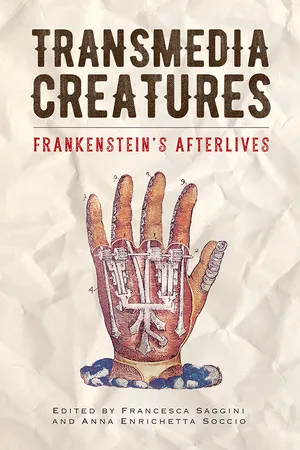
On the 200th anniversary of the first edition of Mary Shelley's Frankenstein, Transmedia Creatures presents studies of Frankenstein by international scholars from converging disciplines such as humanities, musicology, film studies, television studies, English and digital humanities. These innovative contributions investigate the afterlives of a novel taught in a disparate array of courses - Frankenstein disturbs and transcends boundaries, be they political, ethical, theological, aesthetic, and not least of media, ensuring its vibrant presence in contemporary popular culture. Transmedia Creatures highlights how cultural content is redistributed through multiple media, forms and modes of production (including user-generated ones from "below") that often appear synchronously and dismantle and renew established readings of the text, while at the same time incorporating and revitalizing aspects that have always been central to it. The authors engage with concepts, value systems and aesthetic-moral categories—among them the family, horror, monstrosity, diversity, education, risk, technology, the body—from a variety of contemporary approaches and highly original perspectives, which yields new connections. Ultimately, Frankenstein, as evidenced by this collection, is paradoxically enriched by the heteroglossia of preconceptions, misreadings, and overreadings that attend it, and that reveal the complex interweaving of perceptions and responses it generates.Published by Bucknell University Press. Distributed worldwide byRutgers University Press.
- English
- ePUB (mobile friendly)
- Available on iOS & Android
eBook - ePub
About this book
Trusted by 375,005 students
Access to over 1.5 million titles for a fair monthly price.
Study more efficiently using our study tools.
Information
Publisher
Bucknell University PressYear
2018Print ISBN
9781684480609
9781684480616
eBook ISBN
9781684480623
Subtopic
Film & VideoPART I
Labs, Bots, and Punks
TRANSMEDIATING TECHNOLOGY AND SCIENCE
CHAPTER 1
Frankenstein and Science Fiction
Gino Roncaglia
FRANKENSTEIN AND THE ORIGINS OF SCIENCE FICTION
In discussing the relationship between Mary Shelley’s Frankenstein and science fiction (SF), the first question to be addressed is whether Frankenstein itself should be considered an example (possibly, the very first example) of a SF novel.
The most common characterization of Frankenstein in terms of literary genres—even if not a wholly undisputed one—places it squarely in the field of Gothic novels.1 And despite the many defenders of the thesis of “the Gothic origins of science fiction”—to quote the title of the influential essay by Patrick Brantlinger2—it is quite clear that no definition of SF, however broad, could possibly include most Gothic novels. Should we decide to consider Frankenstein both as a Gothic novel and as an early (or the earliest) example of SF, it would be necessary to attribute to it features which go beyond the traditional characterization of Gothic literature. At the same time, it would be necessary to define SF in such a way as to render it compatible with some features traditionally attributed to Gothic literature (and present in Frankenstein).
The first task is relatively easy, and is usually accomplished by pointing to the role of science in Mary Shelley’s novel. Frankenstein is, quite literally, a tale of scientific imagination. The very first lines of the Preface to the 1818 edition (written by Percy Shelley) clearly mark the distance from previous Gothic novels, by underscoring the scientific background of the story:
The event on which this fiction is founded has been supposed, by Dr. Darwin, and some of the physiological writers of Germany, as not of impossible occurrence. I shall not be supposed as according the remotest degree of serious faith to such an imagination; yet, in assuming it as the basis of a work of fancy, I have not considered myself as merely weaving a series of supernatural terrors. The event on which the interest of the story depends is exempt from the disadvantages of a mere tale of spectres or enchantment.3
Mary Shelley’s novel is therefore consciously adding something new to the Gothic tradition: “Frankenstein’s claim to originality is its rejection of the supernatural,” and “science fiction can only exist when it is possible to distinguish in this way between natural and supernatural,” states Paul K. Alkon; on these grounds, he can confidently assert that “science fiction starts with Mary Shelley’s Frankenstein. Its first critic was Percy Shelley.”4 The Gothic mood, however, is still present, since “terror remains a desirable effect. It is only supernatural terrors that are to be avoided.”5 Patricia S. Warrick summarizes this point, observing that Frankenstein is generally regarded as SF “because its protagonist, Victor Frankenstein, has been educated as a scientist, and he builds a creature not through any unexplained magic but through his knowledge of chemistry, anatomy, physiology, and electricity.”6
The second task—providing a definition of SF that connects it to the Gothic tradition—is much more complex, given the broad array of definitions proposed for the SF genre, the complexity of its historical evolution, and the extreme variety of its sub-genres.7 As Adam Roberts points out, “all of the many definitions offered by critics have been contradicted or modified by other critics, and it is always possible to point to texts consensually called SF that fall outside the usual definitions.”8
The topic is only relevant here insofar as the proposed definitions might be of help in discussing the relationship (or the lack thereof) between Gothic literature and SF, and the possible role of Frankenstein in assessing such a relationship. From this point of view, among the different definitions or characterization of SF that have been proposed,9 the most useful is probably the one suggested by Brian Aldiss, a SF writer and one of the most influential historians of the genre: “Science fiction is the search for a definition of mankind and his status in the universe which will stand in our advanced but confused state of knowledge (science), and is characteristically cast in the Gothic or post-Gothic mode.”10
“Science fiction”—states Aldiss elsewhere—“was born from the Gothic mode and it is hardly free of it now. Nor is the distance between the two modes great. The Gothic emphasis was on the distant and the unearthly.”11 I will not discuss here Aldiss’s conception of Gothic, but two further quotations may help to elucidate his idea of the transition from Gothic to SF: “One strong Gothic theme is that of descent from a ‘natural world’ to inferno or incarceration, where the protagonist goes, willingly or otherwise, in search of a secret, an identity, or a relationship.”12 Aldiss’s prototype of a Gothic novel seems to be (here as elsewhere) Matthew G. Lewis’s The Monk (1796), and he stresses that many SF or proto-SF stories share “such motifs, from famous exercises such as Jules Verne’s adventures at the centre of the earth to Frankenstein’s descent into charnel houses, Dracula’s descent to his earth-coffins, or the journey to Trantor, in effect a total underground planet.”13 In this process, “the archetypal figures of cruel father and seducing monk were transformed into those of scientist and alien.”14
Given this conception of the relationship between Gothic and SF, it is not surprising that Aldiss should share the same opinion expressed more recently by Alkon (Aldiss was in fact the first to advance it in a reasoned and convincing way): Frankenstein is not just one among many possible “ancestors” of SF, it is its first (and one of its best) examples, thus making Mary Shelley “the first science fiction writer.”15 And a few years later, in their history of SF, Robert Scholes and Eric Rabkin tellingly labeled the early, pre-pulp era of SF “the first century a.F.” (after Frankenstein).16
In a somewhat more refined way, Brian Stableford includes Frankenstein among the first instances of a more specific tradition of speculative fiction, that of the British scientific romance, which in his opinion will fully merge with US science fiction only after World War II.17 But the role of the novel as key constituent of a tradition that—directly or not—is of immediate relevance in understanding contemporary SF, remains unimpaired.
The thesis that sees Frankenstein as the first SF novel has, however, not gone unchallenged. Adam Roberts “does not concur with the belief—so universally acknowledged by critics as almost to approach dogma—that ‘Science fiction starts with Mary Shelley’s Frankenstein.’ ”18 As he states, “the identification of the point of origin for SF is as fiercely contested a business as defining the form.”19 Yet the two questions are clearly connected.
Roberts identifies three possible “histories” of SF, partially overlapping but based on different conceptions of the genre: 1) a “long history,” stressing the presence of SF themes in literary works as remote from us and from one another, both in time and in nature, as the Epic of Gilgamesh, Cicero’s Somnium Scipionis, and Ariosto’s Orlando Furioso, and dating the convergence of literary fantasy and science back to Kepler’s Somnium, sive Astronomia Lunaris (first published in 1634); 2) a “Gothic” history of SF, with Frankenstein as its starting point, justified by considerations similar to Aldiss’s, Warrick’s, and Alkon’s; 3) what we might call an “editorial” history of SF, starting with the pulp magazines of the 1920s and the founder and first editor of Amazing Stories, Hugo Gernsback.20
The “long history” is clearly based on a broadly “thematic” conception of SF: interplanetary travel and, more generally, otherworldly imagination are typical SF themes, and can be recognized as such even when they are present in literary works not directly connected with modern science or with the use of the label “science fiction.” The “editorial” history, on the contrary, is closer to the circular but undoubtedly effective definition proposed by John W. Campbell, the best known—and the most influential—among the editors working in the “golden age” of the 1930s and 1940s: “Science fiction is what science-fiction editors publish.”21 As we have seen, the “Gothic” history is basically linked to the presence in SF of Gothic themes “enhanced” in such a way as to include scientific imagination. This kind of “enhancement” could be explained in terms of one of the most authoritative definitions proposed for SF, that of Darko Suvin. According to his analysis, SF is “a literary genre or verbal construct whose necessary and sufficient condition are the presence and interaction of estrangement and cognition, and whose main device is an imaginative framework alternative to the author’s empirical environment.”22 In elaborating on this definition, Suvin introduces the notion of “novum”: a new element, usually in the form of a rationally justifiable scientific innovation, which is used or presupposed in the story. And it is precisely the “novum,” constituted by the unexplained but purportedly scientific procedure used by Victor Frankenstein in giving life to the Creature, that would both distinguish Frankenstein from earlier Gothic novels and allow for its inclusion among the ranks of SF works.
FRANKENSTEINIAN DESCENDANTS
The discussion of the role of Frankenstein in the critical assessment of the nature and the early history of SF, however interesting, does not and cannot exhaust the question of the influence of Mary Shelley’s work on contemporary SF. This is a question that deserves a...
Table of contents
- Cover
- Title Page
- Copyright
- Dedication
- Contents
- Abbreviations
- Introduction: Frankenstein: Presence, Process, Progress
- Part I: Labs, Bots, and Punks: Transmediating Technology and Science
- Part II: Becoming Monsters: The Limits of the Human
- Part III: The Evolution Games of Sight and Sound
- Part IV: Monster Reflections
- Acknowledgments
- Bibliography
- Index
- About the Contributors
Frequently asked questions
Yes, you can cancel anytime from the Subscription tab in your account settings on the Perlego website. Your subscription will stay active until the end of your current billing period. Learn how to cancel your subscription
No, books cannot be downloaded as external files, such as PDFs, for use outside of Perlego. However, you can download books within the Perlego app for offline reading on mobile or tablet. Learn how to download books offline
Perlego offers two plans: Essential and Complete
- Essential is ideal for learners and professionals who enjoy exploring a wide range of subjects. Access the Essential Library with 800,000+ trusted titles and best-sellers across business, personal growth, and the humanities. Includes unlimited reading time and Standard Read Aloud voice.
- Complete: Perfect for advanced learners and researchers needing full, unrestricted access. Unlock 1.5M+ books across hundreds of subjects, including academic and specialized titles. The Complete Plan also includes advanced features like Premium Read Aloud and Research Assistant.
We are an online textbook subscription service, where you can get access to an entire online library for less than the price of a single book per month. With over 1.5 million books across 990+ topics, we’ve got you covered! Learn about our mission
Look out for the read-aloud symbol on your next book to see if you can listen to it. The read-aloud tool reads text aloud for you, highlighting the text as it is being read. You can pause it, speed it up and slow it down. Learn more about Read Aloud
Yes! You can use the Perlego app on both iOS and Android devices to read anytime, anywhere — even offline. Perfect for commutes or when you’re on the go.
Please note we cannot support devices running on iOS 13 and Android 7 or earlier. Learn more about using the app
Please note we cannot support devices running on iOS 13 and Android 7 or earlier. Learn more about using the app
Yes, you can access Transmedia Creatures by Francesca Saggini,Anna Enrichetta Soccio in PDF and/or ePUB format, as well as other popular books in Media & Performing Arts & Film & Video. We have over 1.5 million books available in our catalogue for you to explore.