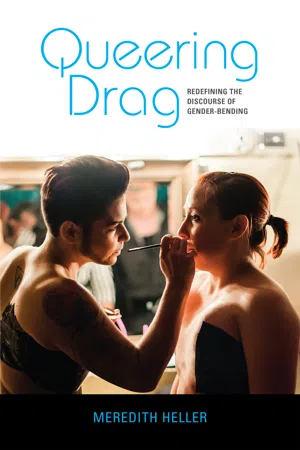
Theatrical gender-bending, also called drag, is a popular form of entertainment and a subject of scholarly study. However, most drag studies do not question the standard words and ideas used to convey this performance genre. Drawing on a rich body of archival and ethnographic research, Meredith Heller illuminates diverse examples of theatrical gender-bending: male impersonation in variety and vaudeville (1860–1920); the "sexless" gender-bending of El Teatro Campesino (1960–1980); queer butch acts performed by black nightclub singers, such as Stormé DeLarverie, instigator of the Stonewall riots (1910–1970); and the range of acts that compose contemporary drag king shows. Heller highlights how, in each case, standard drag discourses do not sufficiently capture the complexity of performers' intents and methods, nor do they provide a strong enough foundation for holistically evaluating the impact of this work. Queering Drag offers redefinition of the genre centralized in the performer's construction and presentation of a "queer" version of hegemonic identity, and it models a new set of tools for analyzing drag as a process of intents and methods enacted to effect specific goals. This new drag discourse not only allows for more complete and accurate descriptions of drag acts, but it also facilitates more ethical discussions about the bodies, identities, and products of drag performers.
- 250 pages
- English
- ePUB (mobile friendly)
- Available on iOS & Android
eBook - ePub
About this book
Trusted by 375,005 students
Access to over 1.5 million titles for a fair monthly price.
Study more efficiently using our study tools.
Information
Publisher
Indiana University PressYear
2020Print ISBN
9780253045652
9780253045652
eBook ISBN
9780253045676
ONE

What’s in a Name?
Redefining the Discourse of Gender-Bending
THEATRICAL GENDER-BENDING, ALSO referred to in this book as drag, is a genre of performance that most people in the contemporary West have been—at least tangentially—exposed to.1 Perhaps, like Mary Cheney, they know the drag queen contest show RuPaul’s Drag Race. Maybe some know the political drag queen troupe the Sisters of Perpetual Indulgence or the popular (now defunct) San Francisco–based drag queen club Finocchio’s. But even people unaware of these iconic examples may know of comedienne Dame Edna, Divine’s appearance in Hairspray, John Travolta’s appearance in the remake of Hairspray, Gwyneth Paltrow’s role in Shakespeare in Love, the historical fact that Shakespeare’s plays were traditionally cast with men, the documentary Paris Is Burning, Tyler Perry’s Madea films, or Lady Gaga’s Joe Calderone persona. In plays, club performances, and pride parades as well as on TV, film, and social media, gender-bending—as both a stage performance and a conceptual discourse about gender flexibility—is part of mainstream consciousness.

Fig. 1.1. Season six finalists of RuPaul’s Drag Race. Left to right: Adore Delano, Bianca Del Rio, and Courtney Act.
This book explores a swath of theatrical gender-bending practiced in the past 150 years of US history: male impersonation, “sexless” mythical characters, queer butch acts, and contemporary drag kinging. Obviously, this list does not constitute the whole of the genre. But even within the delimited time and geography of my study, the full range of gender-bending is much more extensive than what I cover. And yet, despite the vastness of this practice, popular public knowledge about drag is narrow and premised on (and, I argue, bounded and limited by) a myopic vision of the genre. To be blunt, drag is often assumed to mean “performing as a drag queen.” And drag queening is predominantly characterized as an over-the-top, glamorous doing of hyperfemininity by a man who will eventually reveal his underlying “boy body.”2 Indeed, this type of queening is the primary form of drag on RuPaul’s Drag Race. Many types of drag do not make it to RuPaul’s Drag Race but are nevertheless lovingly and skillfully practiced in small theater forums or queer spaces. For many—including non-gender-conforming, trans, and otherwise queer people—drag not only enhances their lives but also reduces and combats their vulnerability to external violence or early death. In fact, many theatrical drag practices in Western entertainment history do not resemble drag queening in the slightest. However, the drag that makes it to RuPaul’s Drag Race does hold a hegemonic, if not singular, position in the cultural imagination: our popular discourse on gender-bending is always filtered primarily through the ideological representation Laurence Senelick dubs “the adult male decked out in seductive feminine frippery.”3 Ask people around you what drag is and very likely you will get a description that would make it onto RuPaul’s Drag Race (see fig. 1.1).
This book grapples with a critical disconnect between what Diana Taylor characterizes as the archive and the repertoire.4 There is a vast drag repertoire, some of which can be learned about experientially by attending live performances. But the archiving of performance is significant in the “production and transmission of knowledge,” especially for practices that are no longer occurring (have no current repertoire).5 So how drag is textually classified, linguistically named, and rhetorically used is as important as the act itself. I argue that current popular knowledge about drag is circumscribed, specifically because of an archival limitation I term drag discourse. I use discourse to reference textual and oral language practices that name, classify, explain, and analyze ideological or physical phenomena. Although discourse may encompass nonlinguistic or experiential modes of transmission, the term primarily encapsulates how language is used to form and exchange thoughts about phenomena. Drag discourse refers to both the process of translating drag performance into oral and written language and also the use of ideas linked to this language for creating and spreading knowledge about the genre.
There are drag performances that elude language and known methods of classification, and, for some, the potential of drag resides in this illegibility. Gender-bending encompasses a generative and rich potential in that it can build community, create safer spaces, and, over time, lead to more possibilities for queer lives. But the most popular, common, and established knowledges about drag have been shaped not by what occurs in the repertoire but by what has been formally and informally archived. To facilitate the spread of a personal experience at a drag show beyond the “bracketed” geographic location of the repertoire, people translate it into standard “linguistic or literary codes.”6 This book illuminates the many ways that drag performers construct, reproduce, bend, and challenge identity. It also acknowledges how these practices have been discursively mapped into archival collections, written histories, scholarship, and news stories. It is not my position that people who produce drag archives cannot see the nuances of drag or are unwilling to acknowledge its complexities. Rather, I argue that we simply do not have a sufficient discourse on this practice yet, and thus we lack vital rhetorical tools to name such nuance and analyze such complexity.
Let me lay out exactly what the discourse on drag is and why it constrains our ability to capture complex knowledges. In The Drag Queen Anthology, Steven P. Schacht and Lisa Underwood define drag queens as “individuals who publicly perform being women in front of an audience that knows they are ‘men’ regardless of how compellingly female—‘real’—they might appear otherwise.”7 Here, a drag queen is defined as a drag queen because she looks “compellingly female” onstage and also because she is really a man offstage. In other words, drag queening is a theatrical presentation of a gendered persona that is not real but rather a parody of reality (the resulting logic is that, in reality, men are not actually feminine). Thus, drag queening is discursively materialized not by reference to the part of the stage presentation that bends or queers identity but rather by direct reference to the performer’s assumed stable cisgender identity in contrast to the gender seen onstage.8 Although Schacht and Underwood’s anthology illustrates a range of drag practices, this definition appears in the introduction and is framed as a legitimate, general, or, at least, objective description.
I do not fault Schacht and Underwood for offering this definition, because it is a very standard way of describing drag. Almost identical definitions can be found in textual descriptions of drag kinging, cross casting, and male and female impersonation. Though common, such definitions are premised on questionable cultural assumptions about the body, including what I find most problematic: the notion that performing bodies are “really” either male or female—or at least can be assumed so. This definition is also problematically tethered to the idea that gendered aesthetics are actively done, but assigned gender—in this book, what I refer to as sex—is ontological and static and thus what you really are. Gender is a cultural construction that is both performed and performative, and theatrical gender-bending can certainly demonstrate this. But other identities, in this case the body’s sex classification as either male or female, are also a form of cultural gendering, albeit a medically accomplished one.9 I discuss Western methods of articulating and maintaining the binary sexed (male or female) body shortly. For now, it suffices to say that many modes of identification and taxonomy—gender, race, ability—have been culturally developed and applied to the unique body.
Many scholars emphasize the great potential of theatrical gender-bending to reveal how identities are not biological mandates but rather cultural ideologies that we do—and thus can undo or do differently.10 Yet, the tools we use to name and define this potential directly reference the assumed biological mandate of sex and its normally or naturally connected cisgender attribution. This is a completely uncomfortable discursive position, and I am not the only one who feels this way. Schacht and Underwood reveal their own awareness of the problem and perhaps discomfort with it when they bracket the words “men” and “real” with quotation marks. Other scholars hedge as well: J. Halberstam defines a drag king as “female” but qualifies it with “(usually).”11 Esther Newton does not qualify her essentialist engagement with sex but does bracket her reference to the “reality” or “essence” of maleness with quotation marks.12 Here, progressive scholars are attempting to define gender-bending as “an act that bends or breaks identity categories.” And yet, their linguistic method of doing so proves my point: no matter how uncomfortable they might be with assuming what performers “really” are, they nevertheless employ this concept in their definitions—and employ it via the construct of biological sex. As Leila J. Rupp and Verta Taylor put it, “Although we argue that drag queens and drag performances break down the boundaries between woman and man, gay and straight, we continue to use these categories, however flawed they might be, to identify people. In part, the language gives us no choice.”13
Drag discourse has the power to affect the people doing the act, watching the act, and learning about the act remotely. In their study of the drag queens at the 801 Cabaret, Rupp and Taylor lay out the possibility that certain cultural entertainment like drag “expands and problematizes identity” in a way that “promotes resistance to domination.”14 A drag act that reimagines identity can be, as Cathy J. Cohen articulates, a “defiant behavior, and [also an act of] political resistance.”15 Lauren Berlant and Michael Warner use the term queer worldmaking to describe the formation of a space that allows for the centralization and celebration of nonnormative bodies and practices.16 Drag actions that participate in queer worldmaking contribute to the framing of nonconformity as something legitimate within a specific space, but they can also spread this ideology beyond the geographic “bracket” of that microsphere.17 For those deemed queer, the spread of a physical or ideological queer world allows more room in which to live tolerable or joyous existences, practice “self-fashioning,” and avoid the dangers of a phobic majoritarian world.18 This is no trivial thing for trans or gender-nonconforming people, especially those who are not White, as their exceedingly high death rates from murder and suicide would suggest. Queer worldmaking is not a project that all drag acts consciously take up. But as José Esteban Muñoz notes, performance can certainly accomplish such goals; specifically, “minoritarian performance” such as drag already “labors to make worlds—worlds of transformative politics and possibilities.”19 Theatrical gender-bending has the potential to be a source of individual or group strength for deeply marginalized people as well a source of large-scale political resistance and cultural change. The discursive component of drag is so important because it factors into drag’s capacity to enact these spaces and changes on a macrolevel. And this potential is stagnated by our current methods of translating drag into a spreadable taxonomy.
Current drag discourse frames the taxonomy of what is—and, by extension, what is not—gender-bending. Taxonomies are tricky things: they are organized around cultural biases but also frame biases as objective and essential truths. In line with Michel Foucault’s argument about sexual classification in The History of Sexuality, I see how organizing and labeling queer practices, even within an expanded taxonomy, is binding to them.20 But while I do not wish to limit queer performance, I also do not want to continue using the terms presently available to describe and explore drag. Therefore, I am cautiously dedicated to expansively reworking the discursive parameters of drag and thus the shape of our drag taxonomy. The fact is that drag is already deeply embedded in the Western imagination and lexicon. Judith Butler discusses the potential of “resignification” projects, or the expansion of terms by adding meanings that do not necessarily “retain and reiterate the...
Table of contents
- Cover
- Title Page
- Copyright
- Contents
- Acknowledgments
- Preface
- 1. What’s in a Name?: Redefining the Discourse of Gender-Bending
- 2. “Masculine Women, Feminine Men”: Variety and Vaudevillian Male Impersonators
- 3. Mythical, “Sexless” Characters: Identity Borders in El Teatro Campesino
- 4. The “First Punch” at Stonewall: Counteridentification Butch Acts
- 5. Bent Means “Not Quite Straight”: Kinging as Disidentification
- Conclusion: Bending Rhetoric
- Bibliography
- Index
- About the Author
Frequently asked questions
Yes, you can cancel anytime from the Subscription tab in your account settings on the Perlego website. Your subscription will stay active until the end of your current billing period. Learn how to cancel your subscription
No, books cannot be downloaded as external files, such as PDFs, for use outside of Perlego. However, you can download books within the Perlego app for offline reading on mobile or tablet. Learn how to download books offline
Perlego offers two plans: Essential and Complete
- Essential is ideal for learners and professionals who enjoy exploring a wide range of subjects. Access the Essential Library with 800,000+ trusted titles and best-sellers across business, personal growth, and the humanities. Includes unlimited reading time and Standard Read Aloud voice.
- Complete: Perfect for advanced learners and researchers needing full, unrestricted access. Unlock 1.5M+ books across hundreds of subjects, including academic and specialized titles. The Complete Plan also includes advanced features like Premium Read Aloud and Research Assistant.
We are an online textbook subscription service, where you can get access to an entire online library for less than the price of a single book per month. With over 1.5 million books across 990+ topics, we’ve got you covered! Learn about our mission
Look out for the read-aloud symbol on your next book to see if you can listen to it. The read-aloud tool reads text aloud for you, highlighting the text as it is being read. You can pause it, speed it up and slow it down. Learn more about Read Aloud
Yes! You can use the Perlego app on both iOS and Android devices to read anytime, anywhere — even offline. Perfect for commutes or when you’re on the go.
Please note we cannot support devices running on iOS 13 and Android 7 or earlier. Learn more about using the app
Please note we cannot support devices running on iOS 13 and Android 7 or earlier. Learn more about using the app
Yes, you can access Queering Drag by Meredith Heller in PDF and/or ePUB format, as well as other popular books in Social Sciences & Rhetoric. We have over 1.5 million books available in our catalogue for you to explore.