- 80 pages
- English
- ePUB (mobile friendly)
- Available on iOS & Android
eBook - ePub
Government Extension to the PMBOK® Guide Third Edition
About this book
The Government Extension to the PMBOK® Guide-Third Edition, extends the baseline information included in the PMBOK® Guide-Third Edition to provide an overview of the key project governance processes used in most public sectors, define key terms, describe atmospheres where government projects operate and review the management life-cycle of government programs. In so doing, the Government Extension outlines the guiding principles for government projects and provides a framework that helps ensure their efficiency, effectiveness and accountability. This updated Government Extension is a must-read for project management practitioners involved with government contracts, as well as anyone who wants a better understanding of the PMBOK® Guide as it applies to the government sector.
Trusted by 375,005 students
Access to over 1.5 million titles for a fair monthly price.
Study more efficiently using our study tools.
Information
| Section III | ||
| The Project Management Knowledge Areas | ||
| Chapter 4 | Project Integration Management | |
| Chapter 5 | Project Scope Management | |
| Chapter 6 | Project Time Management | |
| Chapter 7 | Project Cost Management | |
| Chapter 8 | Project Quality Management | |
| Chapter 9 | Project Human Resource Management | |
| Chapter 10 | Project Communications Management | |
| Chapter 11 | Project Risk Management | |
| Chapter 12 | Project Procurement Management | |
Chapter 4
Project Integration Management
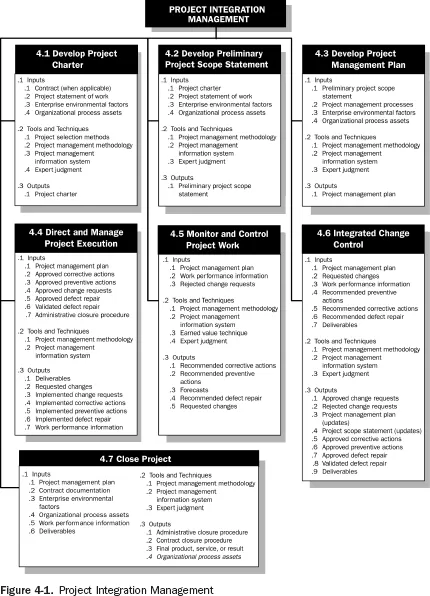
According to the PMBOK® Guide—Third Edition, Project Integration Management includes “the processes and activities needed to identify, define, combine, unify, and coordinate the various processes and project management activities within the Project Management Process Groups.” Chapter 4 of the PMBOK® Guide—Third Edition describes seven major integrative project management processes:
- 4.1 Develop Project Charter
- 4.2 Develop Preliminary Project Scope Statement
- 4.3 Develop Project Management Plan
- 4.4 Direct and Manage Project Execution
- 4.5 Monitor and Control Project Work
- 4.6 Integrated Change Control
- 4.7 Close Project.
In many instances, government projects—and the priority accorded to them—result from public policy requirements, which stipulate that project managers ensure there is clear and continuing integration between these policy requirements, the program, and the project’s scope and deliverables. Changes in policy might affect the program and, in turn, cause the project to be modified or even terminated.
4.1 Develop Project Charter
See Section 4.1 of the PMBOK® Guide—Third Edition.
4.1.1 Develop Project Charter: Inputs
See Section 4.1.1 of the PMBOK® Guide—Third Edition.
Government projects may be initiated in order to achieve a specific policy goal of the administration, for example, a reduction in budget deficit, or to achieve an essentially political goal, such as the nationalization or privatization of a utility company. However, the more common reasons to initiate a public sector project are:
- Public health needs (such as mass immunization, hospitals, sanitation, water purification, research, and food and pharmaceutical administration)
- Public safety needs (such as defense, counterterrorism, police and fire protection, disaster prevention and mitigation, crime prevention, land mine eradication, and drug trafficking control)
- Welfare, socioeconomic, and environmental needs (such as community development, poverty alleviation, education and schools, water supply, transportation and roads, energy, social security, environmental protection, and parks and recreation).
4.1.2 Develop Project Charter: Tools and Techniques
See Section 4.1.2 of the PMBOK® Guide—Third Edition.
4.1.3 Develop Project Charter: Outputs
See Section 4.1.3 of the PMBOK® Guide—Third Edition.
4.2 Develop Preliminary Project Scope Statement
See Section 4.2 of the PMBOK® Guide—Third Edition.
4.3 Develop Project Management Plan
See Section 4.3 of the PMBOK® Guide—Third Edition.
4.4 Direct and Manage Project Execution
See Section 4.4 of the PMBOK® Guide—Third Edition.
4.5 Monitor and Control Project Work
See Section 4.5 of the PMBOK® Guide—Third Edition.
4.6 Integrated Change Control
See Section 4.6 of the PMBOK® Guide—Third Edition.
4.7 Close Project
See Section 4.7 of the PMBOK® Guide—Third Edition.
4.7.1 Close Project: Inputs
See Section 4.7.1 of the PMBOK® Guide—Third Edition.
4.7.2 Close Project: Tools and Techniques
See Section 4.7.2 of the PMBOK® Guide—Third Edition.
4.7.3 Close Project: Outputs
See Section 4.7.3 of the PMBOK® Guide—Third Edition.
Sections 4.7.3.1 through 4.7.3.3 of the PMBOK® Guide—Third Edition discuss outputs from the Close Project process. An additional output specific to government projects is described below:
- .4 Organizational Process Assets. See also section 4.7.3.4 of the PMBOK® Guide—Third Edition.
- Project Files. In government projects, the keeping of government records, including project files, is often required by a myriad of laws, regulations, and policies. The objective of these laws, regulations, and policies is to assure that project files may be accessed many years after completion of the project and understood by those unfamiliar with the project. The project files are maintained for the number of years prescribed by the laws, regulations, and policies applicable to the government body.
Chapter 5
Project Scope Management
See the introduction to Chapter 5 in the PMBOK® Guide—Third Edition.
5.1 Scope Planning
See Section 5.1 of the PMBOK® Guide—Third Edition, with the following additions to better express the scope planning ground rules that are unique to public sector projects.
Whether the organization is setting initial scope, revising the scope after the project is underway, or deciding whether to authorize the next phase, all government entities are subject to two overarching controls: spending authority and public accountability. When planning and executing scope, government entities are expressly prohibited by law from: (a) spending in excess of the approved budget without additional spending authority; (b) spending budgeted program funds on something other than that for which they were intended/budgeted; and (c) fraud, waste, and abuse of program funds (for instance, spending to meet budget levels so as to avoid losing the unspent funds). Discussion of these controls provides a good transition to other chapters dealing with specific areas of project control, such as cost and risk management.
5.1.1 Scope Planning: Inputs
See Section 5.1.1 of the PMBOK® Guide—Third Edition.
5.1.2 Scope Planning: Tools and Techniques
See Section 5.1.2 of the PMBOK® Guide—Third Edition.
5.1.3 Scope Planning: Outputs
See Section 5.1.3 of the PMBOK® Guide—Third Edition.
5.2 Scope Definition
See Section 5.2 of the PMBOK® Guide—Third Edition, with the recognition that government projects are faced with unique scope definition challenges in the context of citizen-driven activity. Due to the presence of the general public as the ultimate stakeholder for government projects, the identification and conversion of stakeholders’ needs into specific project requirements might become a never-ending task.
When addressing essential services like fire and police protection, utilities, etc., the public sector project scope must include a requirement of continuous service delivery throughout the project implementation.
For both new products and the enhancement of existing product initiatives, scope definition methods, such as packaging sets of desired changes in releases or phases, are primarily driven by political or social criteria (e.g., the need to implement a law change in an existing system by a certain date), not by efficiency factors (as is usually the case in the private sector).
5.2.1 Scope Definition: Inputs
See Section 5.2.1 of the PMBOK® Guide—Third Edition.
5.2.2 Scope Definition: Tools and Techniques
See Section 5.2.2 of the PMBOK® Guide—Third Edition.
5.2.3 Scope Definition: Outputs
See Section 5.2.3 of the PMBOK® Guide—Third Edition.
5.3 Create WBS
See Section 5.3 of the PMBOK® Guide—Third Edition.
5.3.1 Create WBS: Inputs
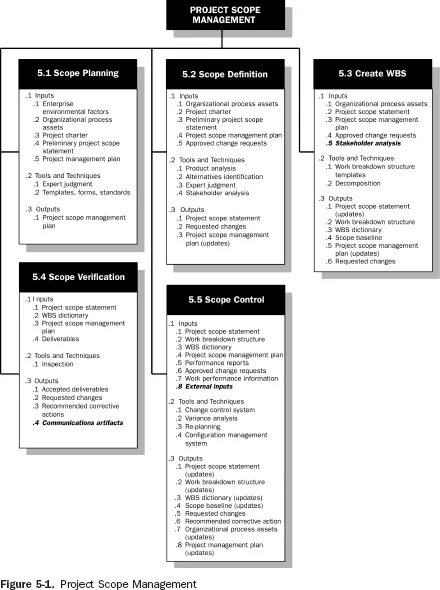
See Sections 5.3.1.1 through 5.3.1.4 of the PMBOK® Guide—Third Edition, with the addition of stakeholders’ analysis (see Section 5.3.1.5) as a specific WBS input for government projects.
- .5 Stakeholder Analysis
While not regularly an input on projects undertaken in the private sector, stakeholder analysis has a definite impact in the definition of work packages for public sector projects, due to hard boundaries between executing organizational stakeholders. It is not unusual for multiple ministries or agencies to execute a joint project, but, in most cases, this will result in separate project teams within each organization that will only coordinate activities through a few predefined communication channels. By contrast, in a private sector project, a similar issue would usually be resolved by creating a single, cross-functional project team based on efficiency criteria.
An additional consideration in a public sector project’s WBS is the involvement of “opposition stakeholder” analysis. Involvement of opposition stakeholders in this early creation of the WBS may assist in a more “positive outcome” for all stakeholders. An additional consideration in public sector projects is the involvement of regulators, opposition stakeholders, the press, etc. (see Section 2.2) in the creation of the WBS and definition of work packages.
5.3.2 Create WBS: Tools and Techniques
See Section 5.3.2 of the PMBOK® Guide—Third Edition.
5.3.3 Create WBS: Outputs
See Section 5.3.3 of the PMBOK® Guide—Third Edition.
5.4 Scope Verification
Section 5.4 of the PMBOK® Guide—Third Edition describes Scope Verification as a stakeholders’ verification and acceptance of the level of completion achieved by a project’s deliverables. Since the ultimate stakeholder in a government project is the general public (which is not usually directly involved in the project), this verification is fulfilled through specific project controls such as compliance and public accountability. While each l...
Table of contents
- Cover Page
- Title Page
- Copyright Page
- Notice
- Contents
- List of Figures
- Preface
- Section I—The Project Management Framework
- Section II—The Standard for Project Management of a Project
- Section III—The Project Management Knowledge Areas
- Section IV—Appendices
- Section V—Glossary
- Glossary
Frequently asked questions
Yes, you can cancel anytime from the Subscription tab in your account settings on the Perlego website. Your subscription will stay active until the end of your current billing period. Learn how to cancel your subscription
No, books cannot be downloaded as external files, such as PDFs, for use outside of Perlego. However, you can download books within the Perlego app for offline reading on mobile or tablet. Learn how to download books offline
Perlego offers two plans: Essential and Complete
- Essential is ideal for learners and professionals who enjoy exploring a wide range of subjects. Access the Essential Library with 800,000+ trusted titles and best-sellers across business, personal growth, and the humanities. Includes unlimited reading time and Standard Read Aloud voice.
- Complete: Perfect for advanced learners and researchers needing full, unrestricted access. Unlock 1.5M+ books across hundreds of subjects, including academic and specialized titles. The Complete Plan also includes advanced features like Premium Read Aloud and Research Assistant.
We are an online textbook subscription service, where you can get access to an entire online library for less than the price of a single book per month. With over 1.5 million books across 990+ topics, we’ve got you covered! Learn about our mission
Look out for the read-aloud symbol on your next book to see if you can listen to it. The read-aloud tool reads text aloud for you, highlighting the text as it is being read. You can pause it, speed it up and slow it down. Learn more about Read Aloud
Yes! You can use the Perlego app on both iOS and Android devices to read anytime, anywhere — even offline. Perfect for commutes or when you’re on the go.
Please note we cannot support devices running on iOS 13 and Android 7 or earlier. Learn more about using the app
Please note we cannot support devices running on iOS 13 and Android 7 or earlier. Learn more about using the app
Yes, you can access Government Extension to the PMBOK® Guide Third Edition by Project Management Institute in PDF and/or ePUB format, as well as other popular books in Business & Government & Business. We have over 1.5 million books available in our catalogue for you to explore.