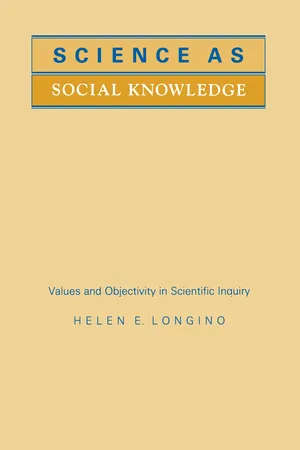
Conventional wisdom has it that the sciences, properly pursued, constitute a pure, value-free method of obtaining knowledge about the natural world. In light of the social and normative dimensions of many scientific debates, Helen Longino finds that general accounts of scientific methodology cannot support this common belief. Focusing on the notion of evidence, the author argues that a methodology powerful enough to account for theories of any scope and depth is incapable of ruling out the influence of social and cultural values in the very structuring of knowledge. The objectivity of scientific inquiry can nevertheless be maintained, she proposes, by understanding scientific inquiry as a social rather than an individual process. Seeking to open a dialogue between methodologists and social critics of the sciences, Longino develops this concept of "contextual empiricism" in an analysis of research programs that have drawn criticism from feminists. Examining theories of human evolution and of prenatal hormonal determination of "gender-role" behavior, of sex differences in cognition, and of sexual orientation, the author shows how assumptions laden with social values affect the description, presentation, and interpretation of data. In particular, Longino argues that research on the hormonal basis of "sex-differentiated behavior" involves assumptions not only about gender relations but also about human action and agency. She concludes with a discussion of the relation between science, values, and ideology, based on the work of Habermas, Foucault, Keller, and Haraway.
- 276 pages
- English
- PDF
- Available on iOS & Android
eBook - PDF
About this book
Trusted by 375,005 students
Access to over 1 million titles for a fair monthly price.
Study more efficiently using our study tools.
Information
Publisher
Princeton University PressYear
2020Print ISBN
9780691020518
9780691073422
eBook ISBN
9780691209753
Topic
PhilosophySubtopic
Epistemology in PhilosophyMethodology,
Goals,
and
Practices
—
37
particular
research
program
may
serve
to
disqualify
it
as
a
source
of
unvarnished
truth
about
its
subject
matter,
such
demonstration
may
have
little
bearing
on
one's
assessment
of
it
as
an
example
of
scientific
inquiry.
This
suggestion,
however,
anticipates
the
arguments
of
the
next
several
chapters.
In
these
I
analyze
several
key
features
of
the
in-
tellectual
practices
constituting
inquiry.
The
account
of
scientific
knowledge
emerging
from
this
analysis
has
points
of
convergence
with
both
the
empiricist
and
the
wholist
view.
My
aims
are
to
show
both
how
social
and
cultural
values
play
a
role
in
scientific
inquiry
and
how
broadening
our
conception
of
that
inquiry
from
an
individual
to
a
so-
cial
activity
enables
us
to
see
that
the
sciences
are
not,
nevertheless,
hopelessly
subjective.
Table of contents
- Cover Page
- Half-title Page
- Title Page
- Copyright Page
- Dedication
- Contents
- Preface
- Chapter One. Introduction: Good Science, Bad Science
- Chapter Two. Methodology, Goals, and Practices
- Chapter Three. Evidence and Hypothesis
- Chapter Four. Values and Objectivity
- Chapter Five. Values and Science
- Chapter Six. Research on Sex Differences
- Chapter Seven. Explanatory Models in the Biology of Behavior
- Chapter Eight. Science in Society
- Chapter Nine. Science and Ideology
- Chapter Ten. Conclusion: Social Knowledge
- Works Consulted
- Index
Frequently asked questions
Yes, you can cancel anytime from the Subscription tab in your account settings on the Perlego website. Your subscription will stay active until the end of your current billing period. Learn how to cancel your subscription
No, books cannot be downloaded as external files, such as PDFs, for use outside of Perlego. However, you can download books within the Perlego app for offline reading on mobile or tablet. Learn how to download books offline
Perlego offers two plans: Essential and Complete
- Essential is ideal for learners and professionals who enjoy exploring a wide range of subjects. Access the Essential Library with 800,000+ trusted titles and best-sellers across business, personal growth, and the humanities. Includes unlimited reading time and Standard Read Aloud voice.
- Complete: Perfect for advanced learners and researchers needing full, unrestricted access. Unlock 1.4M+ books across hundreds of subjects, including academic and specialized titles. The Complete Plan also includes advanced features like Premium Read Aloud and Research Assistant.
We are an online textbook subscription service, where you can get access to an entire online library for less than the price of a single book per month. With over 1 million books across 990+ topics, we’ve got you covered! Learn about our mission
Look out for the read-aloud symbol on your next book to see if you can listen to it. The read-aloud tool reads text aloud for you, highlighting the text as it is being read. You can pause it, speed it up and slow it down. Learn more about Read Aloud
Yes! You can use the Perlego app on both iOS and Android devices to read anytime, anywhere — even offline. Perfect for commutes or when you’re on the go.
Please note we cannot support devices running on iOS 13 and Android 7 or earlier. Learn more about using the app
Please note we cannot support devices running on iOS 13 and Android 7 or earlier. Learn more about using the app
Yes, you can access Science as Social Knowledge by Helen E. Longino in PDF and/or ePUB format, as well as other popular books in Philosophy & Epistemology in Philosophy. We have over one million books available in our catalogue for you to explore.