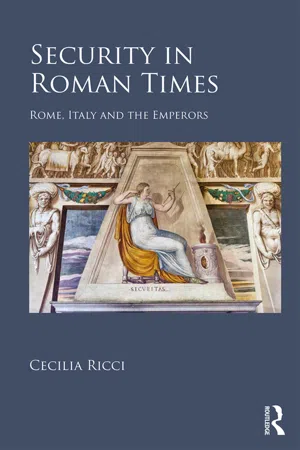
Using literary, epigraphic, numismatic and iconographic sources this book investigates the safety devices that were in place for the protection of the emperor and the city of Rome in the imperial age. In the aftermath of the civil wars Augustus continued to provide for his physical safety in the same way as in the old Republic while, at the same time, overturning the taboo of armed men in the city. During the Augustan age, the division of the city into 14 regions and 265 vici was designed to establish control over the urban space. Augustus' successors consolidated his policy but the specific roles of the various military or paramilitary forces remain a matter for debate. Drawing on the testimony of ancient authors such as Tacitus and Suetonius and on material evidence, the volume examines both the circumstances in which these forces intervened and the strategies that they adopted. It also examines the pre-Augustan, Augustan and post-Augustan sense of 'securitas', both as a philosophical and a political concept. The final section expands the focus from the city of Rome to the Italian peninsula where the security of the emperor as he travelled to his country residences required advance planning and implementation.
- 300 pages
- English
- ePUB (mobile friendly)
- Available on iOS & Android
eBook - ePub
About this book
Trusted by 375,005 students
Access to over 1.5 million titles for a fair monthly price.
Study more efficiently using our study tools.
Information
p.1
Part I
From public order to security
p.3
1 Studies on military forces and public order in Rome and Italy from Republic to Principate
Points of view
A question that scholars have tried to answer in the last fifty years is the following: was there a ‘police’ in the Roman world? The different studies, although sometimes with differing aims, have shared a common guideline that has always been to investigate which instruments and policies, according to the period of interest, the Roman state adopted to contain centrifugal thrusts and public order breakdown. The founding father of all these studies was Otto Hirschfeld who, in an article of 1891 entitled Die Sicherheitspolizei im römischen Kaiserreich, opened a season of studies on the issue of security and ‘police’ tasks carried out during the Roman Empire.1 The term ‘Sicherheitspolizei’, transmitted by the Prussian administration, with minor adaptations, to the young German nation during the period in which Hirschfeld was writing, represents one of the key terms of the ‘police’ apparatus that had developed in European countries at the turn of the eighteenth and nineteenth centuries.2 This was the ‘security police’ in charge of the governance of men (and not of things and places, which the municipal police were instead in charge of), with governing functions on issues relating to social and individual risks; and has led, as already mentioned previously and that will be reaffirmed, to modernity.3
Hirschfeld tried to trace the antecedents of certain figures of the Roman Empire to the Greek and Hellenistic cities. His educational background led him to consider the Digest and juridical epigraphy as the best sources, without, however, neglecting literary references and other types of inscriptions. If the sources are reported following a thematic and not a chronological order – ranging with great ease from late Republic to late antiquity – however, his synthesis is a good starting point in order to gain insight, especially at a provincial level, of the means that were adopted to quell the riots. When considering Rome, special attention is given to the vigiles and their officers, and to the speculatores and the detention areas; and to the beneficiarii, with outdated considerations, given the large number of inscriptions and papyri that had been unearthed and studied in the course of the following century.4
The most comprehensive accounts on public order, however, are given by two authors of the second half of the twentieth century: Andrew William Lintott who, since the late 1960s5 has closely analysed the episodes in which, in Republican Rome, violence exploded and determined the authority’s reaction; and Wilfried Nippel who, in the late 1980s and mid 1990s, worked on a similar theme, although differently, drawing on a more systematic way of proceeding and coming to delineate the ‘features of the new imperial order’.6
p.4
But before reviewing these and other works that have provided, for the present investigation, food for thought and useful interpretive tools; and before describing what I intend to do and how I will proceed, since this book focuses on the city of Rome and imperial Italy, it seems essential to consider another line of investigation, grounded in nineteenth-century historiography: namely the systematic study of the urban garrison, mostly carried out between the 1930s and the 1960s.7 The functions of the cohorts of Rome and their changes over time will receive adequate attention in Parts II and III of this volume. The rich crop of information regarding this, taken from those monographs that are now considered classic, represent the natural premise of this work and act as the backbone to the reflections of many authors who have analysed public order and policy in the imperial age.
What must be pointed out first is that scholars have not given the same attention to all the military forces of Rome. This is due in part to the size and the political role of some of the military forces, such as the Praetorian Guards or the vigiles.8 It is also in part, a result of the partial representativeness of the documents related, as in the case of equites singulares Augusti, to the fortuitousness of their recovery.9
There is no doubt that not only were the praetorians appointed as imperial guards, with their persona closely connected to the one of the Princeps; but they also participated in military campaigns, already in the Julio-Claudian era.10 At the end of the 1930s two volumes, published a year apart, were devoted to the more numerous and substantial cohorts of Rome.11 Sources and considerations contained in the works of Marcel Durry and Alfredo Passerini, despite the fact that eighty years have gone by, are still invaluable and essentially well documented when considering issues such as the number of cohorts12 and of active soldiers13; the onomastics; soldiers’ provenance14 and social background; the duration of military service; the enlistment age; and the structure of careers. New valuable information – apart from the natural enrichment of the documentation15 – regards instead: the fate and the status of veterans (praetorians, and in general of the troops of Rome); and soldiers’ family and social relationships even after their military service.16 In the latter case, on the whole, what seems to arise from an initial social isolation, is an integration, in the second century, into the social fabric mainly through family and freedmen.17 Finally, new considerations have regarded the urban areas used for burial and the types of sepulchral monuments employed, as evidence of a will and capacity to represent themselves in relation to civilians.18
The purpose for which seven vigiles cohorts were created in 6 BC was to prevent and extinguish fires, and to patrol the streets at night. After Paul Kenneth Baillie Reynolds devoted a pioneering monograph in 1926 to this issue, vigiles cohorts were the subject of a major monograph at the end of the 1990s, when Robert Sablayrolles reconstructed the size, the functions, the hierarchy and the action of the firefighters of Rome and of the ostiense statio.19
p.5
In the late 1950s, Edward Echols devoted a long article to the policing of the city of Rome. The aim of his study was to look back through time to find the beginnings of the idea of police. He argues that ancient historians showed ostentatious indifference to “the duties of Rome’s imperial urban cohorts performed in the comfort and relative security of the capital of the world”, which were clearly viewed as less important than the hard work of legionaries in distant and hostile lands. Echols recounts in this way the stages of a long process: during the Republic, starting from the second century BC, a reserve police force (at first composed of citizens who acted as vigilantes, then regular army soldiers) was introduced to support the triumviri cis Tiberim and, above all, the...
Table of contents
- Cover Page
- Security in Roman Times
- Title
- Copyright
- Contents
- List of Figures
- Preamble
- Notes on Translation and Bibliographical References
- Part I From Public Order to Security
- Part II the Birth of a Dispositive
- Part III Testing a Dispositive
- Part IV Policing and Security in Imperial Italy
- Epilogue: Securitati Caesaris Totiusque Urbis
- Bibliography
- Index
Frequently asked questions
Yes, you can cancel anytime from the Subscription tab in your account settings on the Perlego website. Your subscription will stay active until the end of your current billing period. Learn how to cancel your subscription
No, books cannot be downloaded as external files, such as PDFs, for use outside of Perlego. However, you can download books within the Perlego app for offline reading on mobile or tablet. Learn how to download books offline
Perlego offers two plans: Essential and Complete
- Essential is ideal for learners and professionals who enjoy exploring a wide range of subjects. Access the Essential Library with 800,000+ trusted titles and best-sellers across business, personal growth, and the humanities. Includes unlimited reading time and Standard Read Aloud voice.
- Complete: Perfect for advanced learners and researchers needing full, unrestricted access. Unlock 1.5M+ books across hundreds of subjects, including academic and specialized titles. The Complete Plan also includes advanced features like Premium Read Aloud and Research Assistant.
We are an online textbook subscription service, where you can get access to an entire online library for less than the price of a single book per month. With over 1.5 million books across 990+ topics, we’ve got you covered! Learn about our mission
Look out for the read-aloud symbol on your next book to see if you can listen to it. The read-aloud tool reads text aloud for you, highlighting the text as it is being read. You can pause it, speed it up and slow it down. Learn more about Read Aloud
Yes! You can use the Perlego app on both iOS and Android devices to read anytime, anywhere — even offline. Perfect for commutes or when you’re on the go.
Please note we cannot support devices running on iOS 13 and Android 7 or earlier. Learn more about using the app
Please note we cannot support devices running on iOS 13 and Android 7 or earlier. Learn more about using the app
Yes, you can access Security in Roman Times by Cecilia Ricci in PDF and/or ePUB format, as well as other popular books in History & Ancient History. We have over 1.5 million books available in our catalogue for you to explore.