The life and times of a uniquely American testament
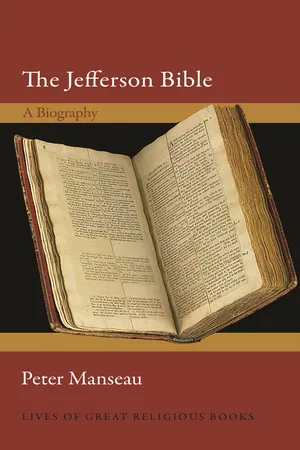
In his retirement, Thomas Jefferson edited the New Testament with a penknife and glue, removing all mention of miracles and other supernatural events. Inspired by the ideals of the Enlightenment, Jefferson hoped to reconcile Christian tradition with reason by presenting Jesus of Nazareth as a great moral teacher—not a divine one. Peter Manseau tells the story of the Jefferson Bible, exploring how each new generation has reimagined the book in its own image as readers grapple with both the legacy of the man who made it and the place of religion in American life.
Completed in 1820 and rediscovered by chance in the late nineteenth century after being lost for decades, Jefferson's cut-and-paste scripture has meant different things to different people. Some have held it up as evidence that America is a Christian nation founded on the lessons of the Gospels. Others see it as proof of the Founders' intent to root out the stubborn influence of faith. Manseau explains Jefferson's personal religion and philosophy, shedding light on the influences and ideas that inspired him to radically revise the Gospels. He situates the creation of the Jefferson Bible within the broader search for the historical Jesus, and examines the book's role in American religious disputes over the interpretation of scripture. Manseau describes the intrigue surrounding the loss and rediscovery of the Jefferson Bible, and traces its remarkable reception history from its first planned printing in 1904 for members of Congress to its persistent power to provoke and enlighten us today.
- English
- ePUB (mobile friendly)
- Available on iOS & Android
eBook - ePub
About this book
Trusted by 375,005 students
Access to over 1 million titles for a fair monthly price.
Study more efficiently using our study tools.
Information
Publisher
Princeton University PressYear
2020Print ISBN
9780691209692
9780691205694
eBook ISBN
9780691209685
Topic
Theology & ReligionSubtopic
BiblesSharpening the Blade
CHAPTER 1
During much of Thomas Jefferson’s lifetime, heresy was a crime with potentially dire consequences. Echoes of English laws that had first called for the burning of “divers false and perverse people” sharing “wicked doctrine and heretical and erroneous opinions” under the writ of De heretico comburendo in 1401, remained on the books in Virginia until 1776, when the commonwealth’s General Assembly “repealed all Acts of Parliament which had rendered criminal the maintaining [of] any opinions in matters of religion.”1
No one was ever executed in Virginia for “wicked doctrine,” but that did not mean religious behavior was not scrupulously policed. The Anglican establishment into which Jefferson was born, and in which he readily played his part in adulthood as a vestryman, maintained its authority by creating obstacles to dissent. Along with laws such as those threatening death for bringing a single Quaker into the colony, Virginians faced scrutiny not just for their actions but also their motivations and beliefs. As Jefferson lamented:
By our own act of assembly of 1705, if a person brought up in the Christian religion denies the being of a God, or the Trinity, or asserts there are more Gods than one, or denies the Christian religion to be true, or the scriptures to be of divine authority, he is punishable on the first offence by incapacity to hold any office or employment ecclesiastical, civil, or military; on the second by disability to sue, to take any gift or legacy, to be guardian, executor, or administrator, and by three years imprisonment, without bail.2
To deny the divine authority of scripture—to suggest that the Bible was crafted by human hands, that it was shaped by history, circumstance, and perhaps even by ignorance and error—was to court the scorn of one’s neighbors and the punishment of the state. What sort of man born in such an environment would dare put a knife edge to a single page of sacred text?
Remarkably, it was one with the least controversial religious upbringing imaginable. As is frequently said to explain this champion of freedom’s ownership of enslaved people, Jefferson was a man of his times. Those times included a widespread reevaluation of religious authority which allowed a boy born in the Virginia woods access to the Enlightenment thinking that was then remaking the world’s churches and nations. The leaders and exemplars of these movements would prove to be the spiritual whetstones against which Jefferson sharpened the blade of his intellect.
As the late dean of American historians of religion Edwin Gaustad put it, Jefferson not only was raised in an “Anglican ambience,” he “began life as an Anglican and ended it the same way.” Most likely baptized at home, as other Virginian gentry like George Washington and George Mason were, Jefferson was from infancy a conventional Christian of the established church, who likely would have been scandalized by the suggestion that one day he would presume to make a Bible of his own.3
Yet even in his youth Jefferson seems also to have had a sense that religious texts have a practical dimension and might be put to novel ends. His nineteenth-century biographer Harry Randall mentions that Jefferson’s second earliest memory was of being a toddler upset when dinner was delayed one night. Though no plate was set before him, he recited the Lord’s Prayer as a grace before the meal. In this act Jefferson hoped not to see food magically appear, but rather that the words alone would satisfy his hunger.
In Randall’s estimation, this memory affirms little more than “that at three or four years old, he was taught to repeat his prayers,” through which Jefferson “retained a familiarity with the Bible, with the prayers and collects of the noble Liturgy of the Church, and with its psalms and hymns, possessed by very few persons.” Yet the account may also suggest that, for Jefferson, religion was by no means separate from worldly concerns, but rather something that might be instrumentalized to positive effect.4
Later in life Jefferson would recognize and write passionately about how religion might also be used for ill, but in the interim he learned that it could be merely dreary. His time spent boarding with the Scottish clergyman Reverend William Douglas from age nine to fourteen taught Jefferson that to be among the professionally religious did not necessarily make one particularly well suited to maintaining the health of the body or the expansion of the mind. He recalled his time there as filled with dinners of “mouldy pies,” to which an empty plate and a prayer might have been preferred, and complained that his teacher was “a superficial Latinist, less instructed in Greek.”5 Even with such failings, however, Reverend Douglas managed to teach the young Jefferson the basics of both classical languages as well as French. Along with the King’s English, these were the tongues he would later make use of when redacting the Gospels.
Though Jefferson’s early education may have been wanting due to Douglas’s deficiencies, it soon improved as the result of a silver lining in the emotional storm cloud brought by death of his father. Peter Jefferson’s dying wish for his teenaged son was that he be thoroughly trained in the classics. The new tutor, Reverend James Maury, while likewise a man of the cloth, was also a man of books. Jefferson found in Maury’s home a vast library that would serve as an early onset of the bibliophilia that would follow him happily through his days.
Despite this consistent and orthodox religious education, Jefferson admitted that he entertained doubts about the certain teachings of the church “from a very early part of my life.” His particular qualms centered on the doctrine of the Trinity, which as he later wrote with a hint of ironic self-deprecation, he “never had sense enough to comprehend.”6
This lack of comprehension, which is perhaps better understood as simply a lack of belief, seems to have been born out of the continuation of Jefferson’s Anglican education. At the College of William and Mary, nearly all the faculty were Anglican divines, as Jefferson’s early teachers had been. As such, they were required to affirm the Thirty-nine Articles of the Church of England, the very first of which was the concept that would later test his credulity: “Of Faith in the Holy Trinity.” Moreover, the principal and masters of the college all signed an oath of affirmation to “avoid the danger of heresy, schism, and disloyalty.”7
The sole outlier among this clergy-dominated faculty was a newly appointed professor of natural philosophy, William Small, who Jefferson would later describe as “a man profound in most of the useful branches of science, with a happy talent of communication, correct and gentlemanly manners, and an enlarged and liberal mind.” It was from Small that Jefferson claimed to receive “my first views of science and the system of things in which we are placed”—his first views, in other words, of a universe moved by laws beyond traditional religious understanding.8
Small introduced his students to the works of John Locke, Francis Bacon, and Isaac Newton, whom for Jefferson quickly became a new trinity to replace the old. As Jefferson later wrote, “I consider them as the three greatest men that have ever lived, without any exception and as having laid the foundations of those superstructures which have been raised in the Physical & Moral sciences.”9
Unlike the Trinity Jefferson found inscrutable in its dependence on mystery for its significance, the trinity he encountered under Small’s tutelage proposed that the world was eminently knowable. All that these men had discovered of the universe and human society had been attained through reason—the application of the mind to observation and deduction. “From Bacon, Locke, and Newton,” Gaustad wrote, “Jefferson learned to count, collect, explore, measure, observe, arrange, invent, and put his trust in the perceptions of the present rather than in the precedents of the distance past.” Though eventually Jefferson focused his studies on law, the tenets of the Enlightenment composed his true education.10
* * *
Even with the new trinity’s lessons, Jefferson might have remained comfortably within the “Anglican ambience” that challenged the authority of neither scripture nor crown, but other influences soon led him to question much of what he had previously taken for granted. In the “Literary Common place Book” Jefferson kept throughout the 1760s and which provides a précis of the reading that occupied years of his adulthood, the single most quoted source is Henry St. John. Also known as the first Viscount Bolingbroke, this somewhat scandalous thinker almost singlehandedly planted and cultivated a crisis of faith in the young Virginian.
Bolingbroke was an English member of parliament best known in Enlightenment circles for his critical writings on religion. As Samuel Johnson memorably summed up his incendiary rhetoric, which was not published until after his death, Bolingbroke “was a scoundrel, and a coward: a scoundrel for charging a blunderbuss against religion and morality; a coward, because he had not resolution to fire it off himself.”11
Throughout his life Jefferson would recommend Bolingbroke’s works “for the sake of the stile, which is declamatory and elegant.” However, during the period in which his thoughts on religion were being transformed, Jefferson seems to have been drawn to the Viscount as much for his radical ideas as his facile pen.12 For example, Bolingbroke wrote:
There are gross defects, and palpable falsehoods, in almost every page of the scriptures and the whole tenor of them is such as no man, who acknowledges a supreme, all-perfect Being, can believe it to be his word.13
Some of Bolingbroke’s sharpest barbs against religion referred to the Hebrew scriptures, such as when he admitted “I cannot believe that the Pentateuch, and the other books of the Old Testament, were writ under a divine influence, and have any right to be called the word of God.” But his critique did not shy away from the New Testament texts that would eventually cry out to Jefferson for redaction.14 As Jefferson quoted with apparent approval:
When we meet with any record cited in history, we accept the historical proof, and content ourselves with it, of how many copies soever it may be the copy. But this proof would not be admitted in judicature. . . . nor any thing less than an attested copy of the record.15
In matters of history and religion, Bolingbroke argued and Jefferson concurred, while hearsay seemed to be sufficiently persuasive to many, the standards of present concerns were invariably higher. Bolingbroke wrote:
The application is obvious and if it be reasonable to take such a precaution in matters that concern private property, and wherein the sum of ten pounds may not be at stake, how much more reasonable is it to neglect no precaution, that can be taken to assure ourselves that we receive nothing for the word of God, which is not sufficiently attested to be so?16
At age 22, Jefferson copied by hand some ten thousand of Bolingbroke’s words, among them judgments of the Gospels that were not quite as sharp tongued as those he directed at older texts. Nonetheless, Bolingbroke made light of the New Testament’s merits when weighing them with the scales of the Enlightenment.
“It is not true that Christ revealed an entire body of ethics, proved to be the law of nature from principles of reason, and reaching all the duties of life,” Bolingbroke wrote. Despite what some may claim, he argued, the Gospels did not provide any such code, but rather only gestured toward the need of its creation. “Moral obligations are occasionally recommended and commanded in it,” he lamented, “but no where proved from principles of reason, and by clear deductions, unless allusions, parables, and comparisons, and promises, and threats, are to pass for such.”17
Were one to attempt to piece together a reason-tested ethical guide from the New Testament, Bolingbroke suggested, one would find only “short sentences” scattered here and there throughout the Gospels. Anyone collecting them would note that “they would compose a very short as well as unconnected system of ethics.”18 It was beyond those short sentences, Bolingbroke ventured, where the true trouble with Christianity arose. Bolingbroke’s dismantling of the biblical worldview ran from alpha to omega, the Garden to Golgotha, and Jefferson carefully copied it all in his own hand. One can only imagine the irreverent thrill of the boy who had once prayed to sate his hunger feverishly copying words so alien to the religious environment in which he was rais...
Table of contents
- Cover Page
- Series Page
- Title Page
- Copyright Page
- Contents
- List of Illustrations
- Author’s Note and Acknowledgments
- Introduction: Excavating the Sacred
- Chapter 1: Sharpening the Blade
- Chapter 2: Making the Cut
- Chapter 3: The Quest for the Jeffersonian Jesus
- Chapter 4: Lost and Found
- Chapter 5: Born Again
- Chapter 6: Social Engineering
- Chapter 7: Congressional Inheritances
- Chapter 8: Jefferson, Jesus, and the Sixties
- Chapter 9: Choose Your Own Adventure
- Epilogue: Bible as Barrow
- Illustrations
- Notes
- Index
Frequently asked questions
Yes, you can cancel anytime from the Subscription tab in your account settings on the Perlego website. Your subscription will stay active until the end of your current billing period. Learn how to cancel your subscription
No, books cannot be downloaded as external files, such as PDFs, for use outside of Perlego. However, you can download books within the Perlego app for offline reading on mobile or tablet. Learn how to download books offline
Perlego offers two plans: Essential and Complete
- Essential is ideal for learners and professionals who enjoy exploring a wide range of subjects. Access the Essential Library with 800,000+ trusted titles and best-sellers across business, personal growth, and the humanities. Includes unlimited reading time and Standard Read Aloud voice.
- Complete: Perfect for advanced learners and researchers needing full, unrestricted access. Unlock 1.4M+ books across hundreds of subjects, including academic and specialized titles. The Complete Plan also includes advanced features like Premium Read Aloud and Research Assistant.
We are an online textbook subscription service, where you can get access to an entire online library for less than the price of a single book per month. With over 1 million books across 990+ topics, we’ve got you covered! Learn about our mission
Look out for the read-aloud symbol on your next book to see if you can listen to it. The read-aloud tool reads text aloud for you, highlighting the text as it is being read. You can pause it, speed it up and slow it down. Learn more about Read Aloud
Yes! You can use the Perlego app on both iOS and Android devices to read anytime, anywhere — even offline. Perfect for commutes or when you’re on the go.
Please note we cannot support devices running on iOS 13 and Android 7 or earlier. Learn more about using the app
Please note we cannot support devices running on iOS 13 and Android 7 or earlier. Learn more about using the app
Yes, you can access The Jefferson Bible by Peter Manseau in PDF and/or ePUB format, as well as other popular books in Theology & Religion & Bibles. We have over one million books available in our catalogue for you to explore.