At a time when accountability and the avoidance of risk are increasingly demanded of social workers, the ability to make clear and informed decisions is essential. This book, written for practicing social workers undertaking their ASYE and compulsory CPD, has been designed to help professionals make sound judgments in increasingly complex contexts and under pressure. The focus is on empowering front-line professionals through reflective practice, so that they are able to draw on multiple factors and perspectives and make sound problem-solving judgements. The book begins with the core concepts, client focus, and legal background before moving on to consider the collaborative processes and the nature of individual judgements. It then considers particular dimensions of social work decision making, such as safeguarding, taking risks, assessment and dynamic decision tools and processes. It then concludes by look at the organisational context of decision management, with a focus on supervision, training and effective communication.
- 272 pages
- English
- ePUB (mobile friendly)
- Available on iOS & Android
eBook - ePub
Decision Making, Assessment and Risk in Social Work
About this book
Trusted by 375,005 students
Access to over 1.5 million titles for a fair monthly price.
Study more efficiently using our study tools.
Information
Chapter 1
A framework for decisions, assessment and risk
Good judgement and quality decisions are two of the marks of the competent professional in any field.
(Simmonds, 1998, p175)
Introduction
This first chapter introduces concepts of judgement, risk and decision making in both everyday life and social work practice. A framework for assessment, professional judgement, decision making and managing risk is outlined, drawing on a range of models. Key terms are discussed and defined. The theoretical material in this chapter provides a framework for understanding situations and a foundation for later chapters by introducing concepts about judgement, risk, assessment and decision making that are then expanded in later chapters where they are applied to practice.
Everyday decisions and risk
How do you make your everyday decisions such as what to eat, what to wear and how to spend your time? We make judgements every day, for example about the anticipated tastiness of some food in a shop, about the likely weather today, and about the value or pleasure that we expect if we use our time in a particular way. We also take risks every day, such as the risk of food poisoning, the risk of embarrassment or getting wet because of choosing the ‘wrong’ clothes to wear or of feeling we have wasted our time on an activity. Decisions, judgements and risk-taking in the face of uncertainty are everyday activities of life. Life without risk would be dull, and lacking in the stimuli that lead to learning and growth. Making choices in the face of uncertainty is part of the challenge and joy of being human; it is part of normal development for children as they grow in knowledge, skill and confidence in dealing with the world.
As social workers, we make many judgements and decisions daily. Our judgements cover diverse domains, such as whether a child should be regarded as in need of protection, assessing the risks inherent in a proposed care arrangement following hospital discharge or selecting a practice method for work with a particular family. Some decision making (generally where consequences are more serious) is formalised into group or organisational processes, such as court hearings, strategic planning meetings, case discussions, family meetings and reviews. Some collaborative decisions are more informal, for instance a practitioner checking a decision with the team leader as he or she is dashing down the corridor to a meeting!
Decision making in situations of uncertainty is a central professional activity in health and social care services. We are making decisions in uncertainty, or taking risks, every time we support a person with a disability to achieve greater independence, plan the discharge of an older person or psychiatric patient from hospital, support a family in a state of dysfunction or intervene to protect an individual from abuse. The fundamental professional task of assessing needs and planning care (including psycho-social interventions such as counselling or group work) is given added complexity by our pivotal decision-making role as social workers in assessing risk as well as needs (Taylor and Devine, 1993; Parton et al., 1997) and the professional judgement that is required.
Our professional judgement and decision making takes place in a variety of contexts including the client, family and wider society; the professional task and role; and the organisation within which the professional is employed. We consider these in turn as we build up a map of concepts to guide our journey through the rest of the book, at the same time defining key terms and integrating these considerations with the social work helping process. The frame of reference by which we conceptualise and articulate a problem situation is crucial to turning need, distress or chaos into a manageable decision process where we can help clients and families to change and where we can undertake safeguarding and service gate-keeping functions on behalf of society. We draw upon research to inform our understanding and our practice.
There is growing interest in moving beyond simplistic laboratory-type research on decisions and a dominant focus on probabilities (of harm) in the conceptualisation of risk to engage with the concepts of complexity and chaos theory (Haynes, 2003). These have an obvious attraction in the complex world of social care delivered within the multiple dimensions of family and social life. This focus opens up consideration of critical incidents and interactions within systems with relevance to social work (Bostock et al., 2005; Fish et al., 2008). Perhaps one contribution of complexity theory may be to dispel the notion that risk could be eliminated if we had sufficient knowledge or control mechanisms. Rather, the more helpful perspective may be to seek to identify those aspects (including interactions) of the care system that are most likely to experience highly undesirable events, and to address those through parts of the organisation that are suitably amenable to change (Taylor and Campbell, 2011). Although complexity and chaos theory seem to have little in the way of principles or tools that are readily applicable in practice, these approaches may lend support to the proposition that the development of expertise amongst social workers in exercising professional judgement (and using knowledge in doing so) is at least as important as developing regulatory systems in ensuring quality decisions (Stacey, 2000). Our overarching model of assessment incorporating risk and problem solving, and leading to decisions informed by evidence (knowledge), is illustrated in Figure 1.1.
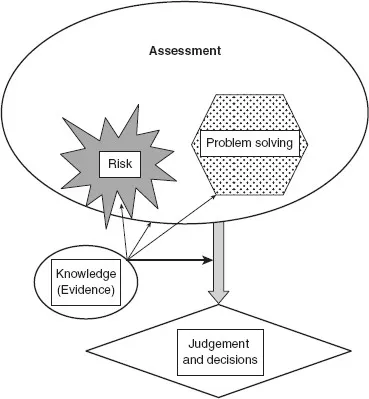
Figure 1.1 Overall schema of decisions in the context assessment, risk and evidence
Engaging clients, families and other stakeholders in assessment and decision processes
Social work practice has learned the lesson over the decades that effective practice needs to engage clients and families as far as possible. Chapter 2 focuses on engaging clients effectively in risk and decision making. Client engagement has particular challenges where – for example – there are issues of addiction and in those countries where the mass media creates a hostility towards social workers. These issues are complex enough to merit the focus of a whole book such as Taylor (2011), to which the reader is referred for further discussion.
Professional social work practice normally takes place within an organisation, whether statutory or voluntary, although a few social workers provide counselling to individuals, family work and expert witness services to courts as self-employed practitioners. The most important decision making will not be left to the individual but will be part of a process within the organisation. By important decisions, we mean those with the most impact on people’s lives (such as taking a child into care) or those with the greatest resource implications. Thus, the most important social work decisions will not be made unilaterally, but will be subject to various checks and balances involving other people. Your line manager or professional supervisor will be involved in these decisions; the most serious decisions will go further up the line management. Other professionals should be involved as and when appropriate in accordance with their area of knowledge and skill in relation to the needs of the client or family. It frequently falls to the social worker to co-ordinate the multi-professional process. In terms of our training this seems appropriate, as the profession with the most holistic, user-centred view of the needs, risks, resources and options. The knowledge, skills and tools of assessment are discussed further in Chapter 4. The contributions of different professions need to be co-ordinated effectively and efficiently, and this is discussed more fully in Chapter 8. Issues of working effectively within professional supervision and management arrangements are discussed in Chapter 10. Key elements of the decision process might be conceptualised as
• involving:

• and using knowledge of:
These decision-making processes (which often take place as part of ‘assessment’ and ‘review’ – see Chapters 4 and 9) feed into and are fed by the individual cognitive judgement of the social worker in order to gather and order appropriate information, ‘frame’ the decision and analyse options.
ACTIVITY 1.1
Meanings of words where outcomes are unknown
What do these words mean to you in the context of your work?
How does their usage differ among your peers at work and in the wider society?
• Dangerousness
• Fate
• Risky
• Risk-taking
• Vulnerable
• Gamble
• God’s will
• Harm
• Hazard
• Judgement
Conceptualising risk, risk-taking and risk communication
Our judgements and decisions are made in situations where the outcome is uncertain. As the outcome is uncertain, there is always the possibility that a less desirable outcome will ensue, possibly some harm or loss. Such losses or harms are sometimes referred to as risks, such as in phrases like the risk of further abuse or the risk of falling. Where the term risk means simply the likelihood of or the probability of, we shall use here these phrases instead as they are more precise. Hence we would ...
Table of contents
- Cover Page
- Halftitle
- Ads
- Title
- Copyright
- Contents
- Foreword
- About the Author
- Preface to the Third Edition
- Acknowledgements
- Introduction
- 1 A Framework for Decisions, Assessment and Risk
- 2 Client Decisions, Perspectives, Emotions and Crises
- 3 Legal Aspects of Decisions, Assessment and Risk
- 4 Assessment, Risk Assessment and Decision Support Systems
- 5 Professional Judgement, Bias and Using Knowledge in Assessment and Decisions
- 6 Judgements about Safeguarding and Service Eligibility, and Predicting Harm
- 7 Risk-Taking Care Choices: Values, Gains and Hazards
- 8 Collaboration, Communication and Contest in Assessment, Risk and Decision Processes
- 9 Dynamics of Practice: Managing Risk, Re-Assessing and Changing Your Mind
- 10 Managing Decisions, Assessment and Risk: Support, Blame and Learning
- Conclusion
- Appendix 1 Pointers in Designing or Completing an Assessment to Inform a decision in uncertainty
- Appendix 2 Supported Decision Tool
- Appendix 3 Professional Capabilities Framework
- Glossary of Terms
- References
- Index
Frequently asked questions
Yes, you can cancel anytime from the Subscription tab in your account settings on the Perlego website. Your subscription will stay active until the end of your current billing period. Learn how to cancel your subscription
No, books cannot be downloaded as external files, such as PDFs, for use outside of Perlego. However, you can download books within the Perlego app for offline reading on mobile or tablet. Learn how to download books offline
Perlego offers two plans: Essential and Complete
- Essential is ideal for learners and professionals who enjoy exploring a wide range of subjects. Access the Essential Library with 800,000+ trusted titles and best-sellers across business, personal growth, and the humanities. Includes unlimited reading time and Standard Read Aloud voice.
- Complete: Perfect for advanced learners and researchers needing full, unrestricted access. Unlock 1.5M+ books across hundreds of subjects, including academic and specialized titles. The Complete Plan also includes advanced features like Premium Read Aloud and Research Assistant.
We are an online textbook subscription service, where you can get access to an entire online library for less than the price of a single book per month. With over 1.5 million books across 990+ topics, we’ve got you covered! Learn about our mission
Look out for the read-aloud symbol on your next book to see if you can listen to it. The read-aloud tool reads text aloud for you, highlighting the text as it is being read. You can pause it, speed it up and slow it down. Learn more about Read Aloud
Yes! You can use the Perlego app on both iOS and Android devices to read anytime, anywhere — even offline. Perfect for commutes or when you’re on the go.
Please note we cannot support devices running on iOS 13 and Android 7 or earlier. Learn more about using the app
Please note we cannot support devices running on iOS 13 and Android 7 or earlier. Learn more about using the app
Yes, you can access Decision Making, Assessment and Risk in Social Work by Brian J. Taylor in PDF and/or ePUB format, as well as other popular books in Social Sciences & Social Work. We have over 1.5 million books available in our catalogue for you to explore.