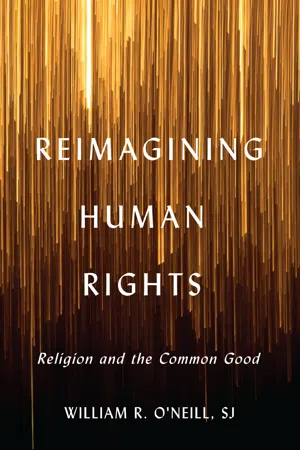
In Reimagining Human Rights, William O’Neill presents an interpretation of human rights “from below,” showing how victims of atrocity can embrace the rhetoric of human rights to dismantle old narratives of power and advance new ones. Topics covered include race and mass incarceration, immigration and refugee policy, and ecological responsibility.
eBook - ePub
Reimagining Human Rights
Religion and the Common Good
- 192 pages
- English
- ePUB (mobile friendly)
- Available on iOS & Android
eBook - ePub
About this book
Trusted by 375,005 students
Access to over 1.5 million titles for a fair monthly price.
Study more efficiently using our study tools.
Information
Publisher
Georgetown University PressYear
2021Print ISBN
9781647120351
9781647120344
eBook ISBN
9781647120368
Topic
Theology & ReligionSubtopic
Ethics & Moral PhilosophyCHAPTER ONE
Interpreting Rights
When sufferings become unendurable the cries are no longer heard. The cries, too, fall like rain in summer.
—Bertolt Brecht
The killings began on the evening of Easter Wednesday, April 6, 1994, and continued for three months. By the end over eight hundred thousand Tutsis as well as Hutus who opposed the genocide were massacred. Between that second week of April and the third week of May it is estimated that the daily rate of killing was at least five times that of the Nazi death camps. Three-quarters of the Rwandese Tutsi population fell victim to the genocide; the elderly, children, the infirm—none were spared. Nor was there haven. The churches, formerly offering sanctuary, were the first places attacked.1 In their environs “more Rwandese citizens died . . . than anywhere else.”2 The horror was unmitigated but not inexplicable, for the killing was due less to atavistic enmity than to a racist mythology nurtured in the colonial period and abetted by Belgian and later French realpolitik.3 Although favoring elite interests, the totalizing myth of Hutu supremacy divested the imagined “other” of moral standing so that the massacres by the Interahamwe (the militia) seemed banal.4 In a perverse inversion of Emmanuel Lévinas’s dictum, neighbor refused to see the neighbor’s face upon which was inscribed the command “Thou shalt not kill.”5 So, too, members of the United Nations Security Council refused to acknowledge the Rwandan killings as genocide lest they incur legal obligations under the Convention on the Prevention and Punishment of the Crime of Genocide to which they were signatories. At the behest of the United States, United Nations peacekeeping troops in Rwanda (UNIMIR) were summarily withdrawn, along with all foreign nationals.6 Others were left to die.
Yet mere wretchedness, Albert Camus reminds us, is not tragedy.7 Whether we see these cruelest months as morally tragic or merely an unimportant failure of realpolitik depends upon evoking what was effaced: bringing to word the transgressed command. And recognizing the nature, force, and scope of victims’ claims, as I noted in the introduction, is the first, indispensable critical or deconstructive role of rights.8 Yet memory speaks, I will argue, as command in the solidarity of remembrance, through what Benjamin calls anamnestic solidarity: the constructive role of rights.9 Here the interpretative burden shifts to identifying correlative duties and duty-bearers in redeeming claim-rights. Finally, the deconstructive and constructive uses combine in a hermeneutic of reconstructive redress. For the denial of rights leaves moral traces, such as in victims’ claims to repentance or reparation. As we shall see, these distinct yet finally inseparable uses of rights configure not only the legal/juridical and ethical but also the religious interpretation of rights. Indeed, our differences regarding the fit of these terms explain, in part, why social reconciliation remains such a vexed issue. Desmond Tutu’s pleas for “confession, forgiveness and reconciliation in the lives of nations” meet with his fellow Nobel laureate Wole Soyinka’s objection, that justice is ill served by “discharging the guilty without evidence of mitigation—or remorse.”10
How, then, can the exigent demands of individual rights be reconciled with “the healing of breaches, the redressing of imbalances, the restoration of broken relationships”?11 Must we choose between the “politics of [individual] rights” and the “politics of the common good” in restorative justice?12 Or is Tutu’s appeal to Ubuntu—the fusing of liberal justice and communitarian solidarity—merely a religious bricolage of incommensurable warrants and backings? As will be shown, any rapprochement must take seriously the genealogy of our differences. For it is only against the inherited theoretical background that the originality of Tutu’s translation appears. Let me first, then, offer a brief genealogy of our rival rhetorics and then elaborate the threefold use of rights at play in “telling the story.” I conclude with a brief response to several salient criticisms of rights rhetoric.
I. A GENEALOGY OF DIFFERENCE
Natural rights, it seems, are the currency of modernity—the coin of a disenchanted realm. The “ultimate and most sublime values have retreated from public life,” wrote Max Weber, while our fragmented values (a demystified polytheism) succeed to the “grandiose moral fervor of Christian ethics.”13 With the eclipse of the religiously inspired ideal of the common good, the liberties of the moderns reign supreme.14 Grotius’s modern heirs speak not of the divine finality of natural law (the jus naturale of the medievals) but of the natural, inalienable, and sacred rights of man.15 So it is for partisans and critics alike: the Western effective history of rights begins with what Jürgen Habermas calls the “positivization” (Positivierung) of the classical jus naturale of modernity. Civic virtue gives way to “a neutral sphere of personal choice” in which, as Mandeville put it, private vice makes public virtue.16
Recent historiography, as noted in the introduction, belies the secular myth of origins. In his magisterial treatise Brian Tierney contends that the origins of subjective natural rights in late twelfth-century canonical jurisprudence betrayed little of the “atomic individualism” of the “more egotistical impulses of early modern capitalism.” The use of rights was not “necessarily opposed to the communitarian values of traditional societies. Nor was the idea dependent on any particular version of Western philosophy; rather, it coexisted with a variety of philosophies, including the religiously oriented systems of the medieval era and the secularized doctrines of the Enlightenment.”17 Indeed, as we shall see, the originality of Tutu’s translation of rights in the South African TRC—one not beholden to the antinomies of modern liberal theory—rests in part on recovering the communitarian values of traditional societies, including the religiously oriented ideal of Ubuntu as expressed in victims’ narrative testimony.18 Yet the history of rights is also a history of forgetting. The secularized doctrines of the Enlightenment set the stage for our (post)modern rhetorical rivalries: variations wrung from the modern strain of natural rights and the neo-Hegelian or Aristotelian ethical riposte.19
The Liberal Metanarrative
While for Aquinas natural law (lex naturalis) preserves “happiness and its parts for the body politic,” for modern social-contract theorists, influenced as they are by nominalist legal theory, social obligation is incurred voluntaristically.20 Divested of its inner teleology, nature, one might say, has ceased to tell a moral tale. For there is, says Hobbes, “no such Finis Ultimus, (utmost ayme,) nor Summum Bonum, (greatest Good).” Augustine’s cor inquietum is now but “a continuall progresse of the desire, from one object to another”—the natural bonum commune of “the old Morall Philosophers” becomes the war “of every man against every man.”21 In this nominalist vein Hobbes opposes liberty as the “RIGHT OF NATURE” (Jus Naturale) “to use his own power, as he will himselfe, for the preservation of his own Nature” to the “LAW OF NATURE, (Lex Naturalis),” which “determineth, and bindeth.”22 For, stripped of Grotius’s natural sociability, it is “the foresight of their own preservation” that leads men “who naturally love Liberty, and Dominion over others” to submit to “that restraint upon themselves, (in which wee see them live in Common-wealths).”23 Society is itself a grand artifice, “an Artificiall Person” created by our mundane fiat.24 And hence the irony: to attain our mortal ends we must sacrifice our natural right of liberty to the ordained order of Hobbes’s “Mortall God,” Leviathan.25
Locke’s state of nature is, by contrast, a relatively peaceable kingdom. Deferring to the “judicious Hooker,” Locke grounds nature’s civility of mores in our natural equality, from which springs “the obligation to mutual love.” Yet the “law of nature” regulating our natural “state of liberty” turns less on Aquinas’s (or Richard Hooker’s) bonum commune than on the domain of individual, prepolitical rights.26 For Locke, writes Louis Dupré, “the existence of individual rights precedes that of the community, which previously had been considered the concrete source of right.”27 Private property (even in one’s “own person”) becomes the regnant metaphor of rights, the preservation and protection of which underwrite the social contract.
Rousseau, too, appeals to the doctrine of a social contract. Yet where Hobbes’s pactum subjectionis resolves the will of all into the will of one, Rousseau depicts the social bond (lien social) as the will’s self-limitation; indeed, it is only “with civil so...
Table of contents
- Cover
- Half title
- Title
- Copyright
- Contents
- Preface
- Introduction
- Chapter One: Interpreting Rights
- Chapter Two: Justifying Rights
- Chapter Three: Rights and Religion
- Chapter Four: Applying Human Rights
- Conclusion
- Bibliography
- Index
- About the Author
Frequently asked questions
Yes, you can cancel anytime from the Subscription tab in your account settings on the Perlego website. Your subscription will stay active until the end of your current billing period. Learn how to cancel your subscription
No, books cannot be downloaded as external files, such as PDFs, for use outside of Perlego. However, you can download books within the Perlego app for offline reading on mobile or tablet. Learn how to download books offline
Perlego offers two plans: Essential and Complete
- Essential is ideal for learners and professionals who enjoy exploring a wide range of subjects. Access the Essential Library with 800,000+ trusted titles and best-sellers across business, personal growth, and the humanities. Includes unlimited reading time and Standard Read Aloud voice.
- Complete: Perfect for advanced learners and researchers needing full, unrestricted access. Unlock 1.5M+ books across hundreds of subjects, including academic and specialized titles. The Complete Plan also includes advanced features like Premium Read Aloud and Research Assistant.
We are an online textbook subscription service, where you can get access to an entire online library for less than the price of a single book per month. With over 1.5 million books across 990+ topics, we’ve got you covered! Learn about our mission
Look out for the read-aloud symbol on your next book to see if you can listen to it. The read-aloud tool reads text aloud for you, highlighting the text as it is being read. You can pause it, speed it up and slow it down. Learn more about Read Aloud
Yes! You can use the Perlego app on both iOS and Android devices to read anytime, anywhere — even offline. Perfect for commutes or when you’re on the go.
Please note we cannot support devices running on iOS 13 and Android 7 or earlier. Learn more about using the app
Please note we cannot support devices running on iOS 13 and Android 7 or earlier. Learn more about using the app
Yes, you can access Reimagining Human Rights by William R. O'Neill,William O'Neill, SJ in PDF and/or ePUB format, as well as other popular books in Theology & Religion & Ethics & Moral Philosophy. We have over 1.5 million books available in our catalogue for you to explore.