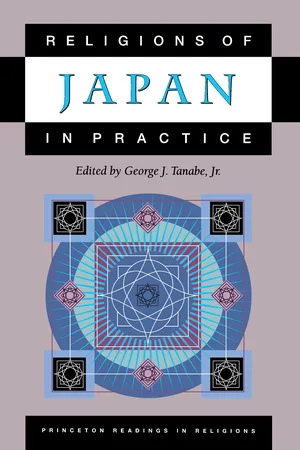
This anthology reflects a range of Japanese religions in their complex, sometimes conflicting, diversity. In the tradition of the Princeton Readings in Religions series, the collection presents documents (legends and miracle tales, hagiographies, ritual prayers and ceremonies, sermons, reform treatises, doctrinal tracts, historical and ethnographic writings), most of which have been translated for the first time here, that serve to illuminate the mosaic of Japanese religions in practice.
George Tanabe provides a lucid introduction to the "patterned confusion" of Japan's religious practices. He has ordered the anthology's forty-five readings under the categories of "Ethical Practices," "Ritual Practices," and "Institutional Practices," moving beyond the traditional classifications of chronology, religious traditions (Shinto, Confucianism, Buddhism, etc.), and sects, and illuminating the actual orientation of people who engage in religious practices. Within the anthology's three broad categories, subdivisions address the topics of social values, clerical and lay precepts, gods, spirits, rituals of realization, faith, court and emperor, sectarian founders, wizards, and heroes, orthopraxis and orthodoxy, and special places. Dating from the eighth through the twentieth centuries, the documents are revealed to be open to various and evolving interpretations, their meanings dependent not only on how they are placed in context but also on how individual researchers read them. Each text is preceded by an introductory explanation of the text's essence, written by its translator. Instructors and students will find these explications useful starting points for their encounters with the varied worlds of practice within which the texts interact with readers and changing contexts.
Religions of Japan in Practice is a compendium of relationships between great minds and ordinary people, abstruse theories and mundane acts, natural and supernatural powers, altruism and self-interest, disappointment and hope, quiescence and war. It is an indispensable sourcebook for scholars, students, and general readers seeking engagement with the fertile "ordered disorder" of religious practice in Japan.
- 586 pages
- English
- PDF
- Available on iOS & Android
eBook - PDF
Religions of Japan in Practice
About this book
Trusted by 375,005 students
Access to over 1.5 million titles for a fair monthly price.
Study more efficiently using our study tools.
Information
Publisher
Princeton University PressYear
2020Print ISBN
9780691057897
9780691057880
eBook ISBN
9780691214740
Topic
Theology & ReligionSubtopic
Asian ReligionsA
SHUGENDO
APOCRYPHAL
TEXT
253
a
golden-haired
lion.
The
Tathagata's
ray
of
light
extended
everywhere,
and
the
color
of
his
body
was
like
that
of
gold.
Manjusri
spoke
to
the
Buddha,
saying,
"World-Honored-One.
We
have
at-
tained
unprecedented
[insight].
Our
hearts
greatly
rejoice."
The
Tathagata
again
preached
in
a
verse,
saying,
The
supreme
path
of
all
Buddhas
Has
the
marks
of
perfect
light
and
eternal
abiding.
Those
who
enter
meditative
concentration
together
with
[the
Buddha]
In
the
same
way
realize
the
mind
of
enlightenment
[bodhicitta].
When
the
Buddha
finished
preaching
these
verses,
the
great
monks
in
the
assembly
at
once
stood
up,
bowed,
and
went
on
their
way.
The
Sutra
on
the
Unlimited
Life
of
the
Threefold
Body
as
Taught
by
the
Buddha
F
A
I
T
H
Table of contents
- Cover Page
- Half-title Page
- Title Page
- Copyright Page
- Contents
- Princeton Readings in Religions
- Note on Transliteration, Names, and Abbreviations
- Contents by Chronology
- Contents by Tradition
- Contributors
- Introduction
- Ethical Practices
- Ritual Practices
- Institutional Practices
- Appendix: Chinese Romanization Conversion Tables
- Index
Frequently asked questions
Yes, you can cancel anytime from the Subscription tab in your account settings on the Perlego website. Your subscription will stay active until the end of your current billing period. Learn how to cancel your subscription
No, books cannot be downloaded as external files, such as PDFs, for use outside of Perlego. However, you can download books within the Perlego app for offline reading on mobile or tablet. Learn how to download books offline
Perlego offers two plans: Essential and Complete
- Essential is ideal for learners and professionals who enjoy exploring a wide range of subjects. Access the Essential Library with 800,000+ trusted titles and best-sellers across business, personal growth, and the humanities. Includes unlimited reading time and Standard Read Aloud voice.
- Complete: Perfect for advanced learners and researchers needing full, unrestricted access. Unlock 1.5M+ books across hundreds of subjects, including academic and specialized titles. The Complete Plan also includes advanced features like Premium Read Aloud and Research Assistant.
We are an online textbook subscription service, where you can get access to an entire online library for less than the price of a single book per month. With over 1.5 million books across 990+ topics, we’ve got you covered! Learn about our mission
Look out for the read-aloud symbol on your next book to see if you can listen to it. The read-aloud tool reads text aloud for you, highlighting the text as it is being read. You can pause it, speed it up and slow it down. Learn more about Read Aloud
Yes! You can use the Perlego app on both iOS and Android devices to read anytime, anywhere — even offline. Perfect for commutes or when you’re on the go.
Please note we cannot support devices running on iOS 13 and Android 7 or earlier. Learn more about using the app
Please note we cannot support devices running on iOS 13 and Android 7 or earlier. Learn more about using the app
Yes, you can access Religions of Japan in Practice by George J. Tanabe, George J. Tanabe Jr. in PDF and/or ePUB format, as well as other popular books in Theology & Religion & Asian Religions. We have over 1.5 million books available in our catalogue for you to explore.