- 244 pages
- English
- ePUB (mobile friendly)
- Available on iOS & Android
eBook - ePub
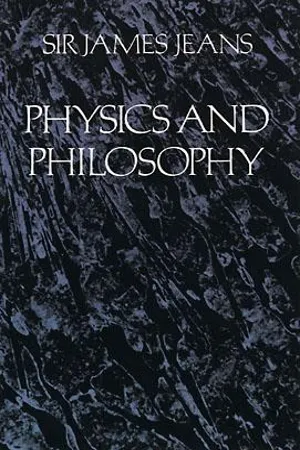
Physics and Philosophy
About this book
"There is no more eloquent, interesting or persuasive exposition of what may be called science of philosophy than Sir James Jeans's." — The New York Times
Can we have any knowledge of the world outside us other than we gain by the methods of science? Are we humans endowed with free will, or are we mere cogs in a vast machine that must follow its predestined course until it finally runs down? Is the world we perceive the world of ultimate reality, or is it only a curtain veiling a deeper reality beyond?
In this strikingly lucid and often poetic book, one of the twentieth century's greatest scientists grapples with these age-old questions, achieving in the process a brilliant and non-technical exposition of the interrelationship between physics and philosophy. He begins by defining physics and philosophy, pointing out the difference in their respective attempts to explain physical reality and man's place in it. This discussion paves the way for an outline of epistemological methods in which the rationalism of thinkers like Descartes, Leibniz, and Kant is compared to the empiricism of Locke and Hume.
Over the course of the book, in a manner that is careful and methodic but never dull, Jeans marshals the evidence for his startling conclusion: recent discoveries in astronomy, mathematics, sub-atomic physics, and other disciplines have washed away the scientific basis of many older philosophic discussions. Such long-standing problems as causality, free will and determinism, the nature of space and time, materialism and mentalism must be considered anew in the light of new knowledge and information attained by twentieth-century physical science. Even then, however, Jeans cautions against drawing any positive conclusions, pointing out that both physics and philosophy are both relatively young and that we are still in Newton's words, like children playing with pebbles on the sea-shore, while the great ocean of truth rolls, unexplored, beyond our reach.
Although first published in 1943, nothing in physics has happened to affect Jeans's account in this book; it remains remarkably fresh and undated, a classic exposition of the philosophical implications of scientific knowledge.
Can we have any knowledge of the world outside us other than we gain by the methods of science? Are we humans endowed with free will, or are we mere cogs in a vast machine that must follow its predestined course until it finally runs down? Is the world we perceive the world of ultimate reality, or is it only a curtain veiling a deeper reality beyond?
In this strikingly lucid and often poetic book, one of the twentieth century's greatest scientists grapples with these age-old questions, achieving in the process a brilliant and non-technical exposition of the interrelationship between physics and philosophy. He begins by defining physics and philosophy, pointing out the difference in their respective attempts to explain physical reality and man's place in it. This discussion paves the way for an outline of epistemological methods in which the rationalism of thinkers like Descartes, Leibniz, and Kant is compared to the empiricism of Locke and Hume.
Over the course of the book, in a manner that is careful and methodic but never dull, Jeans marshals the evidence for his startling conclusion: recent discoveries in astronomy, mathematics, sub-atomic physics, and other disciplines have washed away the scientific basis of many older philosophic discussions. Such long-standing problems as causality, free will and determinism, the nature of space and time, materialism and mentalism must be considered anew in the light of new knowledge and information attained by twentieth-century physical science. Even then, however, Jeans cautions against drawing any positive conclusions, pointing out that both physics and philosophy are both relatively young and that we are still in Newton's words, like children playing with pebbles on the sea-shore, while the great ocean of truth rolls, unexplored, beyond our reach.
Although first published in 1943, nothing in physics has happened to affect Jeans's account in this book; it remains remarkably fresh and undated, a classic exposition of the philosophical implications of scientific knowledge.
Tools to learn more effectively

Saving Books

Keyword Search

Annotating Text

Listen to it instead
Information
Table of contents
- Title Page
- Table of Contents
- PREFACE
- Copyright Page
- CHAPTER I - WHAT ARE PHYSICS AND PHILOSOPHY?
- CHAPTER II - HOW DO WE KNOW?
- CHAPTER III - THE TWO VOICES OF SCIENCE AND PHILOSOPHY
- CHAPTER IV - THE PASSING OF THE MECHANICAL AGE
- CHAPTER V - THE NEW PHYSICS
- CHAPTER VI - FROM APPEARANCE TO REALITY
- CHAPTER VII - SOME PROBLEMS OF PHILOSOPHY
- INDEX
- A CATALOG OF SELECTED DOVER BOOKS IN ALL FIELDS OF INTEREST
- A CATALOG OF SELECTED DOVER BOOKS IN ALL FIELDS OF INTEREST
- DOVER CLASSICS OF SCIENCE AND MATHEMATICS
Frequently asked questions
Yes, you can cancel anytime from the Subscription tab in your account settings on the Perlego website. Your subscription will stay active until the end of your current billing period. Learn how to cancel your subscription
No, books cannot be downloaded as external files, such as PDFs, for use outside of Perlego. However, you can download books within the Perlego app for offline reading on mobile or tablet. Learn how to download books offline
Perlego offers two plans: Essential and Complete
- Essential is ideal for learners and professionals who enjoy exploring a wide range of subjects. Access the Essential Library with 800,000+ trusted titles and best-sellers across business, personal growth, and the humanities. Includes unlimited reading time and Standard Read Aloud voice.
- Complete: Perfect for advanced learners and researchers needing full, unrestricted access. Unlock 1.4M+ books across hundreds of subjects, including academic and specialized titles. The Complete Plan also includes advanced features like Premium Read Aloud and Research Assistant.
We are an online textbook subscription service, where you can get access to an entire online library for less than the price of a single book per month. With over 1 million books across 990+ topics, we’ve got you covered! Learn about our mission
Look out for the read-aloud symbol on your next book to see if you can listen to it. The read-aloud tool reads text aloud for you, highlighting the text as it is being read. You can pause it, speed it up and slow it down. Learn more about Read Aloud
Yes! You can use the Perlego app on both iOS and Android devices to read anytime, anywhere — even offline. Perfect for commutes or when you’re on the go.
Please note we cannot support devices running on iOS 13 and Android 7 or earlier. Learn more about using the app
Please note we cannot support devices running on iOS 13 and Android 7 or earlier. Learn more about using the app
Yes, you can access Physics and Philosophy by Sir James H. Jeans in PDF and/or ePUB format, as well as other popular books in Philosophy & History & Theory of Philosophy. We have over one million books available in our catalogue for you to explore.