The full-arch implant rehabilitation (FAIR) protocol is one of the newest implant therapy innovations to treat the edentulous or nearly edentulous patient. The FAIR prosthesis is immediate, fixed, esthetically pleasing, highly functional, inexpensive, and maintainable, and it can frequently be installed without bone grafting. This book describes how the FAIR protocol works, who it should be used for, and methods to implement it successfully for different patients. The system can be used in both arches and in patients with total or near-total edentulism. Several chapters are devoted to describing step-by-step treatment with detailed clinical photographs documenting every step from initial assessment to prosthesis delivery. Even those new to fixed denture systems will find the procedures easy to follow and can begin implementing the FAIR approach for their patients.
- 120 pages
- English
- ePUB (mobile friendly)
- Available on iOS & Android
eBook - ePub
Full-Arch Implant Rehabilitation
About this book
Trusted by 375,005 students
Access to over 1.5 million titles for a fair monthly price.
Study more efficiently using our study tools.
Information
The full-arch implant rehabilitation (FAIR) protocol is one of the newest innovations in implant therapy to treat the edentulous or nearly edentu-lous patient. Instead of single implants replacing individual missing teeth, four or five implants are spaced throughout the arch and immediately loaded with a provisional fixed prosthesis. While conventional removable dentures and bone grafting with multiple implants are other options, the latter can take several years and has commensurate high costs. Morever, a number of studies have shown that wearing conventional removable dentures can reduce patients’ quality of life, causing pain and areas of discomfort, chewing and speaking difficulties, slippage, reduced occlusal force, and poor oral sensation.
The FAIR dental prosthesis offers many advantages for the dental patient with a fully or partially edentulous arch (Table 1-1). The prosthesis is immediate, fixed, esthetically pleasing, highly functional, inexpensive, and maintainable. Importantly, the FAIR procedure and similar techniques can frequently be performed without bone grafting with exceptional success rates.1–14 Such dental systems are better designed to meet the surgical and restorative needs of more patients with edentulous or partially edentulous arches, because traditional techniques often require extensive bone grafting. The invasiveness of these procedures deters many patients, and others (particularly elderly patients and those with severe bone loss) may not be good candidates for bone grafting.
TABLE 1-1 Advantages and disadvantages of removable dentures, overdentures, and the FAIR approach
| ADVANTAGES | DISADVANTAGES | |
| Removable dentures | ▪ Relatively inexpensive tooth and gingival replacement ▪ Provides lip support ▪ Easy to remove and clean outside of the mouth | ▪ Uncomfortable ▪ May cause sore spots on gingival tissue ▪ Makes it difficult to eat certain foods ▪ Causes accelerated bone loss ▪ Often requires relining to improve comfort as bone deteriorates ▪ May make speech difficult ▪ May require creams or adhesives to reduce mobility ▪ Approximately 10% functionality compared with natural teeth |
| Removable overdenture supported by 2 or 4 implants | ▪ Improves stability and functionality to 60% compared with natural teeth ▪ Relatively inexpensive tooth and gingival replacement ▪ Provides lip support ▪ Easy to clean outside of the mouth | ▪Uncomfortable ▪ May cause sore spots on gingival tissue ▪ Denture must be removed and cleaned outside of the mouth ▪ May still move when chewing or speaking ▪ May require relining to improve fit and comfort as bone deteriorates |
| FAIR approach | ▪ Improves functionality to 70% compared with natural teeth ▪ Eliminates the need for bone grafting ▪ A provisional partial denture can be provided on the day of surgery, allowing a soft food diet during healing ▪ Replaces roots and teeth ▪ Preserves bone and soft tissue ▪ No decay; 95% success rate over 30 years ▪ Natural-looking esthetics ▪ Allows patients to eat any kinds of foods ▪ Can be cleaned like natural teeth | ▪ Requires healing and restorative time ▪ Involves surgical procedure and anesthesia |
During the late 1980s and early 1990s, the success rates for immediately loaded implants improved, both for the restoration of individual teeth and the placement of short-span fixed partial dentures.15–20 These developments served to push the envelope toward full-arch replacement, both with and eventually without bone grafting. The mid to late 1990s saw the development of mandibular restoration protocols that attempted to meet the challenges of anatomical placement and a redesigned partial denture architecture in the dense bone of the mandible.21,22 Similar attempts in the softer, more porous maxillary bone were generally unsuccessful because of poor anchorage.23–28 To overcome this challenge, the threading, size, and length of implants were redesigned to condense and thicken bone during placement in soft bone and with sinus elevation and other procedures.29–32
The early 2000s saw significant improvement in the esthetics of fixed prosthodontics, particularly with the introduction of pink ceramic for the gingiva. Retrospective studies of fixed full-arch prostheses in the mandible and zygomatic implants in the maxilla showed how protocols for full-arch dental prostheses had evolved.33–37 For example, when traditional implant surgery and bone grafting for sinus elevation and other procedures are contraindicated in the maxilla due to patient age or other issues with bone density or availability, the longer, nontraditional zygomatic implants can be placed near the dense, more cortical cheek bone (ie, zygoma) in the posterior maxilla (Fig 1-1). This decreases the time needed for the procedure and increases patient comfort.38,39 By about 2010, additional advancements in implant design and protocols included techniques for extramaxillary anchorage, optimal implant angulation, optional use of cantilevers, and bone reduction (when required).40–45
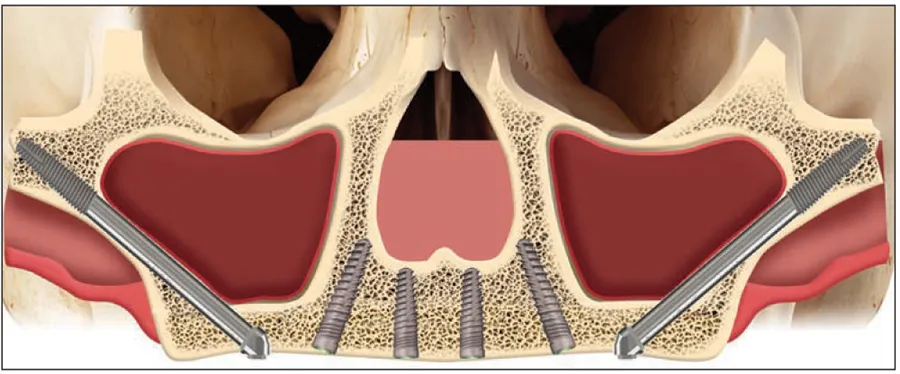
Fig 1-1 Placing zygomatic implants near the dense, more cortical cheekbone in the posterior maxilla is an example of an early evolution in protocol for full-arch dental prostheses.
An earlier treatment option for edentulous patients that reflects the evolution of dental implant technology is the two- or four-implant removable overdenture.46–48 Unlike conventional removable dentures (Fig 1-2), the fixed removable overdenture improves stability and function to approximately 60% that of natural teeth (Fig 1-3) and yet is still relatively inexpensive as a replacement for teeth and gingiva. Additionally, it provides lip support and easy cleaning outside the mouth. Disadvantages include sore spots on the gingiva, some movement when the patient chews and speaks, and the possible need for frequent relining for fit and comfort because of continued bone resorption.
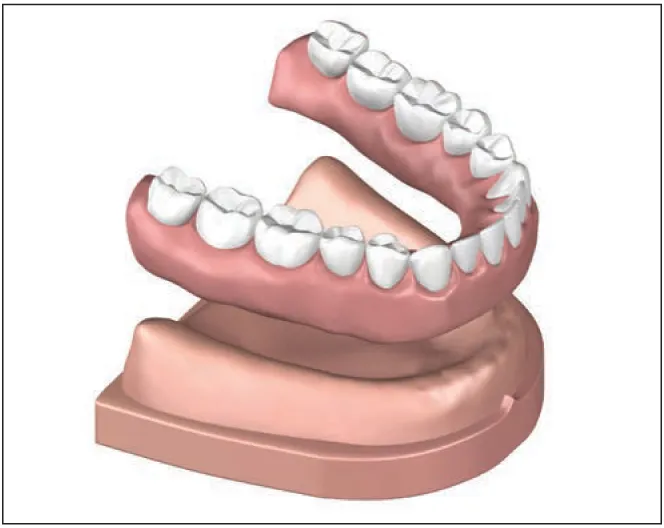
Fig 1-2 The conventional denture was a first step in the evolution toward the FAIR protocol.
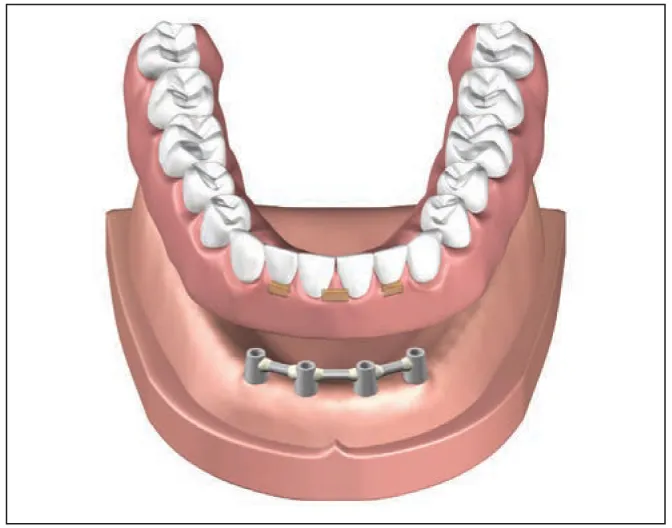
Fig 1-3 The fixed removable overdenture improves stability and function to approximately 60% that of natural teeth.
The FAIR Difference
In contrast, the FAIR prosthesis and other similar protocols have only two requirements that could be considered disadvantages: a surgical procedure and a short period afterward for healing and restoration. For these relatively minor disadvantages, the FAIR protocol (Fig 1-4) provides 70% of the functionality of natural teeth, requires minimal or no grafting before placement, and serves as a replacement for bone and teeth (preserving both bone and soft tissue). A provisional prosthesis is delivered on the day of surgery, allowing the consumption of soft foods during healing. The definitive ...
Table of contents
- Cover
- About the book
- Half Title
- Title Page
- Copyright Page
- Contents
- Preface
- 1 Evolution of the FAIR Protocol
- 2 History of Tilted Implants with an Immediate Prosthesis
- 3 Identifying and Evaluating Candidates
- 4 The FAIR Technique and Its Modifications
- 5 Treating the Fully Edentulous Maxilla
- 6 Treating the Fully Edentulous Mandible
- 7 Treating the Partially Edentulous Maxilla
- 8 Treating the Partially Edentulous Mandible
- 9 FAIR Prosthetics
- 10 Possible Complications
- About the Author
- Backcover
Frequently asked questions
Yes, you can cancel anytime from the Subscription tab in your account settings on the Perlego website. Your subscription will stay active until the end of your current billing period. Learn how to cancel your subscription
No, books cannot be downloaded as external files, such as PDFs, for use outside of Perlego. However, you can download books within the Perlego app for offline reading on mobile or tablet. Learn how to download books offline
Perlego offers two plans: Essential and Complete
- Essential is ideal for learners and professionals who enjoy exploring a wide range of subjects. Access the Essential Library with 800,000+ trusted titles and best-sellers across business, personal growth, and the humanities. Includes unlimited reading time and Standard Read Aloud voice.
- Complete: Perfect for advanced learners and researchers needing full, unrestricted access. Unlock 1.5M+ books across hundreds of subjects, including academic and specialized titles. The Complete Plan also includes advanced features like Premium Read Aloud and Research Assistant.
We are an online textbook subscription service, where you can get access to an entire online library for less than the price of a single book per month. With over 1.5 million books across 990+ topics, we’ve got you covered! Learn about our mission
Look out for the read-aloud symbol on your next book to see if you can listen to it. The read-aloud tool reads text aloud for you, highlighting the text as it is being read. You can pause it, speed it up and slow it down. Learn more about Read Aloud
Yes! You can use the Perlego app on both iOS and Android devices to read anytime, anywhere — even offline. Perfect for commutes or when you’re on the go.
Please note we cannot support devices running on iOS 13 and Android 7 or earlier. Learn more about using the app
Please note we cannot support devices running on iOS 13 and Android 7 or earlier. Learn more about using the app
Yes, you can access Full-Arch Implant Rehabilitation by Arun Garg in PDF and/or ePUB format, as well as other popular books in Medicine & Dentistry. We have over 1.5 million books available in our catalogue for you to explore.