- 242 pages
- English
- ePUB (mobile friendly)
- Available on iOS & Android
eBook - ePub
About this book
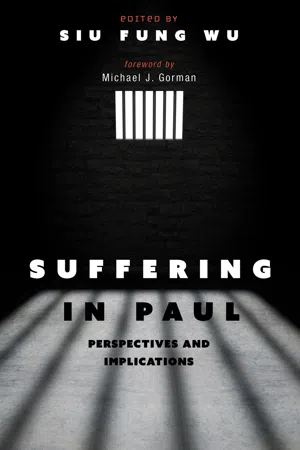
One can hardly ignore the significance of suffering in Paul's letters. Respected scholars (e.g., Scott Hafemann, Christiaan Beker, and Ann Jervis) have demonstrated the indispensable role of suffering in Paul's teaching. Despite that, the topic does not often "hit the headlines" in Pauline studies. Meanwhile, Christians around the world testify to the encouragement and comfort Paul gives them in times of pain and distress. The purpose of this book is to arouse interest in Pauline scholarship on the topic and provide a resource for educators, theological students, and thoughtful pastors. New Testament scholars in five countries across three continents contribute to this volume. They study the texts, intertexts, and the language of suffering in Paul. They explore the notion of participation in Christ's suffering and glory, and examine the significance of identity formation and solidarity in the Christ community. In addition, the authors reflect on the implications for the church today from different social locations and cultural backgrounds. The result is an exegetical and critical reflection that invites the church to seriously engage with Paul on the topic.Contributors: Sunny Chen, Roy Ciampa, Timothy Gombis, Sanyu Iralu, Haley Goranson Jacob, Kar Yong Lim, David Starling, Sean Winter, Siu Fung Wu, and Xiaxia Xue.
Tools to learn more effectively

Saving Books

Keyword Search

Annotating Text

Listen to it instead
Information
1
Introduction
Suffering is an important theme in Paul’s letters and there are many implications for the church. Pauline scholars are very aware of this. For example, Scott Hafemann says, “Paul’s suffering is not an addendum to his preaching. Nor is it merely a consequence of it. Rather, it is constitutive of it.”1 When speaking of Paul’s view of power and weakness, Gordon Fee says that the “present suffering is a mark of discipleship, whose model is our crucified Lord.”2 And in his book, Suffering and Hope, J. Christiaan Beker says that the church is called to redemptive suffering.
Suffering because of human injustice and idolatry evokes Paul’s prophetic response. The church is here called to redemptive suffering, that is, to resist human idolatry and injustice and to suffer redemptively in the world against the world for the world.3
The vocation of the church to participate in Christ’s suffering is well summarized by L. Ann Jervis in her superb book, At the Heart of the Gospel: Suffering in the Earliest Christian Message.
At the heart of the gospel is “the word of the cross” (1 Cor 1:18). The cross’s presence at the center of his good news means that Paul does not shy away from either the existence or the experience of suffering. He sees clearly that the good news he preaches and lives does not promise its converts transformation into super-humans capable of transcending or avoiding the troubles of human existence, and that it obligates them to share in God’s redeeming project—which is to take on an increase of suffering.4
We are called to action, to be “with Christ” in engagement on the side of God’s justice, and to accept the inevitable sufferings that go along with such engagement. By virtue of suffering “with Christ” we are called to face the darkness, to face down what destroys, to reshape what is so that it comes to be dominated not by suffering but by God’s glory. . . . We, of course, do not do this on our own steam. Suffering “with Christ” is to suffer with the Messiah, not to be the Messiah. . . . For, we suffer not on our own but with the one whose sufferings drew him inexorably into God’s luminous life.5
Given the fact that such insightful studies are already available, the purpose of this book is not to rehash what has been done or to present a comprehensive study on suffering in Paul. Rather, the primary goal of the project is to make fresh contributions to the topic. While monographs on suffering in Paul do appear from time to time, the relatively small number of major studies does not, in my view, do justice to such a significant theme in the Pauline corpus.6 It is hoped that the essays in this volume will arouse greater interest among scholars, and provide researchers and educators with a resource on the topic.
Apart from making a contribution to scholarship, the purpose of this book is also to explore the implications of Paul’s view of suffering for the global church today. Our social location and cultural backgrounds do influence how we understand suffering. It is, therefore, gratifying that our authors come from a diverse background. They are based in five countries across three continents. Eight authors have written on specific Pauline texts and themes by focusing on Romans, 2 Corinthians, and Philippians,7 and most of them concluded their essays with brief comments on the implications of their findings for the followers of Jesus. Three contributors responded to the eight articles from their own cultural and social contexts—as a North American, a South Asian, and an Asian-Australian.
It is not a common practice for editors to point out the shortcomings of their books. But I do need to comment on the range of authors in this volume. I regret that only two of the contributors are women. I spent six months looking for female Pauline scholars who might be interested in the topic. But often they were already committed to other projects and hence could not write for this book. I also regret that there are no contributors from outside Asia, Australia, and North America. There are no Indigenous authors either. These deficiencies are due to the small size of my network and hence the limited capacity to find more female contributors and scholars from different cultural backgrounds.
The essays are ordered according to their different focuses, themes, and approaches. Roy Ciampa, Xiaxia Xue, and David Starling discuss suffering in Paul by focusing on several selected texts and intertexts. Their studies on Romans and “the weapons of righteousness” in 2 Corinthians bring unique contributions to our subject. Sean Winter, Haley Goranson Jacob, and I pay special attention to the notion of participation in Christ and the relationship between suffering and glory. The analyses in these essays reveal the cross-shaped Christ-centered character of suffering and the paradoxical coexistence of suffering and glory. Kar Yong Lim and Sunny Chen provide further insights into suffering in Paul by employing their expertise in social identity theory and discourse analysis. According to their studies, suffering is key to Christian identity formation, and the thematic meaning of the terms θλῖψις and στενοχωρία emphasizes corporate solidarity and ecclesial relationships. Finally, Sanyu Iralu, Timothy Gombis, and I respond to the essays through our different cultural and social lenses. These responses serve to enrich our understanding of suffering by opening our eyes to each other’s perspectives. My chapter will also function as a conclusion for the book.8
I am grateful for the participation of the contributors. Their insights have been a blessing to me personally. May this book be beneficial to all who read it.
Bibliography
Beker, J. Christiaan. Suffering and Ho...
Table of contents
- Title page
- Foreword
- Acknowledgments
- Contributors
- Abbreviations
- Chapter 1: Introduction
- Part 1: Essays
- Part 2: Responses
Frequently asked questions
Yes, you can cancel anytime from the Subscription tab in your account settings on the Perlego website. Your subscription will stay active until the end of your current billing period. Learn how to cancel your subscription
No, books cannot be downloaded as external files, such as PDFs, for use outside of Perlego. However, you can download books within the Perlego app for offline reading on mobile or tablet. Learn how to download books offline
Perlego offers two plans: Essential and Complete
- Essential is ideal for learners and professionals who enjoy exploring a wide range of subjects. Access the Essential Library with 800,000+ trusted titles and best-sellers across business, personal growth, and the humanities. Includes unlimited reading time and Standard Read Aloud voice.
- Complete: Perfect for advanced learners and researchers needing full, unrestricted access. Unlock 1.4M+ books across hundreds of subjects, including academic and specialized titles. The Complete Plan also includes advanced features like Premium Read Aloud and Research Assistant.
We are an online textbook subscription service, where you can get access to an entire online library for less than the price of a single book per month. With over 1 million books across 990+ topics, we’ve got you covered! Learn about our mission
Look out for the read-aloud symbol on your next book to see if you can listen to it. The read-aloud tool reads text aloud for you, highlighting the text as it is being read. You can pause it, speed it up and slow it down. Learn more about Read Aloud
Yes! You can use the Perlego app on both iOS and Android devices to read anytime, anywhere — even offline. Perfect for commutes or when you’re on the go.
Please note we cannot support devices running on iOS 13 and Android 7 or earlier. Learn more about using the app
Please note we cannot support devices running on iOS 13 and Android 7 or earlier. Learn more about using the app
Yes, you can access Suffering in Paul by Siu Fung Wu in PDF and/or ePUB format, as well as other popular books in Teologia e religione & Critica e interpretazione biblica. We have over one million books available in our catalogue for you to explore.