- 312 pages
- English
- ePUB (mobile friendly)
- Available on iOS & Android
eBook - ePub
About this book
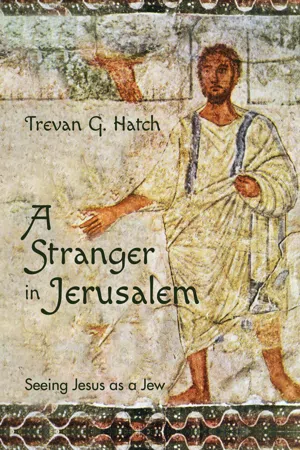
In A Stranger in Jerusalem, Trevan Hatch attempts to situate the stories about Jesus within their Jewish context. Jesus was a Jew, his friends were Jews, his first followers were Jews, he studied the Hebrew Scriptures (either orally or from texts), he worshiped in the synagogue, and he occasionally traveled to Jerusalem to observe the Israelite festivals. Hatch illustrates that Jesus does not seem to have rejected Judaism or acted as a radical outsider in relation to his Jewish peers, but rather he worked within a Jewish framework.
The overarching questions addressed in this book are (1) how can an understanding of early Judaism illuminate our understanding of the Jesus traditions, (2) how did Jesus relate to his Jewish world and vice versa, (3) why did the Gospel writers portray Jesus and his Jewish peers the way they did, and (4) how would Jews in the first and second centuries have interpreted the Jesus traditions upon hearing or reading them? Hatch explores several topics, including childhood and family life in first-century Galilee; Jewish notions of baptism and purity; Jewish prophets and miracle workers; Jewish ideas about the messiah; and Jesus' relationship with Judas, the Pharisees, the priestly establishment in Jerusalem, the Jewish populace, and his own disciples.
Trusted by 375,005 students
Access to over 1.5 million titles for a fair monthly price.
Study more efficiently using our study tools.
Information
Topic
Theology & ReligionSubtopic
Biblical BiographyChapter One
From Bethlehem to Baptism
Childhood and Family in Ancient Judea and Galilee
Most scholars and popular authors who write on Jesus and the New Testament take one of three approaches: (1) they spend a majority of the time analyzing the literary and textual nuances of the Gospels in order to better understand how the texts were created and redacted; (2) they analyze the deeds and sayings of Jesus using scholarly methods of historical criticism in order to determine what the Jesus of history actually said and did; and (3) they discuss how the teachings of Jesus can help people in their spiritual and faith journeys (i.e., “devotional literature”). I too am interested in these approaches to Jesus studies; however, as a social scientist I tend to be most interested in the social and cultural contexts of Jesus’ life and of the Gospels. Regarding Jesus’ childhood and upbringing, for example, what were the general living conditions for a boy in the Greco-Roman world in the first century CE, and specifically for a Jewish boy living in Galilee? How did Jewish boys relate to their parents? How were they educated? What types of struggles and challenges did they face?
In most cultures, boys generally like to play, explore, throw rocks, and catch bugs. While the primary sources (see Introduction) are not focused on these sorts of daily-life activities, they do provide some insights that help illuminate the lifestyle of Galilean families. In this chapter we examine several aspects of childhood and young adulthood in first-century Galilee. We also explore ideas of washing and purity in order to better contextualize the immersion activities of John the Baptist and the baptism of Jesus. The material in this chapter will help foster both a better contextualization of the social setting of first-century Judea and Galilee and a greater appreciation for what the boy Jesus would have experienced during his childhood and early adult years before his ministry.
Villages and Houses
The region of Galilee during Jesus’ lifetime contained hundreds of villages. According to the first-century Jewish historian Josephus, 204 villages peppered the Galilean landscape.9 Only a small number of these settlements, perhaps just Sepphoris and Tiberias, were larger than about twenty acres. Sepphoris, the administrative capital of Galilee, may have been as large as 150 acres.10 Based on several archaeological surveys, a large majority of the villages were between only two and a half acres and ten acres in size. For example, Capernaum, Cana, and Nazareth were probably only five to ten acres in size, the latter containing fifty houses maximum. Accounting for living quarters, estimated persons per household, space for livestock, space for a threshing floor, and crop land, the population was about one hundred inhabitants per acre. This means that most people in first-century Judea and Galilee lived in villages ranging from a few hundred to one thousand inhabitants. Unlike the few larger cities that contained border walls, marketplaces, aqueducts, theaters, stadiums, hippodromes, paved roads, and even sewer systems, these smaller villages contained only a few modest commercial buildings, presses for oil and wine, a small water cistern, narrow and unpaved roads, and a cemetery.11 As a child, Jesus may have seen the contrast in lifestyles between the villages and cities, since Sepphoris was only about three and a half miles from Nazareth.
Extensive research on Palestinian houses in antiquity by Israeli archaeologist and professor at the Hebrew University of Jerusalem Yizhar Hirschfeld has revealed that most peasant dwellings in villages were on average 2,500–3,000 square feet, including both a courtyard and space for animals. These stone structures were flat-roofed and had one to two rooms. Ceilings were quite low at about five and a half feet high. People typically accessed the upper level by ladders. Most walls were typically plastered and the floors were dirt surfaces. Some extended families built houses that shared a central, open-air courtyard. In the hot months, people usually slept on bedrolls in the courtyard or on the roof. Families experienced little privacy in this style of dwelling. Depending on the region and landscape, many houses were built on top of small caves, which were used to store food and keep animals in at night.12
The narratives concerning the birth of Jesus and the elements present in the Gospels allow us to examine this event in relation to our focus on housing and peasant life. In what type of house was Jesus born? What was the social setting of his birth? Where were Joseph’s and Mary’s families during Jesus’ birth? Partial answers to these questions are offered in the Gospels, early Christian tradition, and archaeology. Later Christian interpretation places Jesus’ birth in a wooden stable somewhere away from an “inn.” Most depictions of the episode in cinema and art suggest that Mary and Joseph arrived in Bethlehem at night when Mary was nine months pregnant. She was ready to deliver, but inhospitable Jews (as many Christians portray them) would not give up their rooms, and so Jesus was born in a stable surrounded by animals. The Gospels, however, mention none of this. First, it is unlikely that Joseph and Mary traveled alone all the way from Galilee to Bethlehem in just the nick of time for Mary to deliver Jesus. Travelers, especially the young and vulnerable like Joseph and Mary, journeyed in caravans for protection against bandits and other dangers. Moreover, we would expect Joseph and Mary to arrive in Bethlehem well before the arrival of Jesus. This fits with Luke’s account, which states that Mary was already in Bethlehem for some time: “while they were there, the time came for her to deliver her child” (Luke 2:6; emphasis added). Most likely, Joseph and Mary lodged with family while in Bethlehem—at least based on material in Luke, which claims that everyone participated in the legal registration in “their own towns” (Luke 2:3). Thus, Mary and Joseph would have certainly had family connections in the region.
And as far as Jesus being born in a stable, the Gospel of Matthew states that the magi (wise men) came to a house (oikos) to visit the baby Jesus (2:11). Even if the magi arrived several days, weeks, or even months after Jesus’ birth, the fact that a house was available to Mary in Bethlehem suggests that Jesus was probably born in similar circumstances, surrounded by friends and family. But what about Luke’s language that Jesus was “laid in a manger, because there was no room for them in the inn” (2:7)? The word “inn,” or kataluma in Greek, as Luke uses it, does not suggest what we think of as ...
Table of contents
- Title Page
- Acknowledgments
- Introduction
- Chapter 1: From Bethlehem to Baptism
- Chapter 2: Establishing Authority
- Chapter 3: Mighty in Deed
- Chapter 4: The Kings of the Jews
- Chapter 5: “Who Do Men Say That I Am?”
- Chapter 6: His Friend Judas
- Chapter 7: Jesus’ Enemies?
- Chapter 8: Christ Killers?
- Chapter 9: I Know You Are, but What Am I?
- Chapter 10: Why the Conflict and Hostile Rhetoric?
- Chapter 11: Judaism and Jesus
- Bibliography
Frequently asked questions
Yes, you can cancel anytime from the Subscription tab in your account settings on the Perlego website. Your subscription will stay active until the end of your current billing period. Learn how to cancel your subscription
No, books cannot be downloaded as external files, such as PDFs, for use outside of Perlego. However, you can download books within the Perlego app for offline reading on mobile or tablet. Learn how to download books offline
Perlego offers two plans: Essential and Complete
- Essential is ideal for learners and professionals who enjoy exploring a wide range of subjects. Access the Essential Library with 800,000+ trusted titles and best-sellers across business, personal growth, and the humanities. Includes unlimited reading time and Standard Read Aloud voice.
- Complete: Perfect for advanced learners and researchers needing full, unrestricted access. Unlock 1.5M+ books across hundreds of subjects, including academic and specialized titles. The Complete Plan also includes advanced features like Premium Read Aloud and Research Assistant.
We are an online textbook subscription service, where you can get access to an entire online library for less than the price of a single book per month. With over 1.5 million books across 990+ topics, we’ve got you covered! Learn about our mission
Look out for the read-aloud symbol on your next book to see if you can listen to it. The read-aloud tool reads text aloud for you, highlighting the text as it is being read. You can pause it, speed it up and slow it down. Learn more about Read Aloud
Yes! You can use the Perlego app on both iOS and Android devices to read anytime, anywhere — even offline. Perfect for commutes or when you’re on the go.
Please note we cannot support devices running on iOS 13 and Android 7 or earlier. Learn more about using the app
Please note we cannot support devices running on iOS 13 and Android 7 or earlier. Learn more about using the app
Yes, you can access A Stranger in Jerusalem by Trevan G. Hatch in PDF and/or ePUB format, as well as other popular books in Theology & Religion & Biblical Biography. We have over 1.5 million books available in our catalogue for you to explore.