- 306 pages
- English
- ePUB (mobile friendly)
- Available on iOS & Android
eBook - ePub
About this book
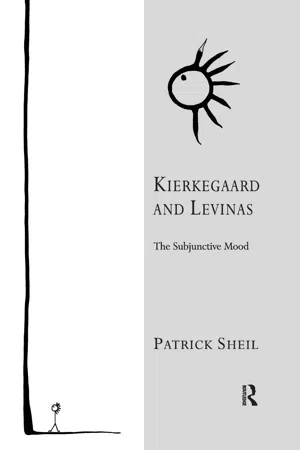
The Danish Christian existentialist Søren Kierkegaard (1813-1855) and the Jewish Lithuanian-born French interpreter of modern phenomenology Emmanuel Levinas (1906-1995) have enabled theology and philosophy to illuminate and confront one another in radical and important ways. This book addresses the theological and philosophical thought of both Kierkegaard and Levinas with a focus on the special form that exists in the grammar of many languages for cases of uncertainty, possibility, hypothesis and for expressions of hope: the subjunctive mood. As well as presenting arguments and observations about Kierkegaard and Levinas through an analysis of the subjunctive mood, Patrick Sheil offers an interesting and accessible way into the thought of these two major European philosophers and he explores a wide range of Kierkegaardian and Levinasian texts throughout.
Tools to learn more effectively

Saving Books

Keyword Search

Annotating Text

Listen to it instead
Information
Chapter 1
Identity and the Subjunctive
Were he suddenly in open country, how he would fly, and it would doubtless not be long before you heard the majestic pounding of his fists on your door.1
Levinas and Kierkegaard
What is the phrase most evocative of inertia in the work of Levinas? It is, perhaps, the simple phrase ‘there is’ (il y a) – the most indicative of all phrases. What, then, is his most enlivening phrase? Is it ‘beyond’ (au-delà de)? As for Kierkegaard, he gratefully acknowledges the solid work of the indicative, and would never take it for granted. In the subjunctive, however, can he not expect the best of everything?
This book is about the Danish philosopher Søren Kierkegaard (1813–1855) and the French-speaking Jewish Lithuanian philosopher Emmanuel Levinas (1906–1995). It looks at uncertainty and at the aspiration towards the infinite in the moral philosophy and in the communicative methods of these two. In Kierkegaard’s Concluding Unscientific Postscript to Philosophical Fragments, the pseudonymous author Johannes Climacus writes: ‘if I, acting, am truly to venture and truly to aspire to the highest good, then there must be some uncertainty and, if I may put it this way, I must have room to move’ (CUP 426; SV VII 416). Accordingly, this book is written with reference to the verb forms that some grammars keep for cases of uncertainty; phrases whose reference is possible, hypothetical, doubtful or desired. These forms are called subjunctive.2 English conditional expressions make occasional use of the present subjunctive in phrases like ‘…if I be alive, and your mind hold, and your dinner be worth the eating!’3 and the imperfect subjunctive in phrases like ‘would it were day!’4 and ‘if I were you’. But compared to languages like French and especially Spanish, English subjunctives are fairly infrequent.5 In French, the subjunctive is used for expressions of fearing and hoping and in certain imperatives. In Spanish, the subjunctive is common, especially in commands, and it is significant for this book, which focuses on ethics, that there is this link between commands and the subjunctive. In Danish use of the subjunctive is very restricted; Kierkegaard’s main experience of the subjunctive was through Latin and German. Early on, he writes: ‘one could […] really present the whole of modern philosophy in a theory about the indicative and the subjunctive; it is indeed purely subjunctive’ (PJS 91; JP III, H-#2314, p. 5; Pap. II, A #159, p. 84).
Kierkegaard and Levinas both use grammatical terms figuratively to refer to ways of being. Some of these usages hint at an idea of grammar as philosophy.5 When Levinas says the self is ‘in the accusative’6 or when Kierkegaard laments his lack of ‘indicative power’ – observing that his life is ‘far too subjunctive’7 – it is as if they are having a joke, partly at their own expense, by debunking scholastic phraseology. Nevertheless, if we take the subjunctive out of its usual context in linguistics and in foreign language acquisition, and look at it in a philosophical way, we follow an example repeatedly set by Kierkegaard and Levinas themselves.
Marx’s famous complaint – that philosophers had only interpreted the world when the point was to change it8 – could not be angled at Kierkegaard or Levinas, although the world they seek to change is not the one that Marx had in mind. Or, if it is, they approach it in a different way: the accent is on subjectivity. As readers of Pascal, Kierkegaard9 and Levinas10 share a sense of how the uncertainty can uplift a person.11 They both see ethics as a command. They both prefer experimentation to exposition. Sentences in Levinas will often begin with as if,12 a phrase deployed not only in the service of negation, in contrastive style, but also in the service of the tentative affirmation: affirmation via a negated counterfactual.13
Later, we will ask whether ‘as if’ can contribute to an idea of freedom. This might be different from the idea that morality must be able to praise or to blame. Praise and blame are often assumed to presuppose that determinism is false. Determinism is even dismissed on the grounds that responsibility can thereby be kept afloat. There are those who feel that since determinism has yet to be soundly refuted, freedom and agency itself are under threat. But all this only arises if we see morality as primarily an evaluation of a past, as forensic, or as an adjudication.
However, neither Kierkegaard nor Levinas do view it in this way; they see it as dynamic, as concerned with the uncertainty of what is yet to come. Might it be possible to stand as if ‘a man were author of himself’?14 Even if we are not our own authors, this ‘as if’ may still be of more use than resignation to a fact that possibility ‘is’ nowhere. Resignation might be as illogical as the attempt to take history by surprise (with, say, a sudden jump or shout) would be futile.
The ‘as if’ in Kierkegaard and Levinas enters into concepts that could be called ‘subjunctive’. In Levinas ‘proximity’15 cannot mean what it says; it refers to the act by which it is as if the Other were nearby. Kierkegaard’s ‘contemporaneity’ (‘Samtidigheden’) means acting as if you were contemporary with Christ. His contemporaneity is as non-historical as Levinasian proximity is non-spatial.
While the subjunctive is more common in French than in English, it is English which typically follows ‘as if’ with an imperfect subjunctive, whereas the French ‘comme si’ will tend to precede an imperfect indicative. An example is Levinas’s paraphrasing of Kant:16 ‘One has to behave as if the soul were immortal and as if God existed.’17 The phrases ‘comme si l’âme était immortelle’ and ‘comme si Dieu existait’ do not contain subjunctives, but the placing of the verbs into a ‘past’ (in these cases, imperfect) tense signals the ‘presence’ of the subjunctive. Translations might give us: ‘as if the soul were immortal’, as above, or ‘as if there were a God’. (‘Were’ is the subjunctive here, as is ‘be’ in ‘be he ne’er so vile’.18) Such phrases are germane to philosophical19 views of the subjunctive.
The subjunctive may be autumnal when it concerns an aesthete who floats voluptuously in possibility and remembrance until at last there is no possibility, but only remembrance.20 But it is hard to name what is essential, or defining, about Kierkegaard’s aesthete; ethics could be called subjunctive too if it valued the good beyond being, as in Levinas; if it were more attuned to the uncertainty of what is still to do than to the ‘totality’ of what has been done. Here, the subjunctive is like a perpetual springtime.21 The life of possibility could be a life in which one languishes, and it would appear that the subjunctive mood may take the blame, or it could be one in which one strives, and then the subjunctive may take the credit.
It may now be asked what it is about Kierkegaard and Levinas that merits their being brought together at all. We will therefore try briefly to summarize the coverage of similarities and divergences between the two thinkers to date.
Michael Weston has written that: ‘Of all modern European thinkers, Levinas is perhaps the closest to Kierkegaard’.22 Merold Westphal has opened an article by saying: ‘The affinities between Levinas and Kierkegaard are deeper and more extensive than one had any reason to suspect’.23 If these assertions are reasonable, and if, moreover, it was possible for Jacques Derrida to argue (as early as the 1960s) against the over-enthusiastic comparison of Kierkegaard and Levinas which, according to him, had often been made,24 then it is surprising that more has not been done to clarify the points at which the concerns of these two writers intersect and where they diverge. Jonathan Rée has, after all, described Kierkegaard as ‘a writer who, with his religious passion for the paradoxical absoluteness of existence, would seem like a natural neighbour for Levinas, even a model’.25 Recently, however, we have seen the publication of Pia Søltoft’s book on the ‘ethics of dizziness’ in Buber, Levinas and Kierkegaard,26 and over the last decade a number of essays have appeared comparing Levinas and Kierkegaard.27
Although Levinas is more explicit about the influence of Edmund Husserl (1859–1938) and Martin Heidegger (1889–1976) on his work and about his relation to such figures as Lucien Levy-Bruhl (1857–1939), Franz Rosenzweig (1886–1929) Jean Wahl (1888–1974)28 and – to a degree – Martin Buber (1878–1965), as well as about his friendship with the nomadic and mysterious Monsieur Shoshani, and while it may appear that his mentions of Kierkegaard are mainly references in passing, it will be seen that Levinas can often be found speaking ‘with’ or about the Danish thinker. Levinas will not always mention the name, or, if he does, he will do so in such a way that the Dane is not invoked directly nor connected unequivocally with the point at issue. But it looks as if Levinas is having a smile at the expense of Kierkegaard in particular and existentialism in general (as well as at himself), when, a few lines after having named him along with Pascal, Nietzsche and Heidegger (writers in the midst of whose forms of anguish we remain, he says, ‘hopelessly bourg...
Table of contents
- Cover Page
- Title Page
- Copyright Page
- Table of Contents
- Kierkegaard and Levinas
- Transcending Boundaries in Philosophy and Theology
- Preface
- Abbreviations
- A Note on References and Textual Practice
- 1 Identity and the Subjunctive
- 2 Representing the Seducer
- 3 Interrupting Philosophy: The Complaint about Knowledge
- 4 Transcendence and Negativity
- 5 The Moodiness of the Subjunctive
- 6 The Accusation of Ethics
- 7 Working through Love: The Subjunctive Hopes All Things
- 8 Freedom
- 9 Suffering, Faith and Forgiveness
- 10 Concluding With the Unscientific
- Bibliography
- Index
Frequently asked questions
Yes, you can cancel anytime from the Subscription tab in your account settings on the Perlego website. Your subscription will stay active until the end of your current billing period. Learn how to cancel your subscription
No, books cannot be downloaded as external files, such as PDFs, for use outside of Perlego. However, you can download books within the Perlego app for offline reading on mobile or tablet. Learn how to download books offline
Perlego offers two plans: Essential and Complete
- Essential is ideal for learners and professionals who enjoy exploring a wide range of subjects. Access the Essential Library with 800,000+ trusted titles and best-sellers across business, personal growth, and the humanities. Includes unlimited reading time and Standard Read Aloud voice.
- Complete: Perfect for advanced learners and researchers needing full, unrestricted access. Unlock 1.4M+ books across hundreds of subjects, including academic and specialized titles. The Complete Plan also includes advanced features like Premium Read Aloud and Research Assistant.
We are an online textbook subscription service, where you can get access to an entire online library for less than the price of a single book per month. With over 1 million books across 990+ topics, we’ve got you covered! Learn about our mission
Look out for the read-aloud symbol on your next book to see if you can listen to it. The read-aloud tool reads text aloud for you, highlighting the text as it is being read. You can pause it, speed it up and slow it down. Learn more about Read Aloud
Yes! You can use the Perlego app on both iOS and Android devices to read anytime, anywhere — even offline. Perfect for commutes or when you’re on the go.
Please note we cannot support devices running on iOS 13 and Android 7 or earlier. Learn more about using the app
Please note we cannot support devices running on iOS 13 and Android 7 or earlier. Learn more about using the app
Yes, you can access Kierkegaard and Levinas by Patrick Sheil in PDF and/or ePUB format, as well as other popular books in Theology & Religion & Religion. We have over one million books available in our catalogue for you to explore.