- 312 pages
- English
- ePUB (mobile friendly)
- Available on iOS & Android
eBook - ePub
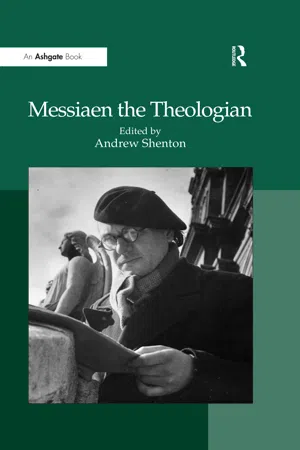
Messiaen the Theologian
About this book
For Olivier Messiaen, music was a way of expressing his faith. He considered it his good fortune to have been born a Catholic and declared that 'the illumination of the theological truths of the Catholic faith is the first aspect of my work, the noblest and no doubt the most useful'. Messiaen is one of the most widely performed and recorded composers of the twentieth-century and his popularity is increasing, but the theological component of his music has so far largely been neglected, or dealt with superficially, and continues to provide a serious impediment to understanding and appreciating his music for some of his audience. Messiaen the Theologian makes a significant contribution to Messiaen studies by providing cultural and historical context to Messiaen's theology. An international array of Messiaen scholars cover a wide variety of topics including Messiaen's personal spirituality, the context of Catholicism in France in the twentieth century, and comparisons between Messiaen and other artists such as Dante and T.S. Eliot. Interdisciplinary methodologies such as exegesis, theological studies and analysis are used to contribute to the understanding of several major works including Sept Haïkaï and Saint Francis d'Assise. By approaching Messiaen and his music from such important and original perspectives, this book will be of interest not only to musicians and theologians, but also to readers interested in the connection between spirituality and the arts.
Trusted by 375,005 students
Access to over 1.5 million titles for a fair monthly price.
Study more efficiently using our study tools.
Information
Subtopic
MusicPART I
Messiaen the Theologian
Chapter 1
Religious Literature in Messiaen’s Personal Library
Yves Balmer
Personal libraries allow us to materialize in the most visible manner the interface between the act of creation and the social space in which that act is immersed.
– Paulo D’Ioro and Daniel Ferrer1
The eclecticism and the sheer number of references cited in Messiaen’s Traité de rythme, de couleur et d’ornithologie, combined with third-party reports of the composer’s monumental literary knowledge, give clear proof that Messiaen possessed a vast and varied library.2 Still, to date, there have been few studies of Messiaen’s private library and preferred reading materials, despite existing research that has revealed the heuristic potential of such investigations.3 The present study elaborates upon the concept of Messiaen as a reader. It does not seek to discover how specific texts may have influenced the composer personally or musically, but rather to sketch a portrait of the composer through the medium of the texts he read.
There is currently no formal catalogue of Messiaen’s personal library.4 This study draws from a body of some 600 references to works or authors contained in the seven volumes of Messiaen’s theoretical magnum opus, the Traité, with the intention of reconstructing not the definitive version of Messiaen’s library, but rather, an impression of that collection’s essence. While there are certainly lacunae in this portrait, it is nevertheless based upon a set of works read by the composer and judged by him to be of interest and worthy of citation in his own writings. Beyond the coherence lent to this corpus by the identity of its reader, it was an interest in possible links between these references that motivated this investigation, with the hope that it will broaden our knowledge of the composer through the medium of his readings, which he presented in his writings as some of the sources of his art. A personal library, and more particularly, a group of books known to have been read by their owner, reveals something about the owner’s taste and choices. It contains traces of his personal intellect. These traces have implications on both the personal and social levels.
Messiaen came from a family of intellectuals and was therefore well read. It is no surprise therefore that he provided references for most of the citations in the Traité.5 These references constitute a clear collection of primary source material while also hinting at the composer’s sense of their usefulness. The first chapter of volume 1 of the Traité, entitled ‘Le Temps’, for example, is based primarily on the juxtaposition of citations pulled from a variety of texts, revealing Messiaen as a reader who compiles material from multiple sources. The sum of this heterogeneous set of citations creates a strange new whole, reminiscent of the eclectic construction of Messiaen’s musical language.6
It is possible to define several coherent groups within the whole of Messiaen’s citations; however, the majority of references are the names of composers (see appendix, p. 26). Messiaen also refers to a number of painters. It is harder to discern other groups because the texts come from a variety of disciplines including literature, poetry, musicology, ornithology and philosophy. This essay explores two key points gleaned from the Traité’s textual references. First, Messiaen’s literary references contain a clear set of readings rooted in the Catholic Literary Renaissance. Second, Messiaen’s frequent citation of the collective work Les Rythmes et la vie (discussed in detail below) provides an opportunity to understand his discovery of seemingly secular authors via the Catholic milieu.
Olivier Messiaen, a reader influenced by the Catholic Renaissance
In late nineteenth-century France, a movement developed that became known as the ‘Christian Intellectual Renaissance’. According to historian Hervé Serry, this movement encompassed ‘all of the debates, public entreaties, essays, novels and poetry up until the early 1930s written by authors identifying themselves as Catholic and intended as specifically literary and more generally intellectual’.7 The Christian Intellectual Renaissance found a more explicitly literary expression with the advent of the Catholic Literary Renaissance, founded by a group of writers determined, according to Serry, to ‘forge a Catholic aesthetic that, in their spirits, would serve as spearhead for the religious reconquest of the “eldest daughter of the Church” whose straying into “secularism” had culminated with the 1905 French law on the separation of Church and State’.8 Most of the movement’s writers were converts to Catholicism and included Paul Claudel, Charles Péguy, Georges Bernanos and François Mauriac.9
Messiaen shared with these writers a rejection of Enlightenment ideals, asserting his distaste for the work of French philosopher Jean-Jacques Rousseau, much like Ernest Hello, one of the movement’s precursors.10 The ‘condemnation of the infernal foursome of Voltaire, Rousseau, Hegel, and Renan’ was a major theme throughout Hello’s work.11
Messiaen’s literary references in the Traité include writers who were precursors to the Christian Intellectual Renaissance, writers solidly positioned within the movement itself, and philosophers who followed in its footsteps. Among the nineteenth-century authors who prefigured the Catholic Renaissance and embodied its spiritualist essence stands Ernest Hello, who is also known for his influence on Messiaen’s Visions de l’Amen.12 Hello (1828–85) represents a model Catholic writer, described by essayist François Angelier as a man whose ‘influence on the mystical literature of the 19th and 20th centuries is as pregnant as it is discreet: [author] Georges Bernanos claims to owe “everything” to him, [poet and diplomat] Paul Claudel praises his “dazzling strokes of lightening,” and [Nobel laureate] André Gide makes reference to him. Echoes of Hello’s writing can also be heard in the work of [prominent contemporary writers] Julien Green and Dominique De Roux.’13 Hello’s position as a precursor to the Christian intellectual movements also stems from his determining influence on Léon Bloy while Hello was still alive.14 Bloy would later become the Godfather of Jacques Maritain,15 one of the key figures in the Christian Intellectual Renaissance.16
Another precursor to the Christian intellectual movement quoted by Messiaen is Maurice de Guérin, a poet of Christian and spiritualist sensibilities.17 For example, Messiaen cites a long passage from Guérin’s poem Centaure to clarify the effect of the ‘gradual slowing of durations’ in the Indian rhythm Lakskmîça (tâla number 88 in Messiaen’s list in Traité I, p. 296):
Slept on the threshold of my retirement, the sides hidden in the cave and the head under the sky, I followed the spectacle of the shades. Then the foreign life that had penetrated me during the day detached from me drop by drop, turning over to the peaceful centre of Cybele, as after the heavy shower the remains of the rain attached to the foliages make their fall and join water.18
A Christian figure who considered that ‘Man’s heart is the place of union between the sky and the earth, the meeting point of God and the animal within humanity’, Maurice de Guérin was a poet in close touch with nature with whom Messiaen identified.19 François Mauriac,, one of the major figures of the Catholic Literary Renaissance, later wrote a preface for an edition of Guérin whom he considered as a reference for the movement. Mauriac described Guérin’s poems as ‘the most beautiful of our literature’.20
Other authors cited by Messiaen in his Traité, including Paul Claudel, Emile Baumann and Pierre Reverdy, were directly involved in the Catholic Literary Renaissance. These three writers all published in Plon’s collection Roseau d’or edited by Jacques Maritain and Stanislas Fumet.21 Claudel characterized the Catholic Literary Renaissance as ‘one of the most interesting literary revolutions to take place in our country’.22 He noted: ‘For centuries all of our poets’ efforts have gone towards the creation of a fictitious land where the Gospel never sets foot, a place ignorant of Christ’s Revolution and moral code and reigned over by the gods of paganism’.23
Messiaen also refers to Pierre Reverdy, one of his favourite poets, who also belonged to the Catholic Literary Renaissance.24 In reality, Reverdy was thirstier for the absolute than a true Catholic or mystic, but he converted to the Catholic faith for a period of time, and lived near the Benedictine Abbey of Solesmes from 1926 onwards. In 1927, Reverdy published the poem ‘Le Gant de crin’ [The Horsehair Glove] in the Roseau d’or collection. Many of his other poems were also featured in the collection’s collective volumes.
There is one more literary work that Messiaen cites (in the third volume of his Traité), which relates to the Catholic Renaissance: Baumann’s Nourritures célestes. Emile Baumann (1868–1941) wrote the preface for the translation of L’Imitation de Jésus-Christ, published by the Catholic editor Desclée de Brouwer.25 His work is penetrated with a mystical, sorrowful Catholicism in the tradition of Léon Bloy and Joris-Karl Huysmans. Some of Baumann’s works were reprinted (a few appeared for the first time) in a collection called ‘Catholic Renaissance Anthology at the beginning of the twentieth century’,26 in which the editor’s biographical study of Baumann refers widely to the Catholic Renaissance.27
There remains a third category of references, those Catholic thinkers and philosophers who were part of the Catholic Literary Renaissance. First, there is Messiaen’s reference to Dom Columba Marmion (1858–1923) and his well-known book Le Christ dans ses mystères (1919). In a work that traces the major themes...
Table of contents
- Cover Page
- Title Page
- Copyright Page
- Dedication
- Contents
- List of Figures and Plates
- List of Tables
- List of Music Examples
- Notes on Contributors
- Acknowledgements
- Editor’s Note
- Introducing Messiaen the Theologian
- PART I MESSIAEN THE THEOLOGIAN
- 1 Religious Literature in Messiaen’s Personal Library
- 2 Messiaen as Preacher and Evangelist in the Context of European Modernism
- 3 Messiaen’s Saintly Naïveté
- PART II MESSIAEN’S RELATIONSHIP WITH THEOLOGIANS
- 4 Olivier Messiaen and Cardinal Jean-Marie Lustiger: Two Views of the Liturgical Reform according to the Second Vatican Council
- 5 Messiaen’s Relationship to Jacques Maritain’s Musical Circle and Neo-Thomism
- 6 Messiaen and Aquinas
- PART III MESSIAEN, POETS AND THEOLOGICAL THEMES
- 7 Dante as Guide to Messiaen’s Gothic Spirituality
- 8 Five Quartets: The Search for the Still Point of the Turning World in the War Quartets of T. S. Eliot and Olivier Messiaen
- 9 The Charm of Impossibilities: Mystic Surrealism as Contemplative Voluptuousness
- PART IV THEOLOGY IN MESSIAEN’S MUSIC
- 10 ‘Une œuvre simple, solennelle …’: Messiaen’s Commission from André Malraux
- 11 Olivier Messiaen and the Avant-Garde Poetics of the Messe de la Pentecote
- 12 Messiaen as Explorer in: Livre du Saint Sacrement
- 13 Buddhist Temple, Shinto Shrine and the Invisible God of Sept Haïkaï
- Glossary of People
- Select Bibliography
- Select Bibliography
Frequently asked questions
Yes, you can cancel anytime from the Subscription tab in your account settings on the Perlego website. Your subscription will stay active until the end of your current billing period. Learn how to cancel your subscription
No, books cannot be downloaded as external files, such as PDFs, for use outside of Perlego. However, you can download books within the Perlego app for offline reading on mobile or tablet. Learn how to download books offline
Perlego offers two plans: Essential and Complete
- Essential is ideal for learners and professionals who enjoy exploring a wide range of subjects. Access the Essential Library with 800,000+ trusted titles and best-sellers across business, personal growth, and the humanities. Includes unlimited reading time and Standard Read Aloud voice.
- Complete: Perfect for advanced learners and researchers needing full, unrestricted access. Unlock 1.5M+ books across hundreds of subjects, including academic and specialized titles. The Complete Plan also includes advanced features like Premium Read Aloud and Research Assistant.
We are an online textbook subscription service, where you can get access to an entire online library for less than the price of a single book per month. With over 1.5 million books across 990+ topics, we’ve got you covered! Learn about our mission
Look out for the read-aloud symbol on your next book to see if you can listen to it. The read-aloud tool reads text aloud for you, highlighting the text as it is being read. You can pause it, speed it up and slow it down. Learn more about Read Aloud
Yes! You can use the Perlego app on both iOS and Android devices to read anytime, anywhere — even offline. Perfect for commutes or when you’re on the go.
Please note we cannot support devices running on iOS 13 and Android 7 or earlier. Learn more about using the app
Please note we cannot support devices running on iOS 13 and Android 7 or earlier. Learn more about using the app
Yes, you can access Messiaen the Theologian by Andrew Shenton in PDF and/or ePUB format, as well as other popular books in Media & Performing Arts & Music. We have over 1.5 million books available in our catalogue for you to explore.