JAK-STAT pathway is one of the few signal transduction pathways that transduce signals involved in multiple homeostatic biological processes including cell differentiation and proliferation, cell death, hematopoiesis and immune responses. JAK-STAT is an elegant pathway that is relatively simple and evolutionary conserved as gene expression is regulated by external parameters. Activated by growth factors or cytokines, this signal transduction cascade regulates the transcription of genes at the nucleus. Mutations and polymorphisms in JAK-STAT pathway are associated with inflammatory diseases and cancers that could impede regular homeostasis.
Features:
Details activation and microRNA-mediated regulation of JAK-STAT pathway
Provides exclusive information about the association of the pathway in various diseases including allergic inflammation, neuro-inflammatory disorder, atopic dermatitis hematopoietic malignancies, cardiovascular disorder, renal disorder, immunodeficiency, liver fibrosis, diabetes and obesity that affect individuals across the globe
Clinical relevance of the signaling cascade has been discussed in context of novel class of therapeutics that targets this pathway.
An overview of JAK-STAT signaling pathway and the structure-function relationship of different domains of the cascade are discussed. This book provides detailed information on various diseases that are associated with JAK-STAT pathway. It will act as a very good reference book for basic science researchers, academicians, industry professionals involved in translational research leading to product development. This book will excite future professionals towards better understanding of the regulation of this pathway, its association with other signaling cascades to design novel therapeutics.
Trusted by 375,005 students
Access to over 1 million titles for a fair monthly price.
Regulation of Cytokine Signaling by the JAK-STAT Pathway
Nicolette Nadene Houreld
Laser Research Centre, Faculty of Health Sciences
University of Johannesburg
Johannesburg, South Africa
1.1 Introduction
The Janus kinase/signal transducers and activators of transcription (JAK-STAT) pathway is a prompt pleiotropic cytoplasmic to nuclear signaling pathway used to transduce a variety of signals, activated by cytokines, hormones, and growth factors, for development and homeostasis. The JAK-STAT pathway is responsible for controlling signals of over fifty cytokines, growth factors, and hormones (Morris, Kershaw, and Babon 2018; Hammaren et al. 2019), while negative regulation is through suppressor of cytokine signaling (SOCS) proteins (bind to and inactivate JAK3), and the protein inhibitors of activated STATs (PIAS; bind to STAT dimers thereby preventing DNA binding). Cytokines are glycoproteins (ligands) secreted by cells and operate as intercellular messengers, inducing differentiation, proliferation, growth, and apoptosis of their target cells.
Signaling via the JAK-STAT pathway is instigated by binding of a ligand to its receptor. Binding results in dimerization, oligomerization, and/or conformational changes of the receptor complex, which allow JAK proteins to bind to the receptor complex intracellular domains inducing trans-autophosphorylation of the tyrosine residues (JH1), converting the receptor into a tyrosine kinase. Phosphorylated chains serve as docking sites for SH2 domain-containing signaling molecules such as STATs. Receptor-bound STATs are phosphorylated by JAK on a specific tyrosine in the C-terminal tail, allowing them to form homo- and heterodimers, which rapidly translocate into the nucleus. In the nucleus, they associate with proteins and produce transcriptional complexes/factors with extensive effects on regulation of transcription and epigenetics (Hammaren et al. 2019).
1.2 The JAKs
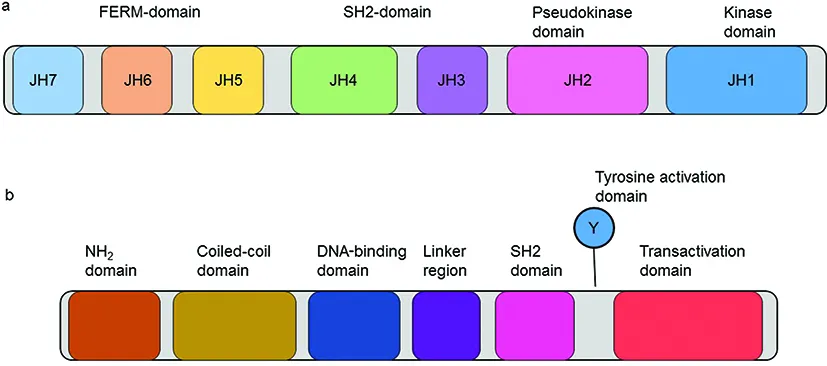
Janus (kinase) comes from the Roman mythological two-faced god, who looks to the future and the past. JAK relates to the two faces due to the presence of two kinase domains, namely the pseudokinase domain (JAK homology 2, JH2) and a catalytically active kinase domain (JH1). They also contain an N-terminal band, and a four-point-one, ezrin, radixin, moesin (FERM)-domain, which mediate the interaction of JAKs with their receptors. JAKs combine with the proline-rich, membrane-proximal box1/box2 domain on cytokine receptors. They also contain an Src homology 2 (SH2)-like domain, of unknown function, which lies between the pseudokinase and FERM domains (Figure 1.1a) (Schindler, Levy, and Decker 2007; Hammaren et al. 2019). JH2 has significant regulatory functions and is a source of numerous mutations that is the cause of various diseases and disorders, including hematopoietic malignancies (JAK2 mutations), leukemia and lymphomas (all JAKs), and cancer (JAK1, JAK3) (Hammaren et al. 2019). There are four JAKs in mammals (JAK1, JAK2, JAK3, and TYK2). JAK1, JAK2, and TYK2 are ubiquitously expressed and relatively constitutive in their expression, while the expression of JAK3 is mostly confined to cells of hematopoietic origin, and its expression is more inducible.
Figure 1.1 Structural organisation of JAK-STAT proteins. (a) JAKs share seven conserved homology domains: JH1 serves as the catalytic, kinase domain, while JH2 represents the pseudokinase domain. JH3 and half of JH4 include the nonfunctional SH2-domain, and half of JH4 to JH7 includes a FERM domain. (b) STATs share seven domains: the amino-terminal domain (NH2), the coiled-coil domain, the DNA-binding domain, the linker domain, the SH2 domain, the tyrosine-activation domain, and the transactivation domain.
JAK1 associates with type I (IFN-α/β), type II (IFN-γ), IL-2, and IL-6 receptors. JAK2 interacts with single-chain receptors (i.e., EPOR, GH-R, and PRL-R) and IL-3 (IL-3R, IL-5R, and GM-CSFR) cytokine families, as well as the IFN-γ receptor. Leukocyte-specific JAK3 exclusively associates with the IL-2 receptor γ-chain, and Tyk2 associates with receptors for IFN-I, IL-6, IL-10, and IL-12/23 cytokine families (Schindler, Levy, and Decker 2007).
1.3 The STATs
The STAT family includes STAT1, STAT2, STAT3, STAT5A/B, and STAT6. STAT proteins consist of seven well-defined, conserved domains: an N-terminal conserved domain (NH2, critical for STAT function); a coiled-coil domain (involved in receptor binding, and associates with regulatory proteins); a DNA-binding domain (DBD, cooperate in binding to the promoters of target genes); a linker region (LK, spacer to maintain proper conformation between the dimerization and DNA binding domains); an SH2 domain (critical for the recruitment of STATs to activated receptor complexes and for the interaction with JAK and Src kinases); a tyrosine-activation domain (Y); and a C-terminal transactivation domain (TAD, modulates the transcriptional activation of target genes and vary considerably among STAT family members) (Jatiani et al. 2010) (Figure 1.1b).
1.4 Cytokine Receptors
Cytokines function by binding to their associated transmembrane receptor, which triggers intracellular signaling events and pathways that result in the alteration of gene expression. Most of these receptors consist of a unique ligand-binding subunit and a signal-transducing subunit. Often the signal transducing or cytoplasmic subunits are structurally similar to other cytokine receptors, particularly in regions labeled as box 1 or the proline-rich motif and the box-2 motif, and this is critical for proper receptor functioning and mediating of mitogenic signals. The ligand-binding subunit, or membrane distal region, remains uniquely different to ensure differentiation (Jatiani et al. 2010). Cytokine binding results in receptor tyrosine phosphorylation.
Cytokine receptors are divided into type I and type II receptors. Type I cytokine receptors bind to and react to cytokines with four α-helical strands and share an amino acid motif (WSXWS). Type II cytokine receptors are similar to type I, but lack the WSXWS motif. Cytokine receptors signal through the JAK-STAT pathway and other pathways that typically trigger activation of the mitogen-activated protein (MAP) kinase cascade. Different types of cells and tissues express well-defined and diverse receptor combinations that respond to cytokine combinations unique to their microenvironment. Thus, at any particular time, a single cell may respond to signals from multiple cytokine receptors (Murray 2007). Different receptor classes preferentially associate with one JAK family member, or a JAK combination.
Typically, receptors required for hematopoietic cell development and proliferation prefer JAK2; common γ-chain receptors utilize JAK1 and JAK3, while other receptors use only JAK1 (Murray 2007). All interferons (IFNs), which are essential mediators of innate immunity against bacterial and viral infection, as well as the interleukin(IL)-10 family (IL-10, IL-19, IL-20, IL-22, IL-24, IL-26), anti-inflammatory cytokines, function through type II cytokine receptors, which dimerize in multiple combinations to generate distinct downstream effects. JAK1 is imperative for signaling through these type II receptor complexes (Ferrao et al. 2016).
1.5 Activation of JAK-STAT Pathways by Cytokines
Cytokine signaling through the JAK-STAT pathway regulates numerous cellular responses, including proliferation, differentiation, motility, and cell survival. JAKs mediate signaling of around fifty to sixty different hormones, cytokines, and growth factors ranging from regulators of the immune system and hematopoiesis, such as IFNs, ILs, thrombopoietin (TPO), and erythropoietin (EPO), to regulators of development and metabolism, such as growth hormone (GH) and prolactin (PRL) (Table 1.1) (O’Shea and Plenge 2012).
Table 1.1
Type I and Type II Cytokine Receptors and their Corresponding JAKs and STATs. Associated JAK-STAT Proteins for which the Data is Weaker are Shown in Brackets (adapted from (Hammaren et al. 2019)).
Cytokine
JAKs
STATs
Type I Cytokine Receptors
IL-6
JAK1, JAK2, TYK2
STAT3, STAT1
IL-11
JAK1, JAK2, TYK2
STAT3, STAT1
LIF
JAK1, JAK2, TYK2
STAT3, STAT1
CNTF
JAK1, (JAK2, TYK2)
STAT3, (STAT1)
CLCF1
JAK1, (JAK2)
STAT3, STAT1
CT-1
JAK1, (JAK2, TYK2)
STAT3
OSM
JAK1, (JAK2, TYK2)
STAT3, STAT1
IL-31
JAK1, (JAK2)
STAT3, STAT5,STAT1
G-CSF
JAK1, (JAK2)
STAT3
Lepti...
Table of contents
Cover
Half Title
Title Page
Copyright Page
Table of Contents
Preface
Editor
Contributors
1. Regulation of Cytokine Signaling by the JAK-STAT Pathway
2. The Structure-Function Bonhomie of JAK-STAT Molecules
3. MicroRNA-Mediated Regulation of JAK-STAT Signaling in Non-Cancerous Human Diseases
4. JAK-STAT Signaling in Asthma and Allergic Airway Inflammation
5. Role of JAK-STAT Signaling in Atopic Dermatitis
6. JAK-STAT Signaling Pathway and Gliosis in Neuroinflammatory Diseases
7. JAK-STAT Signaling in Cardiovascular Disease
8. Diabetes and Obesity: Abnormal JAK-STAT Signaling
9. JAK-STAT Signaling in Liver Fibrosis
10. Renal Disorders: Involvement of JAK-STAT Pathway
11. JAK-STAT Signaling in Hematologic Malignancies
12. Aberrant JAK-STAT Signaling in Hematopoietic Malignancies
13. Immunodeficiency: Consequences of Mutations in JAK-STAT Signaling
14. Targeting JAK-STAT Pathway for Various Inflammatory Diseases and Viral Infections
Index
Frequently asked questions
Yes, you can cancel anytime from the Subscription tab in your account settings on the Perlego website. Your subscription will stay active until the end of your current billing period. Learn how to cancel your subscription
No, books cannot be downloaded as external files, such as PDFs, for use outside of Perlego. However, you can download books within the Perlego app for offline reading on mobile or tablet. Learn how to download books offline
Perlego offers two plans: Essential and Complete
Essential is ideal for learners and professionals who enjoy exploring a wide range of subjects. Access the Essential Library with 800,000+ trusted titles and best-sellers across business, personal growth, and the humanities. Includes unlimited reading time and Standard Read Aloud voice.
Complete: Perfect for advanced learners and researchers needing full, unrestricted access. Unlock 1.4M+ books across hundreds of subjects, including academic and specialized titles. The Complete Plan also includes advanced features like Premium Read Aloud and Research Assistant.
Both plans are available with monthly, semester, or annual billing cycles.
We are an online textbook subscription service, where you can get access to an entire online library for less than the price of a single book per month. With over 1 million books across 990+ topics, we’ve got you covered! Learn about our mission
Look out for the read-aloud symbol on your next book to see if you can listen to it. The read-aloud tool reads text aloud for you, highlighting the text as it is being read. You can pause it, speed it up and slow it down. Learn more about Read Aloud
Yes! You can use the Perlego app on both iOS and Android devices to read anytime, anywhere — even offline. Perfect for commutes or when you’re on the go. Please note we cannot support devices running on iOS 13 and Android 7 or earlier. Learn more about using the app
Yes, you can access JAK-STAT Signaling in Diseases by Ritobrata Goswami in PDF and/or ePUB format, as well as other popular books in Medicina & Inmunología. We have over one million books available in our catalogue for you to explore.