![]()
Equity and the nature
and types of trust
What is meant by the term ‘Equity’? | |
Why did Equity develop as a system of law separate to the Common Law? | |
Were the systems of Common Law and Equity fused by the Judicature Acts? | |
What is understood by the term ‘Trust’? | |
Distinguish between an express trust, resulting trust and constructive trust | |
What is a discretionary trust? | |
| What is a protective trust? | |
Distinguish between a bare power and a trust | |
Identify six maxims of Equity | |
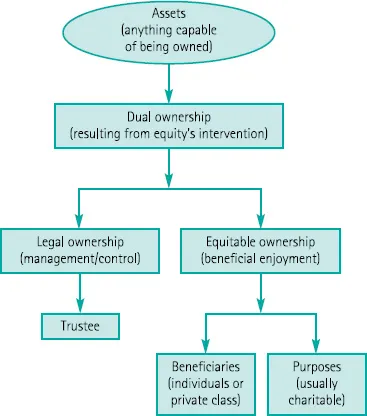
A trust is a relationship which arises where one person (the trustee) is compelled in equity to hold assets for the benefit of another (the beneficiary) or for a purpose permitted by law.
THE ANATOMY OF A TRUST
KEY ELEMENTS OF THE TRUST
ASSETS
Trusts are inextricably linked to assets. As Lord Browne-Wilkinson emphasised in Westdeutsche Landesbank Girozentrale v Islington LBC [1996], ‘in order to establish a trust, there must be identifiable trust property’. Anything that is capable of being owned may constitute the assets.
EQUITABLE ORIGIN OF THE TRUST
The trust (or use as it was called) arose in the Middle Ages for a variety of reasons, for example as a way of avoiding feudal dues which were payable on death. By vesting legal ownership of property in two or more trustees, who could be replaced as they died, continuous ownership of the property could be secured and the feudal dues avoided.
From the outset, the common law courts refused to recognise the rights of the beneficiary who began to petition the King. In time, the King passed these petitions to his Chancellor, who could use his discretion and make such order as appeared to him to be fair or ‘equitable’. The sittings of the Chancellor to hear the petitions became more regular and by the end of the 14th century had developed into the Court of Chancery. Gradually a doctrine of precedent began to develop for equity, just as it did for the common law.
There were thus two sets of courts, the common law courts administering the common law and the Court of Chancery administering equity. Both had their own particular procedure and remedies. During the 19th century, a number of reforms took place culminating in the Judicature Acts of 1873–1875 which replaced the common law courts and the Court of Chancery by one Supreme Court of Judicature in which each court had the power to administer both common law and equity according to the same rules of procedure. The orthodox view is that whilst the administration of the common law and equity were fused, the rules of common law and equity remain distinct. ‘The two streams of jurisdiction, though they run in the same channel, run side by side and do not mingle their waters’ per Lord Evershed.
THE MAXIMS OF EQUITY
The maxims of equity are basic principles developed by the Court of Chancery which are still applied by the courts as guidelines when exercising their equitable jurisdiction. The main maxims are as follows.
Delay defeats equities
The claimant who seeks an equitable remedy should not delay in taking action.
Equity is equality
Where two people have an equal claim to property, equity will order an equal division.
Equity acts in personam
Equity acts against the person and not in rem, ie equitable remedies are exercised against the person, for example an injunction may compel a person not to do something. A failure to comply is regarded as contempt of court punishable by imprisonment.
Equity looks to the intent rather than the form
Equity will give effect to the substance of the transaction rather than merely to its outward appearance.
Equity will not allow a statute to be used as an instrument of fraud
The court will not apply a statute which imposes formal requirements if strict compliance would be unjust by promoting the fraud of a litigant.
Equity will not allow a trust to fail for want of a trustee
If necessary, the court will appoint a trustee.
Equity will not assist a volunteer
Equity will not provide a remedy for a person who has not given consideration, for example the contractual remedy of specific performance would not be available to a volunteer. However, in relation to trusts, a beneficiary (even if he is a volunteer) will be afforded the protection of equity provided the trust is completely constituted (see later).
Equity will not perfect an imperfect gift
If a donor makes an imperfect gift (ie the donor does not comply with the requirements to transfer legal title to the property to the donee), equity will not perfect that gift.
He who comes to equity must come with clean hands
Equitable remedies are discretionary, and such a remedy will not be granted if the claimant h...