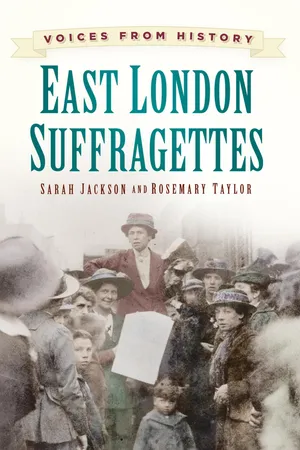
In 1914, the East London Federation of Suffragettes, led by Sylvia Pankhurst, split from the WSPU. Sylvia's mother and sister, Emmeline and Christabel, had encouraged her to give up her work with the poor women of East London – but Sylvia refused. Besides campaigning for women to have an equal right to vote from their headquarters in Bow, the ELFS worked on a range of equality issues which mattered to local women: they built a toy factory, providing work and a living wage for local women; they opened a subsidized canteen where women and children could get cheap, nutritious food; and they launched a nursery school, a crèche, and a mother-and-baby clinic. The work of the Federation (and 'our Sylvia', as she was fondly known by locals) deserves to be remembered, and this book, filled with astonishing first-hand accounts, aims to bring this amazing story to life.
- 192 pages
- English
- ePUB (mobile friendly)
- Available on iOS & Android
eBook - ePub
Voices from History: East London Suffragettes
About this book
Information
Six
SPREADING THE WORD
The East London Federation of the Suffragettes understood that getting their message out was essential to raising awareness, and to recruiting and mobilising the women of the East End, but before radio, television or the internet this was no mean feat. Billboard advertising was expensive then as it is now, and besides, they were radicals – it’s likely that many companies selling advertising space would not have wanted to do business with a group of militants. They printed posters, handbills and pamphlets, they wrote and were written about in newspapers, but that still didn’t allow them to reach the large numbers of East End people at that time who were unable to read. Through their constant, impassioned public speaking, and by developing ingenious ways to harness the most powerful communications tool of all – word of mouth – the Federation succeeded in reaching many thousands of women and men with its call for equality and justice.
Speaking out
East London has a long tradition of public speaking, open-air rallies and lively political meetings, which continues to the present day. At the start of the twentieth century, with widespread illiteracy, and limited access to free newspapers (which didn’t much concern themselves with the views and interests of working people anyway), free public meetings were a vital source of news and information. Listening to speeches became a common pastime even among people who weren’t necessarily involved in any particular cause. Stepney suffragette Annie Barnes remembers first encountering the suffragettes by chance at a local pub: ‘There was a big hall there that was used for big meetings. You never knew who was going to hire it. I think the Salvation Army hired it sometimes and they gave the kids buns and cups of cocoa. Anyway, out of curiosity, I walked down just to see what was going on.’
When they arrived in the East End, the Women’s Social and Political Union took full advantage of this tradition and the existing network of venues and audiences. With the help of local activists like Minnie Baldock, speakers including Sylvia and Annie Kenney recruited new WSPU members by speaking as widely as possible. One of the great assets of the suffragette movement was its pool of fiery, inspiring, passionate speakers. In particular Emmeline, Christabel and Sylvia Pankhurst were in great demand, and acted as a huge draw at any meeting. Annie Barnes remembered: ‘We used to chalk the pavements advertising meetings. “COME AND HEAR SYLVIA PANKHURST AT SO AND SO”. And the crowds used to come.’
One of the differences that was to emerge between the WSPU’s approach to campaigning and that of the Federation centred on who was encouraged, or even permitted, to speak. The WSPU ultimately became a very autocratic organisation, with a tightly controlled ‘party line’ and a number of high profile speakers who could be relied upon to stay ‘on-message’. In many ways this was a very effective tactic, as Emmeline and Christabel Pankhurst built a powerful unity and consistency across the whole of their campaign.
However, this inevitably created a focus on individual ‘stars’ which Sylvia found very uncomfortable, even as a star speaker herself. And whether because of differences in education, or because of outright prejudice, most of the stars of the WSPU were middle- or upper-class women. Sometimes they spoke on behalf of working-class women. More often they forgot. Sylvia was more interested in building a mass movement in which working women were empowered to speak for themselves. And even in the very early days of the WSPU’s East End campaign in 1912, the East London suffragettes were claiming their right to be heard – a group of local suffragettes, led by Melvina Walker, demanded that there should be at least one speaker from the local branch on every platform.
With a tremendous talent for public speaking, Melvina Walker was to become one of the most popular speakers in London, among any movement. ‘She seemed to me like a woman of the French Revolution,’ Sylvia observed in The Home Front: ‘I could imagine her on the barricades, waving the bonnet rouge, urging on the fighters with impassioned cries. When in full flood of her oratory, she appeared the very embodiment of toiling, famine-ridden, proletarian womanhood.’ Melvina lived in Poplar where she was married to a docker, but previously she had been a lady’s maid, an experience which gave her a cool confidence around her ‘betters’, having seen what went on behind the scenes in their great houses. She had ‘black eyes, feline in their mysterious aloofness and uncertainty, blazing at times with a swift and sudden fire’.
Members of the Federation were encouraged to speak in public, at meetings, at open-air rallies, at their weekly stall at Roman Road market, or even just on the street. Many, like Melvina Walker, discovered a natural talent for it; others attended the inexpensive speaking classes advertised in the Dreadnought: ‘Miss Amy Hicks M.A. Will take a Speakers’ Class at 20 Railway Street, Poplar, on Monday evenings, at 8pm, beginning April 26th. The course will consist of twelve lessons. The fee will be 1s which may be paid in 1d instalments.’
As well as speaking about the suffrage cause in the East End, many of the women accompanied Sylvia to other events, including WSPU branch meetings in places like Kensington and Mayfair, where their speeches made a powerful impression on their wealthy audiences.
In its early years, the East London Federation of the Suffragettes sent several deputations of working women to meet politicians and ministers in Westminster. The membership of these delegations was decided democratically, through votes at large public meetings. While many of the women who made up these delegations were confident and accomplished political speakers who could advance a case for their cause – whether votes for women, wartime price controls or old age pensions – the transcripts of these meetings show that they continually referred to their own life and experiences, and those of people they knew. In her memoirs, Sylvia Pankhurst more than once refers to Melvina Walker’s ‘tales of woe’, and the effect they made on listening crowds. As well as campaigners, the members of the Federation were clearly positioning themselves as what we might now call ‘experts by experience’, which gave them an authority that their class and gender denied them.
A number of members of the East London Federation of the Suffragettes went on to be active in local politics, as campaigners, councillors and even mayors, in the case of Daisy Parsons, Nellie Cressall and Dorothy Lansbury. ‘Tough’ Annie Barnes was a Labour Councillor in Stepney from 1934 to 1948 and always credited her famous confidence to her experience as a suffragette: ‘Being in the suffragettes did a lot for me. I couldn’t say “Boo” to a goose before that. It really brought me out.’
One instance of this confidence in action is recorded in Annie’s memoirs. On the eve of the 1921 general election, the local Conservative Party held a meeting in Limehouse Town Hall for their new candidate, Evan Morgan. Annie and her brother went along and listened as the new candidate was introduced as a ‘very handsome fellow’. The fellow went on to promise that he would eradicate unemployment in Limehouse, whereby Annie stood up to speak and refused to wait until the end. The audience started calling for her to be heard and the candidate invited her up to the platform, to show he was a gentleman. Annie began:
‘Friends’, I said, ‘our candidate here, oh yes, he’s a perfect gentleman. I’m not disputing that. His father’s a coal owner, Lord Tredegar. He’s shut down the mines in South Wales and opened up in India because he could get people to work out there for next to nothing … and the miners, our miners, are out of work. If this gentl...
Table of contents
- Cover
- Title Page
- Contents
- Introduction
- One The East End
- Two Women’s Activism in the East End
- Three Early Suffragette Activity in East London
- Four The East London Federation of the Suffragettes
- Five Protest, Police and the People’s Army
- Six Spreading the Word
- Seven The War
- Eight Women and Work
- Nine Food and Family
- Ten Later Years
- Eleven Women’s Activism After the Suffragettes
- Acknowledgements
- Bibliography
- Copyright
Trusted by 375,005 students
Access to over 1.5 million titles for a fair monthly price.
Study more efficiently using our study tools.
Frequently asked questions
Yes, you can cancel anytime from the Subscription tab in your account settings on the Perlego website. Your subscription will stay active until the end of your current billing period. Learn how to cancel your subscription
No, books cannot be downloaded as external files, such as PDFs, for use outside of Perlego. However, you can download books within the Perlego app for offline reading on mobile or tablet. Learn how to download books offline
We are an online textbook subscription service, where you can get access to an entire online library for less than the price of a single book per month. With over 1.5 million books across 990+ topics, we’ve got you covered! Learn about our mission
Look out for the read-aloud symbol on your next book to see if you can listen to it. The read-aloud tool reads text aloud for you, highlighting the text as it is being read. You can pause it, speed it up and slow it down. Learn more about Read Aloud
Yes! You can use the Perlego app on both iOS and Android devices to read anytime, anywhere — even offline. Perfect for commutes or when you’re on the go.
Please note we cannot support devices running on iOS 13 and Android 7 or earlier. Learn more about using the app
Please note we cannot support devices running on iOS 13 and Android 7 or earlier. Learn more about using the app
Yes, you can access Voices from History: East London Suffragettes by Sarah Jackson,Rosemary Taylor in PDF and/or ePUB format, as well as other popular books in Politics & International Relations & 20th Century History. We have over 1.5 million books available in our catalogue for you to explore.